The highest point in County Kerry is Carrauntoohil (Corrán Tuathail), standing at 1,038.6 meters (3,407 feet). It is also the highest peak in Ireland. Carrauntoohil is located in the MacGillycuddy’s Reeks, a rugged mountain range in central County Kerry, near Killarney and the Gap of Dunloe. It lies within the Killarney National Park region, part of the Wild Atlantic Way, renowned for its dramatic peaks and scenic beauty.
- Elevation: At 1,038.6 meters, Carrauntoohil is Ireland’s tallest mountain, dominating the Reeks and offering unparalleled views across Kerry and beyond.
- Terrain: The mountain features steep, rocky slopes, narrow ridges, and scree-covered paths. The summit is a rocky pyramid with a large metal cross, surrounded by precipitous drops, including the famous Devil’s Ladder gully. The terrain is challenging, with loose rocks and exposure to harsh weather.
Starting Point and Access:
- Driving Route: The most common trailhead is at Cronin’s Yard, near Beaufort, accessible via the N72 from Killarney (20 minutes, 15 km) or the R562 from Killorglin. Cronin’s Yard offers parking, a tea room, and basic facilities (small fee for parking). From Tralee, the drive takes about 40 minutes (30 km), and from Cork, it’s about 1.5 hours (~90 km). Another popular trailhead is Hydro Road (Lisleibane), used for the Caher route, about 10 minutes further from Cronin’s Yard.
- Alternative Access: The Hag’s Glen route from Lisleibane or the Brother O’Shea’s Gully route from Caragh Lake offer alternative approaches, though they are less common and more challenging. The Coomloughra Horseshoe starts near Hydro Road for a longer circuit.
- Public Transport: Public transport is limited. Killarney is served by trains and buses from Dublin, Cork, or Tralee (e.g., Irish Rail or Bus Éireann 279), but reaching Cronin’s Yard requires a car or taxi. Guided hikes, such as those offered by Kerry Climbing or Outdoor Adventures Ireland, include transport from Killarney or Tralee.
Devil’s Ladder Route (Cronin’s Yard):
- Distance: Approximately 12 km round trip.
- Duration: 5–7 hours, depending on pace and conditions.
- Description: This is the most popular route, starting at Cronin’s Yard. The trail enters Hag’s Glen, a scenic valley, and follows a clear path to the base of Devil’s Ladder, a steep, rocky gully. The ascent up the Ladder is strenuous, with loose scree and erosion making it challenging. From the top of the Ladder, hikers follow a rocky ridge to the summit, marked by a large cross. The descent retraces the route, requiring care on the Ladder.
- Difficulty: Strenuous, suitable for experienced hikers with good fitness. The Ladder’s loose rocks and steep gradient demand sure footing and caution.
Brother O’Shea’s Gully Route:
- Distance: 10–12 km round trip.
- Duration: 5–7 hours.
- Description: Starting from Cronin’s Yard or Lisleibane, this route ascends via Brother O’Shea’s Gully, a less crowded alternative to Devil’s Ladder. It involves steep, rocky climbing and joins the summit ridge. The route offers quieter trails but requires scrambling skills.
- Difficulty: Very strenuous, best for experienced hikers comfortable with scrambling and navigation.
Coomloughra Horseshoe Circuit:
- Distance: 12–15 km round trip.
- Duration: 6–9 hours.
- Description: Starting at Hydro Road, this challenging circuit includes Carrauntoohil, Caher (1,000 meters), and Beenkeragh (1,008 meters), crossing narrow ridges like Beenkeragh Ridge. It offers stunning views but involves exposed scrambling, including the infamous “Beenkeragh Knife-Edge.”
- Difficulty: Very strenuous, requiring advanced navigation, scrambling skills, and confidence on exposed ridges.
Navigation Tips:
- Use an Ordnance Survey map (Discovery Series Sheet 78) or apps like HiiKER, AllTrails, or PeakVisor for navigation, as fog and mist are common, reducing visibility.
- Bring a compass or GPS device, as the summit and ridges lack clear waymarking, and routes like the Horseshoe involve complex terrain.
- Wear sturdy, waterproof hiking boots with excellent grip, as the terrain is rocky, loose, and often wet. Trekking poles are useful for stability on steep sections.
Scenery and Views:
- Summit Views: On clear days, Carrauntoohil offers spectacular 360-degree views of the MacGillycuddy’s Reeks, Killarney National Park, the Dingle Peninsula, and the Atlantic Ocean. Notable sights include the Lakes of Killarney, Mangerton Mountain, and, on exceptional days, distant peaks like the Galtees or Slieve League. The summit’s dramatic cliffs and corries, like Eagle’s Nest, are breathtaking.
- Landscape: The lower slopes feature boggy paths and grassy valleys (Hag’s Glen), transitioning to steep, rocky ridges and scree-covered slopes. The summit is a rocky pyramid with a 5-meter metal cross, surrounded by sheer drops.
- Unique Features: Carrauntoohil’s rugged beauty inspired its use in films like Star Wars: The Last Jedi (nearby Skellig Michael). The Devil’s Ladder and Beenkeragh Ridge are iconic challenges for mountaineers, and the mountain holds cultural significance as Ireland’s highest peak.
Hiking Experience:
- Duration: The Devil’s Ladder route takes 5–7 hours, Brother O’Shea’s Gully 5–7 hours, and the Coomloughra Horseshoe 6–9 hours, including summit time.
- Conditions: The terrain is demanding, with loose scree, steep inclines, and exposure to wind and rain. The Devil’s Ladder is eroded and slippery, especially after rain. Spring and summer (April–September) are ideal for milder weather and longer daylight, with August offering vibrant heather. Winter hikes are risky due to snow, ice, and shorter days, requiring mountaineering skills.
- Cultural Significance: Carrauntoohil is tied to Kerry’s Irish language heritage and is a pilgrimage site for hikers. The MacGillycuddy’s Reeks are named after an ancient clan, and nearby Killarney is steeped in history and folklore.
- Weather: The summit is highly exposed, with frequent fog, strong winds, and rapid weather changes. Check forecasts (e.g., Met Éireann) and avoid hiking in severe conditions.
- Terrain: The steep, rocky slopes and narrow ridges (especially on the Horseshoe) require careful footing and scrambling skills. Devil’s Ladder is prone to erosion and rockfall.
- Safety: Inform someone of your plans, as there are no rangers. Bring water, snacks, and warm clothing, as temperatures drop significantly. Solo hikers should be highly experienced or opt for guided tours, especially for the Horseshoe.
- Wildlife: Expect to see red deer, Irish hares, and birds like peregrine falcons or ravens. The Reeks support unique flora, including alpine plants and heather.
Highest point in county
Antrim – Armagh – Carlow – Cavan – Clare – Cork – Derry – Donegal – Down – Dublin – Fermanagh – Galway] – Kerry – Kildare – Kilkenny – Laois – Leitrim – Limerick – Longford – Louth – Mayo – Meath – Monaghan – Offaly – Roscommon – Sligo – Tipperary – Tyrone – Waterford – Westmeath – Wexford – Wicklow
County Kerry:
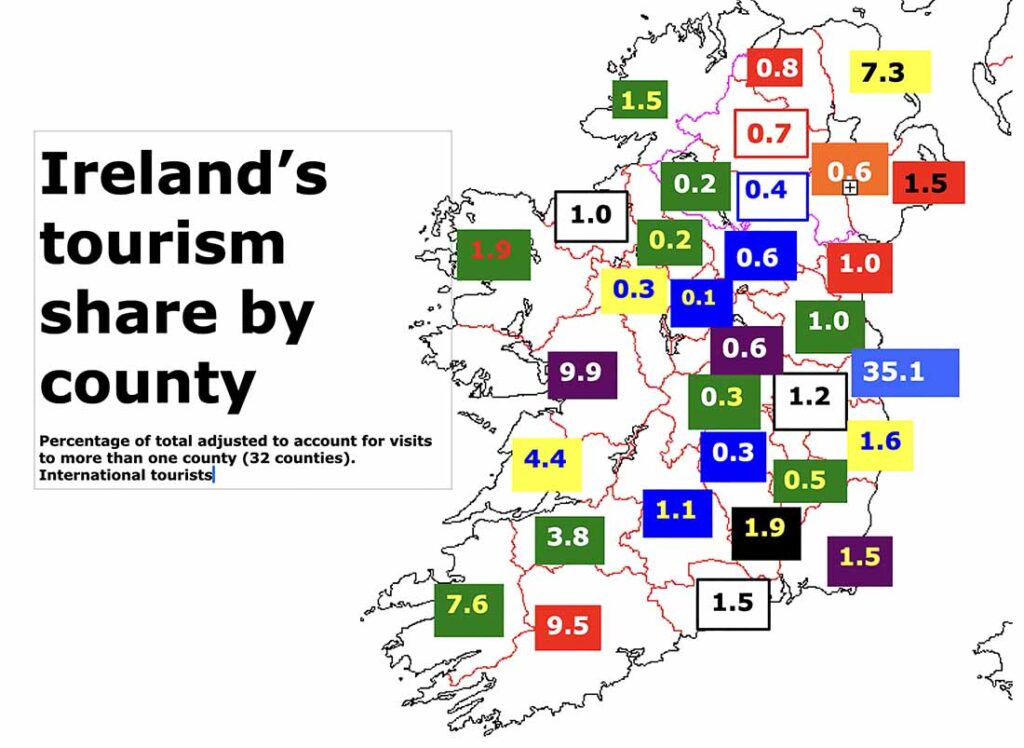
Ireland’s county Kerry is renowned for its dramatic landscapes, with the Ring of Kerry offering scenic drives past lakes and coastal cliffs. Killarney National Park features the serene Lakes of Killarney and historic Muckross House, while Dingle’s coastal trails and dolphin-watching opportunities add natural allure. Accessible by seasonal ferry, the Skellig Islands’ ancient monastic ruins make Kerry a compelling choice for outdoor adventure and history. Kerry is Ireland’s fifth largest county by size (4,701 square km) and 15th largest by population (156,458). Population peaked at 293,880 in 1841 and reached its lowest point, 112,785 in 1966. In terms of hospitality, Kerry is Ireland’s fourth most visited tourist county with around 877,000 international visitors per year.
Introduction – Adventure – Anthem – Archaeology – Attractions – Awards – Birdwatching – Camping – Castles – Churches – Contact list – Cycling – Dining – Equestrian – Festivals – Fishing – Folklore – Gardens – Golf – Graveyards – Happening – Haunted – Highest – Hiking – History – Holy Wells – Hotels – Hotels top 8 – Hunting & shooting – Instagrammable – Itineraries – Largest town – Luxury – MICE – Movies – Music – Name – New – Novelists – Off the beaten track – Poets – Pubs – Quotes – Random Facts – Restaurant Awards – Sacred Places – Saints – Songs – Spas – Sports – Sunsets – Sustainable – Things to do – Towns – Video – Villages – Walking – Wanderlist – Weddings – Wild swimming – Writers – 1837 – 1846 – 1852 – 1909 – 1955 – 1980 –