- Piaras Feiritéar (Pierce Ferriter): Born and lived in Ballyferriter, Dingle Peninsula, County Kerry . (c.1600-1653): A Gaelic poet and aristocrat, Feiritéar was known as the “Gentleman Harper of Kerry” for his harp-playing. His Irish-language poetry, including love poems and political verse, reflected the decline of Gaelic nobility during the Cromwellian conquest. He was hanged in 1653 for leading a rebellion. His work is celebrated as part of Kerry’s bardic tradition.
- Geoffrey O’Donoghue (Eoghan Ó Donnchadha): Lived in Killarney, County Kerry; buried in Muckross Abbey . (c.1620-1677): A Gaelic poet in the Munster tradition, O’Donoghue succeeded Feiritéar as Kerry’s poet laureate. His Irish-language verse mourned the loss of Gaelic power and patronage following English plantations. His work, though less extant, was influential in the cúirteanna filíochta (courts of poetry) and is commemorated by the Sky Woman statue in Killarney.
- Aodhagán Ó Rathaille (Egan O’Rahilly): Born in Scrahanaveal, near Killarney, County Kerry; lived in Sliabh Luachra . (c.1670-1729): One of Ireland’s greatest Irish-language poets, Ó Rathaille created the aisling (vision) poetic form, where Ireland is personified as a woman awaiting liberation. His poems, like Gile na Gile, lament the dispossession of Gaelic nobility. Buried in Muckross Abbey, he is a key figure in Kerry’s literary heritage.
- Eoghan Rua Ó Súilleabháin (Owen Roe O’Sullivan): Born in Meentogues, near Gneeveguilla, County Kerry; lived in Knocknagree and Killarney . (c.1748-1784): A celebrated Irish-language poet, Ó Súilleabháin was a schoolmaster and sailor known for his aisling poems and lively verse about love and merry-making. His work, recited widely during his lifetime, expressed both patriotic longing and personal charm. He was buried in Muckross Abbey and is honored by the Sky Woman statue.
- Seán Ó Braonáin (John Brennan): Born in Ballymacandrew, near Ardfert, County Kerry . (c.1790-1838): A tenant farmer and schoolmaster, Ó Braonáin was one of Kerry’s last great poets in the bardic tradition. His Irish-language verse, collected in Filíocht Seán Ó Braonáin (1972), addressed the land struggles and peasant life in Kerry. A passionate nationalist, his work was revived through scholarly efforts in the 20th century.
- Brendan Kennelly: Born in Ballylongford, County Kerry; lived in Listowel and Tralee . (1936–2021): One of Ireland’s most popular poets, Kennelly’s works, such as My Dark Fathers (1964) and The Book of Judas (1991), blend North Kerry’s vernacular with universal themes. A professor at Trinity College Dublin, he translated Irish poetry and wrote over 50 collections, earning acclaim as the “poet of the people.” His Ballylongford roots deeply influenced his work.
- Dairena Ní Chinnéide: Born and lived in Corca Dhuibhne, Dingle Peninsula, County Kerry (Gaeltacht) . (1969-): A bilingual poet and Listowel Poet Laureate, Ní Chinnéide has published 11 collections, including An Trodaí & Dánta Eile (2016). Her Irish- and English-language poetry explores West Kerry’s landscapes, identity, and community life. She is a prominent voice in the Gaeltacht’s contemporary literary scene.
Poets
Antrim – Armagh – Carlow – Cavan – Clare – Cork – Derry – Donegal – Down – Dublin – Fermanagh – Galway – Kerry – Kildare – Kilkenny – Laois – Leitrim – Limerick – Longford – Louth – Mayo – Meath – Monaghan – Offaly – Roscommon – Sligo – Tipperary – Tyrone – Waterford – Westmeath – Wexford – Wicklow
County Kerry:
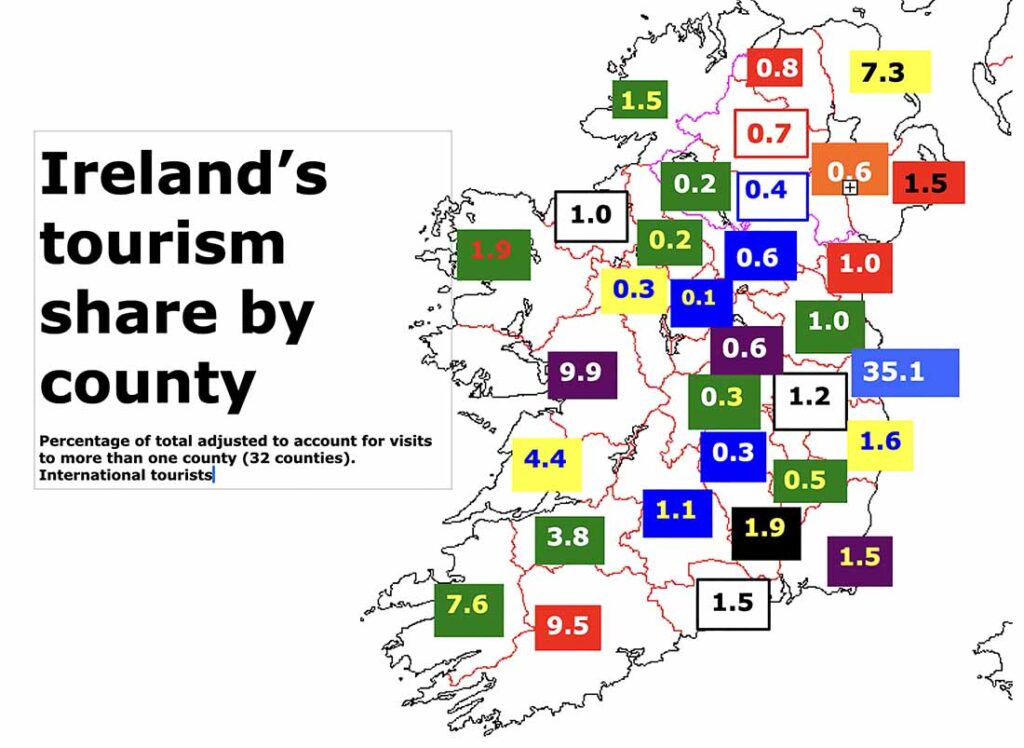
Ireland’s county Kerry is renowned for its dramatic landscapes, with the Ring of Kerry offering scenic drives past lakes and coastal cliffs. Killarney National Park features the serene Lakes of Killarney and historic Muckross House, while Dingle’s coastal trails and dolphin-watching opportunities add natural allure. Accessible by seasonal ferry, the Skellig Islands’ ancient monastic ruins make Kerry a compelling choice for outdoor adventure and history. Kerry is Ireland’s fifth largest county by size (4,701 square km) and 15th largest by population (156,458). Population peaked at 293,880 in 1841 and reached its lowest point, 112,785 in 1966. In terms of hospitality, Kerry is Ireland’s fourth most visited tourist county with around 877,000 international visitors per year.
Introduction – Adventure – Anthem – Archaeology – Attractions – Awards – Birdwatching – Camping – Castles – Churches – Contact list – Cycling – Dining – Equestrian – Festivals – Fishing – Folklore – Gardens – Golf – Graveyards – Happening – Haunted – Highest – Hiking – History – Holy Wells – Hotels – Hotels top 8 – Hunting & shooting – Instagrammable – Itineraries – Largest town – Luxury – MICE – Movies – Music – Name – New – Novelists – Off the beaten track – Poets – Pubs – Quotes – Random Facts – Restaurant Awards – Sacred Places – Saints – Songs – Spas – Sports – Sunsets – Sustainable – Things to do – Towns – Video – Villages – Walking – Wanderlist – Weddings – Wild swimming – Writers – 1837 – 1846 – 1852 – 1909 – 1955 – 1980 –