Pre-1000 The Gaelic Nation
County Kerry’s pre-1000 history is rooted in its role within the Eóganachta kingdoms of Munster, particularly the Eóganacht Locha Léin. Archaeological sites, such as the Staigue Fort (a stone ringfort) and ogham stones on the Dingle Peninsula, indicate settlement from the Bronze and Iron Ages. The region was controlled by Gaelic dynasties like the Ciarraige, from whom Kerry derives its name. Christianity arrived by the 5th century, with monasteries founded at Ardfert by Saint Brendan the Navigator (c. 484–577) and on Skellig Michael, a remote monastic site. The Annals of Inisfallen, compiled in Kerry, record Viking raids on coastal monasteries, particularly Skellig Michael and Inisfallen, from the 9th century. Kerry’s isolation preserved Gaelic culture, but ecclesiastical sources dominate, potentially exaggerating Christian influence while marginalising pre-Christian traditions.
1000–1100: Gaelic Power and Viking Incursions
In the 11th century, Kerry remained under Eóganachta control, with the O’Moriarty (Ó Muircheartaigh) and O’Carroll dynasties prominent. The Annals of Inisfallen record conflicts between Munster kingdoms. The region’s monasteries, including Ardfert and Inisfallen, were centres of learning, producing the Annals. Viking raids continued along Kerry’s coast, but its rugged terrain limited Norse settlement. The Battle of Clontarf (1014) weakened Viking influence, though Kerry’s ports maintained minor trade links. Ecclesiastical sources dominate, potentially overshadowing Gaelic secular life.
1100–1200: Norman Incursions and Gaelic Resistance
The Norman invasion (1169–1171) had limited direct impact on Kerry due to its western isolation. The Eóganachta and local dynasties like the O’Connors Kerry resisted Norman expansion. The Annals of the Four Masters (record Munster conflicts, but Kerry remained largely Gaelic. The Normans, under figures like Maurice Fitzgerald, reached east Kerry by 1200, establishing a presence at Tralee. The Synod of Cashel (1172) aligned Kerry’s monasteries, such as Ardfert, with Roman reforms. Gaelic sources provide local context but are limited, requiring cautious interpretation.
1200–1300: Anglo-Norman Settlement and Gaelic Strongholds
In the 13th century, Kerry was partially shired, with boundaries including parts of modern Cork. The Fitzgeralds, granted lands in north Kerry, built castles like Listowel and Tralee, establishing Anglo-Norman control in the east. The O’Connors Kerry and O’Moriartys retained power in west Kerry, particularly the Dingle and Iveragh peninsulas. The Annals of Loch Cé mention Fitzgerald conflicts with Gaelic lords. Monasteries like Muckross Abbey (founded c. 1300) grew in significance. Kerry’s coastal trade with Spain began, but Norman records overemphasise their control, requiring balance with Gaelic sources.
1300–1400: Gaelic Revival and Fitzgerald Dominance
The 14th century saw a Gaelic revival in Kerry, as Anglo-Norman power weakened post-Black Death (1348–1350). Gaelic clans, including the O’Donoghues and O’Sullivans, regained influence in south and west Kerry. The Fitzgeralds, now Gaelicised as Earls of Desmond, dominated north Kerry, with figures like Maurice Fitzgerald (d. 1356) consolidating power. The Statute of Kilkenny (1366) had little impact in Kerry, where Gaelic law prevailed outside Norman strongholds. The Annals of the Four Masters record frequent Desmond campaigns in this era. English sources portray Gaelic lords as chaotic, necessitating critical interpretation.
1400–1500: Desmond Autonomy and Gaelic Culture
The 15th century saw Kerry under mixed Gaelic and Anglo-Irish control. The Fitzgeralds of Desmond, under leaders like Thomas Fitzgerald (d. 1477), acted with near autonomy, while Gaelic dynasties like the O’Sullivans and O’Donoghues held west Kerry. The Wars of the Roses (1460–1485) distracted English authorities, allowing local power to flourish. Ardfert and Muckross remained ecclesiastical centres, with Gaelic bards patronised by both Gaelic and Anglo-Irish lords. Kerry’s isolation preserved its Gaelic culture, but the lack of secular records limits insights, with ecclesiastical sources dominating.
1500–1600: Tudor Reconquest and Desmond Rebellions
The 16th century brought Tudor efforts to control Kerry. The Fitzgeralds of Desmond, under Gerald Fitzgerald (d. 1583), resisted during the Desmond Rebellions (1569–1583), with Kerry as a battleground. The rebellions led to land confiscations and the Munster Plantation, with English settlers arriving in east Kerry. Gaelic dynasties like the O’Sullivans resisted, with figures like Donal Cam O’Sullivan Beare (d. 1618) leading a famous march to Leitrim after defeat. The Reformation had limited impact, as Kerry remained Catholic. The annals document Gaelic resistance, while English records portray rebels as traitors, requiring balance.
1600–1700: Plantations and Confederate Wars
The 17th century saw Kerry transformed by the Munster Plantation, with Gaelic and Desmond lands confiscated and granted to English settlers, particularly around Tralee and Killarney. The 1641 Rebellion saw Catholic forces, including the O’Sullivans, resist, with Tralee briefly captured. The Cromwellian conquest (1649–1653) led to further confiscations, with Catholics transplanted to west Kerry. The Williamite War (1689–1691) saw Kerry loyal to William III, with no major battles. The Annals of the Four Masters document Catholic losses. English sources vilify rebels, necessitating critical interpretation.
1700–1800: Protestant Ascendancy and Rural Stagnation
The 18th century saw Kerry under the Colonial/Protestant Ascendancy, with Anglo-Irish landlords like the Brownes (Kenmare) dominating. The Penal Laws marginalized Catholics, who formed the majority in rural Kerry. The county’s economy relied on agriculture and fishing, with Killarney and Dingle as market centres. The 1798 Rebellion saw minimal activity in Kerry, but local discontent fueled Whiteboy agrarian unrest. The Act of Union (1800) strengthened English control.
1800–1900: Famine, Emigration, and Nationalism
The 19th century was marked by hardship in Kerry. The Great Famine (1845–1849) devastated the county, reducing its population from 293,000 in 1841 to 238,000 in 1851 due to starvation, disease, and emigration, particularly from west Kerry’s Gaeltacht. The railway (1853) and Tralee’s port aided recovery. The Gaelic Revival saw the Gaelic League thrive in Kerry’s Gaeltacht, with figures like Tomás Ó Criomhthain documenting Blasket Islands life. The GAA, founded in 1884, established strong Kerry football teams, winning All-Ireland titles. The Land League and Home Rule movement, led locally by figures like Daniel O’Connell (d. 1847), gained traction. English famine records tend to understate suffering..
1900–2025: Independence, Gaeltacht, and Tourism
The 20th and 21st centuries saw Kerry play a key role in Ireland’s independence. The War of Independence (1919–1921) saw intense IRA activity, with figures like Thomas Ashe active. The Civil War (1922–1923) saw heavy fighting in Kerry, with anti-treaty forces strong. Post-independence, Kerry’s Gaeltacht preserved Irish language, with Blasket literature gaining fame. Kerry’s GAA dominance grew, with numerous All-Ireland football titles, including 1903, 1924, and multiple post-1950 wins. Tourism boomed around Killarney’s lakes, the Ring of Kerry, and Skellig Michael (a UNESCO site). Kerry’s economy diversified with tech and agriculture. Official narratives tend to overemphasise progress, overlooking rural challenges. Kerry is one of 24 Irish counties that still has a smaller population than it did in 1841.
History
Antrim – Armagh – Carlow – Cavan – Clare – Cork – Derry – Donegal – Down – Dublin – Fermanagh – Galway – Kerry – Kildare – Kilkenny – Laois – Leitrim – Limerick – Longford – Louth – Mayo – Meath – Monaghan – Offaly – Roscommon – Sligo – Tipperary – Tyrone – Waterford – Westmeath – Wexford – Wicklow
County Kerry:
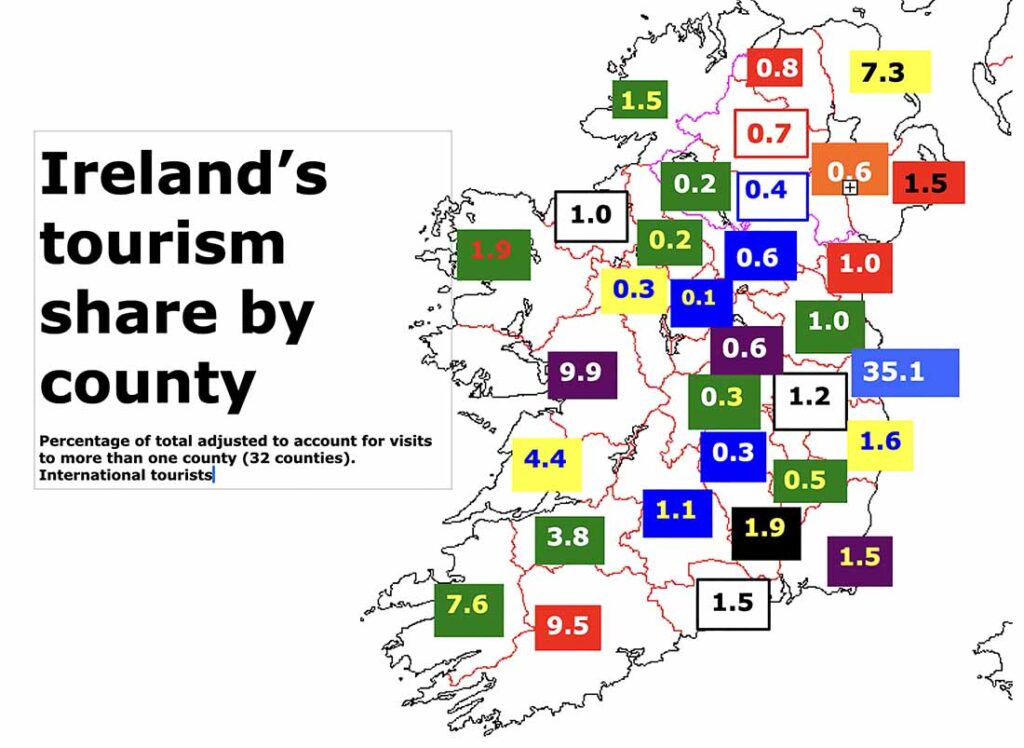
Ireland’s county Kerry is renowned for its dramatic landscapes, with the Ring of Kerry offering scenic drives past lakes and coastal cliffs. Killarney National Park features the serene Lakes of Killarney and historic Muckross House, while Dingle’s coastal trails and dolphin-watching opportunities add natural allure. Accessible by seasonal ferry, the Skellig Islands’ ancient monastic ruins make Kerry a compelling choice for outdoor adventure and history. Kerry is Ireland’s fifth largest county by size (4,701 square km) and 15th largest by population (156,458). Population peaked at 293,880 in 1841 and reached its lowest point, 112,785 in 1966. In terms of hospitality, Kerry is Ireland’s fourth most visited tourist county with around 877,000 international visitors per year.
Introduction – Adventure – Anthem – Archaeology – Attractions – Awards – Birdwatching – Camping – Castles – Churches – Contact list – Cycling – Dining – Equestrian – Festivals – Fishing – Folklore – Gardens – Golf – Graveyards – Happening – Haunted – Highest – Hiking – History – Holy Wells – Hotels – Hotels top 8 – Hunting & shooting – Instagrammable – Itineraries – Largest town – Luxury – MICE – Movies – Music – Name – New – Novelists – Off the beaten track – Poets – Pubs – Quotes – Random Facts – Restaurant Awards – Sacred Places – Saints – Songs – Spas – Sports – Sunsets – Sustainable – Things to do – Towns – Video – Villages – Walking – Wanderlist – Weddings – Wild swimming – Writers – 1837 – 1846 – 1852 – 1909 – 1955 – 1980 –