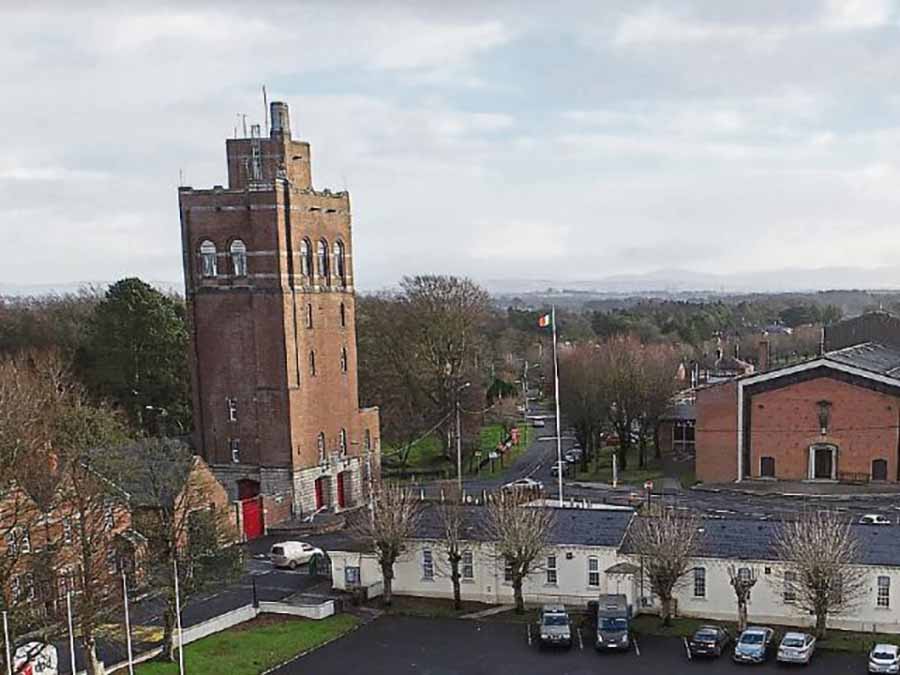
Begin your walking tour of the Curragh in Ireland’s county Kildare in the French Furze area between Maddenstown and French Furze on the southwestern edge of the plain. The name French Furze derives from a corruption of the Gaelic term for place of tombs according to historian Lord Walter Fitzgerald. Leave Kildare town on the old N7 towards Newbridge and turn right at Chapman’s garage onto the LR3006 signposted for Curragh Camp and Kilcullen. Two miles out French Furze Cottage appears on the left once a racing stables and now the marker for the area. The nearby French Furze Fair Green covered in furze today hosted one of Leinster’s most important horse fairs.
The fair originated in 1790 as a hurling match between fifteen young men from the north side of the Liffey and fifteen from the south side. The game proceeded without rules later formalised by the GAA. The winning team received a barrel of porter with pipes as prizes. The annual match drew large crowds and evolved into a horse fair. Dealers arrived from across the country in pony traps or on foot to trade ponies and working horses for ploughing fields. Women operated stalls selling farm produce including gooseberries raspberries strawberries rhubarb and new season potatoes. The fair commenced at dawn lasted all day and gained further popularity after a public house opened in 1870. The last fair took place on 26 July 1951 and attracted few dealers as tractors and motor cars replaced horses and ponies.
Continue north towards Gibbet Rath past an area once inhabited by women known as the Wrens of the Curragh who lived in furze-covered hollows and worked as prostitutes serving the military camp each evening. The most famous was Nellie Clifden who as a young woman visited the Prince of Wales an officer stationed on the Curragh in 1861. News of the liaison reached Buckingham Palace and the prince transferred to Cambridge University.
Ascend Maddenstown Hill to the Priest’s Grave marked by a white cross beside the gallops. The grave holds the remains of Father William Ahern a curate from Kildare town killed by sabre during the Gibbet Rath massacre on 29 May 1798 while tending the wounded. Local women hid his body temporarily under sods to prevent it becoming a trophy before burial at the spot. Proceed to Gibbet Rath the site of a massacre during the 1798 United Irishmen Rebellion. Rebels in Kildare supported the rising strongly.
After holding towns for over a week they negotiated surrender terms with Lieutenant General Sir Ralph Dundas commander of the Midland District militia. Rebels agreed to assemble at Gibbet Rath on the southwestern Curragh on 29 May hand over arms and return home unarmed. Dundas departed before the surrender and General Sir James Duff arrived with forces including Roden’s Foxhunters dragoons and mounted cavalry.
Over 350 rebels died as they surrendered and fled many more sustained injuries. Widows numbered 85 in one Kildare street that night and few homes within ten miles escaped loss of a family member. Some victims received burial in Kildangan others in Grey Abbey or elsewhere. Gibbet Rath forms the largest circular earthwork on the Curragh.
Mid-19th century excavations uncovered deer antlers horse teeth bones sword fragments and arrowheads. From the summit one of the highest points on the plain. Views extend east to Donnelly and Newbridge town, north to the Curragh Racecourse grandstand, west to the Hill of Allen associated with Fionn mac Cumhaill and the Fianna for training and further to the Chair of Kildare, Dunmurry Hill the Red Hills, Kildare round tower and Carmelite church.
On the road to Kilcullen near Athgarvan School lies Donnelly’s Hollow. Dan Donnelly a carpenter known for tavern brawls caught the eye of Captain Kelly a horse trainer from Maddenstown who trained him in boxing. Donnelly’s first major fight occurred on the Curragh in September 1814 against Tom Hall for a purse of 100 sovereigns witnessed by twenty thousand spectators. He won in twenty minutes. His second fight on 13 November 1815 at Donnelly’s Hollow a natural amphitheatre defeated English champion George Cooper. Celebrations lasted weeks.
Donnelly died in poverty and lies in an unmarked grave. His arm once displayed in a Dublin pub. Follow the closed former main road from Kildare to Curragh Camp shut for the M7 motorway construction. On the left appear foundations of the Rath Camp built in 1920 by the Westminster government to hold up to 1,200 IRA prisoners during the War of Independence.
At the motorway fencing turn left parallel to the M7 to Colgan’s Cut named after highwayman Colgan who robbed mail coaches was captured hanged and gibbeted at Gibbet Rath. Turn left to return towards French Furze Fair Green, along a path possibly part of the ancient Race of the Black Pig mentioned in Saint Colmcille’s prophecy as a site of future slaughter where a black pig would run and destroy all. On the right Curragh Farm supplies hay and straw for the National Stud animals.
Nearby Straw Hall one of the Curragh lodges built with straw-roofed stables stands. French House appears on the right opposite the fair green constructed by the Board of Ordnance in the mid-19th century along with Straw Hall Curragh House and Tully House. The circuit takes about one hour.
Ireland county by county
Antrim – Armagh – Carlow – Cavan – Clare – Cork – Derry – Donegal – Down – Dublin – Fermanagh – Galway – Kerry – Kildare – Kilkenny – Laois – Leitrim – Limerick – Longford – Louth – Mayo – Meath – Monaghan – Offaly – Roscommon – Sligo – Tipperary – Tyrone – Waterford – Westmeath – Wexford – Wicklow
Largest town walking tour
Antrim – Armagh – Carlow – Cavan – Clare – Cork – Derry – Donegal – Down – Dublin – Fermanagh – Galway – Kerry – Kildare – Kilkenny – Laois – Leitrim – Limerick – Longford – Louth – Mayo – Meath – Monaghan – Offaly – Roscommon – Sligo – Tipperary – Tyrone – Waterford – Westmeath – Wexford – Wicklow
Towns
Antrim – Armagh – Carlow – Cavan – Clare – Cork – Derry – Donegal – Down – Dublin – Fermanagh – Galway – Kerry – Kildare – Kilkenny – Laois – Leitrim – Limerick – Longford – Louth – Mayo – Meath – Monaghan – Offaly – Roscommon – Sligo – Tipperary – Tyrone – Waterford – Westmeath – Wexford – Wicklow
Villages
Antrim – Armagh – Carlow – Cavan – Clare – Cork – Derry – Donegal – Down – Dublin – Fermanagh – Galway – Kerry – Kildare – Kilkenny – Laois – Leitrim – Limerick – Longford – Louth – Mayo – Meath – Monaghan – Offaly – Roscommon – Sligo – Tipperary – Tyrone – Waterford – Westmeath – Wexford – Wicklow