An inland county of the province of Connacht, is bounded, on the north, by Sligo and Leitrim; on the east, by Leitrim, Longford, and Westmeath; on the south, by Westmeath, Offaly, and Galway; and on the west, by Mayo and Galway. Its greatest length, from north to south, is about 55 miles; its greatest breadth, from east to west, is about 35 miles; and its area is 647,578 statute acres, or about 1,012 square miles, of which about 450,000 acres are arable or under cultivation, 150,000 bog and waste (including large portions of the great Bog of Allen and other extensive bogs), 15,000 woodland, and the rest towns, villages, roads, and water (including considerable portions of Lough Ree and the Shannon).
POPULATION, In 1831, 114,600; in 1841, 116,228, showing an increase of 1,628, or about 1.4 per cent. Houses in 1841, 19,614. Families chiefly employed in agriculture, 15,614; in manufactures and trade, 2,000; in other pursuits, 2,000. Families dependent chiefly on property and professions, 800; on the direction of labour, 5,614; on their own manual labour, 13,000; on means not specified, small number.
The county is divided into 6 baronies: Athlone (part), Ballintober North, Ballintober South, Ballymoe (part), Boyle, Castlereagh, Frenchpark, and Roscommon. It contains 67 civil parishes, and parts of others; about 1,200 townlands. Poor Law Unions: Boyle, Castlerea, Roscommon, Strokestown, and parts of Athlone, Carrick-on-Shannon. The Poor-Law valuation is about £180,000 to £220,000.
SURFACE AND TOPOGRAPHY, The surface is chiefly level or gently undulating champaign, part of the great central limestone plain of Ireland; diversified with low hills, ridges, isolated eminences, and extensive bogs; mean elevation about 200-300 feet above sea-level. The principal elevations are the Curlew Mountains (on the north, rising to about 1,000-1,200 feet), the hills near Boyle and Frenchpark, and some low ridges in the centre and south. Bogs are very extensive (the great Bog of Allen extends into the east, with other large tracts in the centre and north; many reclaimable with drainage and liming). Limestone prevails generally, affording excellent manure; freestone, sandstone, and some granite in hills; scenery flat but with picturesque spots along the Shannon and lakes.
RIVERS AND LAKES, The chief river is the Shannon (forms much of the western boundary, navigable for large vessels; expands into Lough Ree, a large lake about 18 miles long and 7 broad, with numerous islands). Principal tributaries: Suck (forms southern boundary in part, navigable from Ballinasloe); Boyle River (flows from Lough Key to the Shannon); Hind, Lung, Breedoge, etc. Lakes: Lough Key (beautiful, with islands and ruins), Lough Gara, Lough Elia, Lough Drumaleague, and numerous smaller loughs and turloughs (seasonal). Fisheries valuable (salmon, trout, eel in Shannon and lakes).
SOIL AND AGRICULTURE, The soil is generally fertile where not bog: rich limestone loam in centre and east (good for oats, barley, potatoes); strong clayey in parts; lighter gravelly in hills. Limestone abundant for manure. Crops: oats (principal), barley, potatoes extensive, wheat limited, flax small. Pasture supports cattle and sheep; dairy produce fair. Tillage improving with liming and rotation; farms small to medium; husbandry backward in boggy districts but advancing near towns.
CLIMATE, Mild, moist, equable; rainfall moderate to heavy from Atlantic influence; salubrious for inland county.
MINERALS, Limestone chief; freestone, sandstone; coal seams (thin, worked limitedly near Boyle); iron ore traces; peat extensive in bogs.
TRADE AND MANUFACTURES, Chiefly agricultural; trade at Roscommon, Boyle, Castlerea, Strokestown (grain, butter, cattle, provisions to Dublin via canals/rivers). Manufactures limited: coarse linen, brewing, distilling, malt.
TOWNS, Roscommon (county town, market and assize, pop. about 4,000); Boyle (pop. about 4,000); Castlerea (pop. about 2,500); Strokestown (pop. about 2,000); Elphin, Frenchpark, Ballaghaderreen, Tulsk, etc.
ECCLESIASTICAL, Diocese of Elphin (province of Tuam; cathedral ruins at Elphin); parts in Tuam, Clonfert. Roman Catholic dioceses of Elphin, Achonry (part); numerous chapels. Protestant churches in towns. Tithes commuted.ANTIQUITIES, Numerous: Roscommon Abbey (Dominican, ruins with tombs); Boyle Abbey (Cistercian, extensive ruins); Rathcroghan (ancient royal seat of Connacht, earthworks, caves); Rathcroghan mound; castles (Roscommon, Ballintober, Cloonfree); round towers (none prominent); raths, forts, cromlechs, high crosses, ancient churches abundant; Cong Abbey influences nearby
Ireland in 1846
Antrim – Armagh – Carlow – Cavan – Clare – Cork – Derry – Donegal – Down – Dublin – Fermanagh – Galway – Kerry – Kildare – Kilkenny – Laois – Leitrim – Limerick – Longford – Louth – Mayo – Meath – Monaghan – Offaly – Roscommon – Sligo – Tipperary – Tyrone – Waterford – Westmeath – Wexford – Wicklow
County Roscommon:
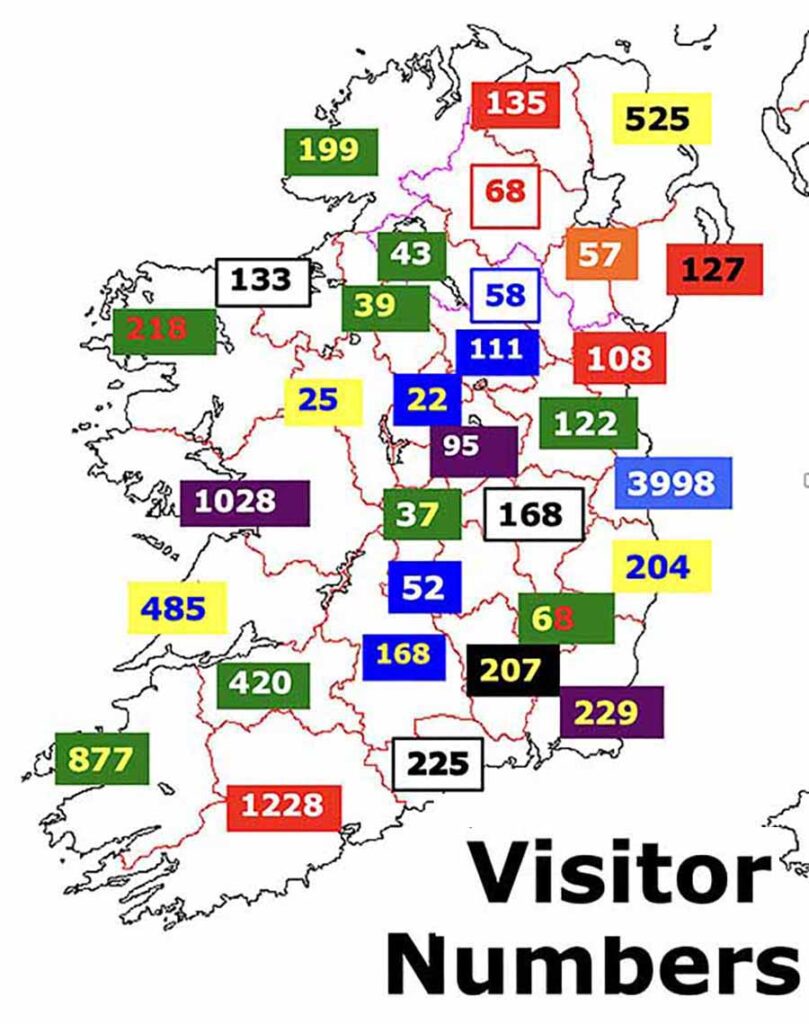
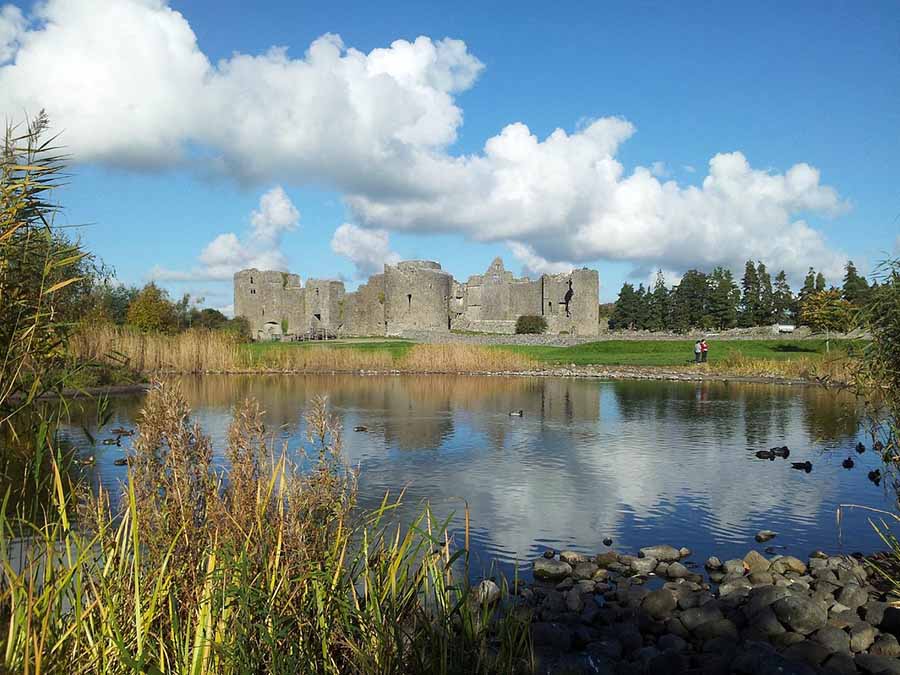
Ireland’s county Roscommon combines historic sites with tranquil landscapes, with Roscommon Castle’s imposing ruins offering a glimpse into medieval Ireland. Lough Key Forest Park provides boating and treetop canopy walks, while the Arigna Mining Experience explores the county’s industrial past. Other attractions include the sacred site of Rathcroghan, linked to ancient mythology. Roscommon is Ireland’s 11th largest county by size (2,463 square km) and eighth smallest by population (70,259). Population peaked at 253,591 in 1841 and reached its lowest point, 53,519 in 1971. In terms of hospitality, Roscommon is Ireland’s 31st most visited and Ireland’s second least visited tourist county with around 25,000 international visitors per year.
Introduction – Adventure – Anthem – Archaeology – Attractions – Awards – Birdwatching – Camping – Castles – Churches – Contact list – Cycling – Dining – Equestrian – Festivals – Fishing – Folklore – Gardens – Golf – Graveyards – Happening – Haunted – Highest – Hiking – History – Holy Wells – Hotels – Hotels top 8 – Hunting & shooting – Instagrammable – Itineraries – Largest town – Luxury – MICE – Movies – Music – Name – New – Novelists – Off the beaten track – Poets – Pubs – Quotes – Random Facts – Restaurant Awards – Sacred Places – Saints – Songs – Spas – Sports – Sunsets – Sustainable – Things to do – Towns – Video – Villages – Walking – Wanderlist – Weddings – Wild swimming – Writers – 1837 – 1846– 1852 – 1909 – 1955 – 1980 –