Start your walking tour of Maynooth in Ireland’s county Kildare starts at Maynooth Castle the town’s most storied landmark overlooking the entrance to the south campus of Maynooth University. Two massive towers remain from the original structure with the Fitzgerald coat of arms above the archway through one tower featuring figures on either side that depict monkeys.
Legend states that generations earlier a Fitzgerald heir asleep in his cot faced disaster when straw flooring caught fire from a candle but a pet monkey in a cage screeched and wailed alerting adults who rushed in to rescue the child and secure the dynasty’s succession.
The castle traces origins to the late 1100s when the first Fitzgerald baron of Welsh descent built the initial fortification extended over successive generations into one of Ireland’s finest fortresses reaching its peak under Gerald Mór the eighth Earl of Kildare so powerful that England’s King Henry VII remarked if Ireland cannot rule Fitzgerald let Fitzgerald rule Ireland. Legends surround Gerald Mór including one that he slumbers in a cavern beneath the Curragh of Kildare rising every seven years in May to defend Ireland against enemies with sightings of a broken period dress in areas like Brownstown Suncroft or Ballymoney on the Curragh edge possibly linked to him.
His grandson Silken Thomas the tenth Earl led a failed uprising against the English garrison in Dublin prompting Henry VIII to send an army to besiege Maynooth Castle with tradition holding that on the night before surrender Silken Thomas played his harp under a yew tree in the grounds. Proceed into the grounds of Maynooth College passing under an archway marked Cullen Hall commemorating Reverend Nicholas Callan professor of natural science who developed the induction coil a forerunner of many modern electrical components including those in car ignition systems.
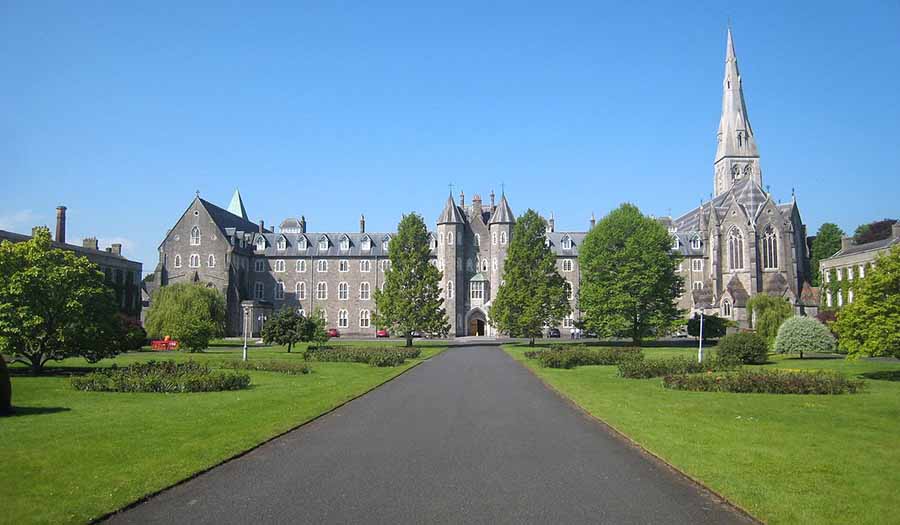
Advance to Saint Joseph’s Square a quadrangle surrounded by college buildings dominated by the main seminary designed by architect Augustus Welby Pugin. The college established in 1795 as Saint Patrick’s Seminary to train Catholic priests grew into the largest seminary in the English-speaking world. Return to the college gate onto the Main Street following the route of the Maynooth 15 who on Easter Monday 1916 marched from the town to Dublin joining the Easter Rising the only Kildare contingent to see action in the GPO led by Donal Buckley later appointed last governor-general of the Irish Free State by Éamon de Valera in the 1930s. Reach the Roost Junction named after the licensed premises there. Turn left up Mill Street named after former cavernous manor mills now occupied by Manor Mills shopping centre opposite Saint Mary’s Catholic Church with the road continuing to Laraghbryan old church site and cemetery.
Return to the Roost Junction and turn right down Leinster Street to the picturesque triangular harbour of the Royal Canal part of the newly launched Royal Canal Greenway allowing walking or cycling east to Leixlip and Dublin or west to Kilcock and the Midlands. Beyond the canal lies the railway built by the Midland Great Western Railway in 1845. Proceed down the Main Street with wide footpaths and tree-lined pavements reflecting the town’s evolution around the Fitzgerald estate to Carton Avenue a tree-lined public walk legacy of the great estate leading to the John Boyne Road accessing Carton Estate proper.
The Fitzgeralds were associated with Maynooth Castle until the 1600s when ruined for the second time relocated briefly to Kilkea Castle between Castledermot and Athy before returning to Maynooth, commissioning Carton House a Palladian mansion by the nineteenth Earl of Kildare architect Richard Cassels who also designed Leinster House seat of the Irish Dáil and Seanad.
By the late 1700s the Fitzgeralds owned Carton as country house Leinster House as city residence and Frescati House in Blackrock as summer house elevated to Duke of Leinster in the peerage of Britain and Ireland. The first Duke married Emily Lennox who completed interior decoration including the Chinese Room still visible today bore nineteen children and maintained access to high aristocratic and political circles. The family’s presence in Maynooth and Leinster continued through the 1800s but declined in the early 1900s with three brothers the eldest Maurice confined due to mental illness the second Desmond killed in a 1914 army training accident and the third Edward, a gambler who mortgaged the Leinster Estate lost to English industrialist Malaby.
The title continues with the ninth Duke living a low-profile life in England occasionally visiting Ireland. On a day in February 1879 Empress Elizabeth, of Austria and Hungary known as Sisi arrived in Ireland for a hunting expedition staying at Summerhill House north of Kilcock. She became detached from her party during a Ward Union hunt and her horse carried her into Maynooth College grounds where staff recognised her ,summoned the president provided tea on the best china. Months later a parcel from the continent arrived containing clerical vestments embroidered with arms of Austria Hungary and shamrock as her gift for the hospitality.
She was so popular in Ireland that an enraged Queen Victoria of England sent word to Vienna that she was never to visit the country again and her miliratary commanders considered burning Maynooth college to the ground. Sisi herself met a tragic end almost twenty years later stabbed by an anarchist in Geneva. Return through the town to the starting point at Maynooth Castle.
Ireland county by county
Antrim – Armagh – Carlow – Cavan – Clare – Cork – Derry – Donegal – Down – Dublin – Fermanagh – Galway – Kerry – Kildare – Kilkenny – Laois – Leitrim – Limerick – Longford – Louth – Mayo – Meath – Monaghan – Offaly – Roscommon – Sligo – Tipperary – Tyrone – Waterford – Westmeath – Wexford – Wicklow
Largest town walking tour
Antrim – Armagh – Carlow – Cavan – Clare – Cork – Derry – Donegal – Down – Dublin – Fermanagh – Galway – Kerry – Kildare – Kilkenny – Laois – Leitrim – Limerick – Longford – Louth – Mayo – Meath – Monaghan – Offaly – Roscommon – Sligo – Tipperary – Tyrone – Waterford – Westmeath – Wexford – Wicklow
Towns
Antrim – Armagh – Carlow – Cavan – Clare – Cork – Derry – Donegal – Down – Dublin – Fermanagh – Galway – Kerry – Kildare – Kilkenny – Laois – Leitrim – Limerick – Longford – Louth – Mayo – Meath – Monaghan – Offaly – Roscommon – Sligo – Tipperary – Tyrone – Waterford – Westmeath – Wexford – Wicklow
Villages
Antrim – Armagh – Carlow – Cavan – Clare – Cork – Derry – Donegal – Down – Dublin – Fermanagh – Galway – Kerry – Kildare – Kilkenny – Laois – Leitrim – Limerick – Longford – Louth – Mayo – Meath – Monaghan – Offaly – Roscommon – Sligo – Tipperary – Tyrone – Waterford – Westmeath – Wexford – Wicklow