A maritime county of the province of Connacht, is bounded, on the north, by Mayo; on the east, by Roscommon and Offaly; on the south, by Clare and the Bay of Galway; and on the west, by the Atlantic Ocean. Its greatest length, from east to west, is about 80 miles; its greatest breadth, from north to south, is about 50 miles; and its area is 2,007,911 statute acres, or about 3,138 square miles, of which 1,523,000 acres are land under cultivation or capable of it, and the rest bog, mountain, and water. It is the second largest county in Ireland.
POPULATION, In 1831, 256,392; in 1841, 241,506, showing a decrease of 14,886, or about 5.8 per cent. Houses in 1841, 40,614. Families chiefly employed in agriculture, 32,614; in manufactures and trade, 6,614; in other pursuits, 2,614. Families dependent chiefly on property and professions, 2,000; on the direction of labour, 20,000; on their own manual labour, 18,614; on means not specified, a small number.
The county is divided into 12 baronies: Athenry, Ballymoe, Ballynahinch, Clare, Clonmacnowen, Dunkellin, Dunmore, Galway (town and liberties), Kilconnell, Kiltartan, Leitrim, Loughrea, Moycullen, Ross, and Tiaquin. It contains 93 civil parishes, 1,093 townlands, and parts of others. Poor Law Unions: Ballinasloe (part), Galway, Gort, Loughrea, Mountbellew, Oughterard, Tuam, and parts of others. The valuation under the Poor Law is about £511,839.
SURFACE AND TOPOGRAPHY, The surface is very diversified. The east and south-east portions are level or gently undulating champaign, fertile, and well cultivated; the centre and north are partly level, partly hilly, with extensive bogs; the west is mountainous and rugged, with glens, lakes, and sea-indents. The principal mountains are the Twelve Bens or Benna Beola (culminating in Benbaola or Benlettery at 2,246 feet, Bengower 2,221 feet), the Maumturks (up to 2,510 feet in Mám Tuirc), Slieve Aughty (1,853 to 2,598 feet), Partry Mountains, and others in Connemara and Joyce’s Country. The coast is bold, rocky, and highly picturesque, with numerous bays (Galway Bay, Kilkieran Bay, Bertraghboy Bay, Roundstone Bay, etc.), excellent harbours, and the fine group of the Aran Islands off Galway Bay.
LAKES AND RIVERS, The chief lakes are Lough Corrib (about 30,000 acres, 27 miles long, navigable), Lough Mask (20,000 acres), Lough Carra, Lough Nafooey, Lough Orid, and numerous smaller loughs and turloughs (seasonal lakes). The principal rivers are the Corrib (short but deep and rapid, flowing from Lough Corrib to Galway Bay), the Clare or Clarin (subterranean in parts), the Suck (forming boundary with Roscommon, navigable), the Black River, the Owenriff, the Recess River, the Ballynahinch River, and tributaries of the Shannon. Subterranean rivers and swallows are common in the limestone districts.
SOIL AND AGRICULTURE, The soil varies greatly: rich loam and clay in the east and south-east; limestone pasture and arable in central districts; light sandy or gravelly in parts; deep bog in extensive tracts (especially north and west); barren mountain in Connemara. Crops: oats (chief), barley, wheat (limited), potatoes, flax. Pasture supports good cattle and sheep. Kelp-burning and fishing are important on the coast. The agriculture is improving, but backward in the west.
CLIMATE, Mild, moist, and equable, tempered by the Atlantic; mean temperature about 50° Fahrenheit; rainfall heavy (40+ inches); frequent fogs and storms from the west.
MINERALS, Limestone and building stone abundant; marble (Connemara), iron ore, lead, copper, silver (limited working); some coal seams (thin); manganese.
TRADE AND MANUFACTURES, Principal trade at Galway (seaport, exports: agricultural produce, fish, wool, butter; imports: coal, timber, etc.). Fisheries valuable (herring, mackerel, cod, salmon). Manufactures limited: coarse linen, woollens, distilleries, breweries.
TOWNS, Galway (county town and seaport, pop. about 16,000–18,000), Tuam (archiepiscopal see, pop. about 6,000), Loughrea (pop. about 4,000), Gort, Clifden, Oughterard, Athenry, Dunmore, etc.
ECCLESIASTICAL, In the province of Tuam; dioceses Tuam (archdiocese), Kilmacduagh, Clonfert, and parts of others. Numerous Roman Catholic chapels; Protestant churches limited. Tithes commuted.
ANTIQUITIES, Numerous: round towers, castles (Athenry, Oranmore, Dunguaire, Menlo), abbeys (Tuam, Abbeydorney, Kilmacduagh with round tower), ancient forts, cromlechs, and ecclesiastical remains in Aran Islands and elsewhere.
Ireland in 1846
Antrim – Armagh – Carlow – Cavan – Clare – Cork – Derry – Donegal – Down – Dublin – Fermanagh – Galway – Kerry – Kildare – Kilkenny – Laois – Leitrim – Limerick – Longford – Louth – Mayo – Meath – Monaghan – Offaly – Roscommon – Sligo – Tipperary – Tyrone – Waterford – Westmeath – Wexford – Wicklow
County Galway:
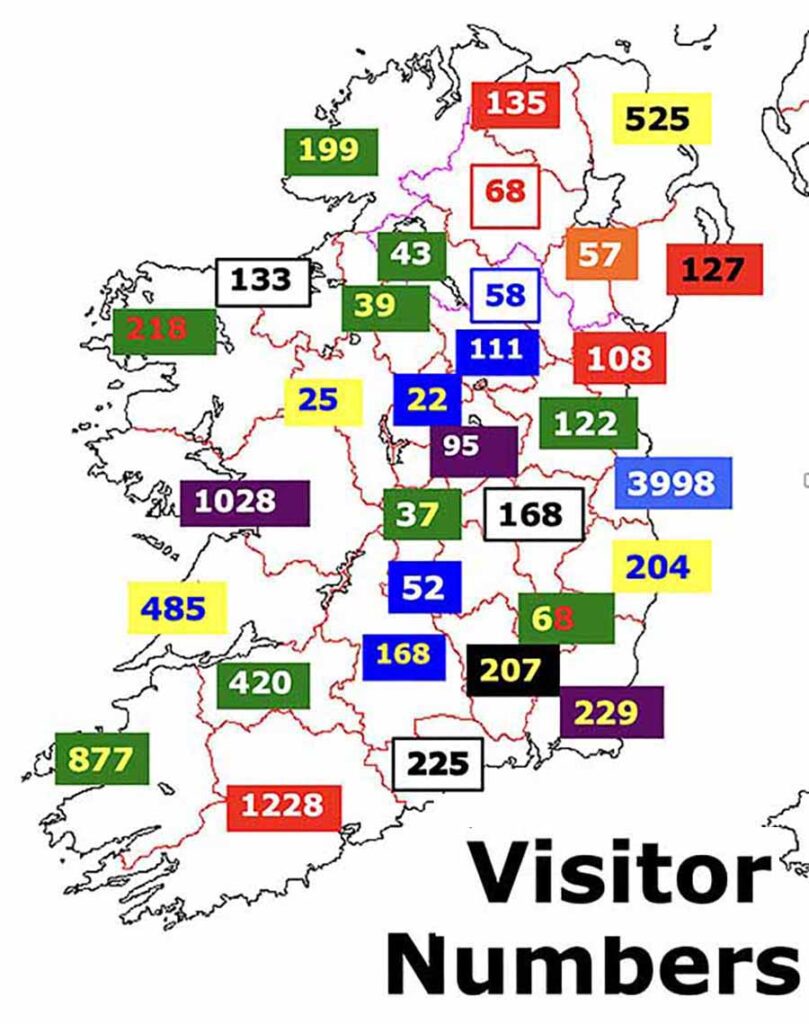
Ireland’s county Galway offers a delightful mix of cultural heritage and coastal beauty, with Galway City’s Latin Quarter showcasing historic streets and traditional music venues. The Connemara National Park provides hiking trails through rugged mountains and bogs, while the Aran Islands offer ancient stone forts like Dún Aonghasa. Other favourite stop is ithe Kylemore Abbey’s Victorian gardens and coastal cliffs. Galway is Ireland’s second largest county by size (5,939 sq km) and fifth largest by population (277,737). Population peaked at 440,198 in 1841 and reached its lowest point, 148,340 in 1966. In terms of hospitality, Galway is Ireland’s third most visited tourist county with around 1,028,000 international visitors per year.
Introduction – Adventure – Anthem – Archaeology – Attractions – Awards – Birdwatching – Camping – Castles – Churches – Contact list – Cycling – Dining – Equestrian – Festivals – Fishing – Folklore – Gardens – Golf – Graveyards – Happening – Haunted – Highest – Hiking – History – Holy Wells – Hotels – Hotels top 8 – Hunting & shooting – Instagrammable – Itineraries – Largest town – Luxury – MICE – Movies – Music – Name – New – Novelists – Off the beaten track – Poets – Pubs – Quotes – Random Facts – Restaurant Awards – Sacred Places – Saints – Songs – Spas – Sports – Sunsets – Sustainable – Things to do – Towns – Video – Villages – Walking – Wanderlist – Weddings – Wild swimming – Writers – 1837 – 1846 – 1852 – 1909 – 1955 – 1980 –