A maritime county of the province of Leinster, is bounded, on the north, by Laois and Offaly; on the east, by Carlow and Wexford; on the south, by Waterford and the estuary of the Suir; and on the west, by Tipperary. Its greatest length, from north to south, is about 45 miles; its greatest breadth, from east to west, is about 35 miles; and its area is 795,718 statute acres, or about 1,243 square miles, of which about 531,614 acres are arable, 113,614 uncultivated (bog and mountain), 25,000 planted or in towns/roads/water, and the rest minor features.
POPULATION, In 1831, 192,759; in 1841, 202,420, showing an increase of 9,661, or about 5 per cent. Houses in 1841, 33,614. Families chiefly employed in agriculture, 27,614; in manufactures and trade, 4,614; in other pursuits, 1,386. Families dependent chiefly on property and professions, 1,614; on the direction of labour, 8,614; on their own manual labour, 22,614; on means not specified, small number.
The county is divided into 12 baronies: Callan, Crannagh, Fassadinin, Galmoy, Gowran, Ida, Iverk, Kells, Knocktopher, Shillelogher, Slievemargue, and Upperthird. It contains 153 civil parishes (including parts), about 2,000 townlands. Poor Law Unions: Callan, Kilkenny, Thomastown, Urlingford, and parts of New Ross, Waterford. The Poor-Law valuation is about £300,000 to £350,000.
SURFACE AND TOPOGRAPHY, The surface is diversified: chiefly a fertile undulating champaign plain, sloping gently to the south-east; mean elevation about 300 feet above sea-level. The north and north-west are level or gently hilly; the centre and east rich valleys and plains; the south and south-west more elevated with hills and low mountains (Slieveardagh range up to 1,132 feet, Brandon Hill 1,702 feet, Blackstairs Mountains on border up to 2,400 feet in parts, Knockmealdown outliers). Bogs occur in low tracts (reclaimable); limestone prevails, with fertile soil in valleys; picturesque scenery with wooded hills, glens, and river views.
RIVERS AND CANALS, The chief rivers are the Nore (principal, rises in Tipperary, traverses centre north to south, navigable to Inistioge/Thomastown, joins Suir at Waterford; tributaries: King’s River, Erkina, Dinin, Breagagh, Munster Blackwater); the Suir (forms southern boundary for part, navigable); the Barrow (eastern boundary for part, navigable). Smaller streams: Clodiagh, Lingaun, etc. The Barrow Navigation and branches of Grand Canal afford water communication to Dublin and south; navigation supports trade in grain and produce.
SOIL AND AGRICULTURE, The soil is generally fertile: rich deep loam and clay in valleys and east (excellent for wheat, barley, oats); strong clayey in north; lighter gravelly or slatey in hills; limestone base aids fertility with marl/lime manure. Crops: oats and barley chief, wheat increasing, potatoes extensive, turnips/green crops improving. Pasture supports dairy cattle, sheep; butter and provisions high quality. Tillage advancing with better rotations, liming, drainage; farms medium to small; husbandry superior in east, backward in hilly west.
CLIMATE, Mild, moist, equable; mean temperature about 50° Fahrenheit; rainfall abundant (35-40 inches); tempered by proximity to sea; salubrious, suitable for agriculture and grazing.
MINERALS, Limestone abundant (quarried for building and manure); coal (bituminous, worked near Castlecomer in Leinster coalfield, limited extent); slate, sandstone, marble (black and variegated); iron ore, lead (traces, not extensively worked); marl, ochre.
TRADE AND MANUFACTURES, Chiefly agricultural; exports grain, butter, cattle, provisions via Waterford and New Ross (though ports partly adjacent); imports coal, timber, manufactures. Manufactures: coarse linen, woollens, brewing/distilling (Kilkenny noted for ale), milling, tanning. Trade centres at Kilkenny, Callan, Thomastown.
TOWNS, Kilkenny (county town, municipal borough, pop. about 11,000-12,000; cathedral, castle, markets); Callan (pop. about 3,000); Thomastown (pop. about 2,500); Castlecomer (mining, pop. about 2,000); Graiguenamanagh (on Barrow, pop. about 2,000); Inistioge; Gowran; Freshford; Johnstown; Mullinavat; etc.
ECCLESIASTICAL, Diocese of Ossory (chief; cathedral at Kilkenny, St. Canice’s; Protestant: about 50 benefices, churches; Roman Catholic: united sees, numerous parishes/chapels, bishop at Kilkenny). Parts in Leighlin, Ferns. Tithes commuted; numerous chapels and churches.
ANTIQUITIES, Very rich: Kilkenny Castle (Norman, extensive); cathedral of St. Canice (Gothic, with round tower 100 feet); Black Abbey (Dominican); St. John’s Abbey; Grey Friars; Jerpoint Abbey (beautiful ruins); Kells Priory; Duiske Abbey (Graiguenamanagh); round towers (Aghaviller, etc.); high crosses; castles (Gowran, Knocktopher); raths, cromlechs, ancient churches throughout.
Ireland in 1846
Antrim – Armagh – Carlow – Cavan – Clare – Cork – Derry – Donegal – Down – Dublin – Fermanagh – Galway – Kerry – Kildare – Kilkenny – Laois – Leitrim – Limerick – Longford – Louth – Mayo – Meath – Monaghan – Offaly – Roscommon – Sligo – Tipperary – Tyrone – Waterford – Westmeath – Wexford – Wicklow
County Kilkenny:
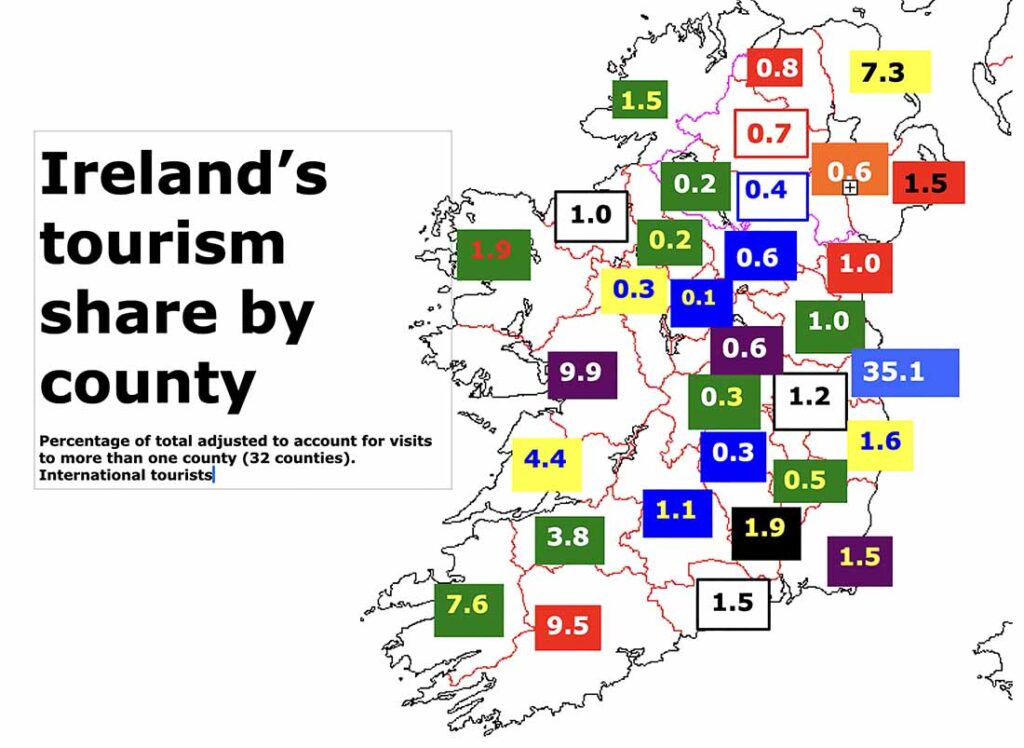
Ireland’s county Kilkenny is a county of medieval charm, with Kilkenny City’s castle and St Canice’s Cathedral showcasing well-preserved architecture and round towers. The Dunmore Cave offers intriguing limestone formations, while the Nore Valley’s walking trails provide scenic beauty. Other attractions include the historic Jerpoint Abbey’s intricate carvings. Kilkenny is Ireland’s 16th largest county by size (2,062 square km) and 21st largest by population (104,160). Population peaked at 202,420 in 1841 and reached its lowest point, 60,463 in 1966. In terms of hospitality, Kilkenny is Ireland’s eleventh most visited tourist county with around 207,000 international visitors per year.
Introduction – Adventure – Anthem – Archaeology – Attractions – Awards – Birdwatching – Camping – Castles – Churches – Contact list – Cycling – Dining – Equestrian – Festivals – Fishing – Folklore – Gardens – Golf – Graveyards – Happening – Haunted – Highest – Hiking – History – Holy Wells – Hotels – Hotels top 8 – Hunting & shooting – Instagrammable – Itineraries – Largest town – Luxury – MICE – Movies – Music – Name – New – Novelists – Off the beaten track – Poets – Pubs – Quotes – Random Facts – Restaurant Awards – Sacred Places – Saints – Songs – Spas – Sports – Sunsets – Sustainable – Things to do – Towns – Video – Villages – Walking – Wanderlist – Weddings – Wild swimming – Writers – 1837 – 1846 – 1852 – 1909 – 1955 – 1980 –