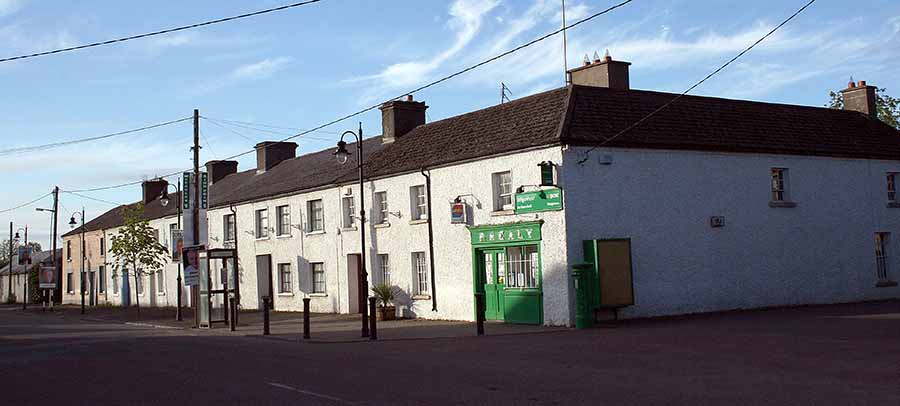
Start your walking tour of Prosperous in Ireland’s county Kildare starts along the R408 known locally as the New Road about a kilometre before the village. On the left stands Curry Hill from which the Irish name for Prosperous An Chorrchoill derives. On the hill lies Eldon’s Fort one of many ringforts in the village area.
The high point of the road forms a triple watershed dividing the river basins of the Boyne the Liffey and the Barrow. Prosperous was founded in 1780 by Robert Brooke a former lieutenant in the British army in India who married Anna Mabeltoft and settled in Killybegs on the village outskirts. In the late 18th century amid attempts at industrialisation in Ireland Brooke established the town on cotton manufacturing modelled on Manchester in England. He leased over 400 acres of the Killybegs estate from Charles O’Neill planned the town and employed builder Michael Hayes from Timahoe who later constructed many locks on the Grand Canal between Lowtown and Shannon Harbour. The Grand Canal opened to Robertstown in 1784 with hopes of extension to the village and onward to the sea.
Proceed along the New Road which Brooke called New Street turn left onto the 100-foot-wide Main Street named Temple Street by Brooke. On the left pass the site of the old cotton factory continue to the two main squares. Market Square lies on the left between the old post office and Larry’s Bar with a monument erected there in 1980 for the village bicentenary. Beyond on the same side Larry’s Pub and off-licence occupies the former Navin’s cotton factory by 1833 converted to a school. Tom Harris once lived there injured at the GPO in the Easter Rising later TD for Clare from 1932 until 1957. Brooke envisioned round-the-clock cotton production prohibited whiskey use and provided each tenant a cow and garden for potatoes.
By 1783 200 houses stood by 1784 over 4000 employed making him Ireland’s largest cotton manufacturer. Poor workmanship piece-rate pay low productivity led to unrest once 400 men surrounded him in a field demanding higher doubling rates he escaped narrowly after which soldiers stationed in Prosperous built a barracks. Constant need for grants arose from poor management high transport costs in March 1785 Brooke sought another £57000 in the Irish House of Commons admitted Prosperous not ideal yet received £32000.
Mid-1780s economic difficulties English manufacturers excluded from America during the War of Independence flooded Ireland with cheap textiles in 1786 Brooke requested another grant refused a parliamentary committee appointed trustees he declared bankrupt returned to army as governor of Saint Helena in the South Atlantic. Under trustees the industry struggled wound up officially in 1792 Brooke spent over £132000 equivalent to many millions of euros today small-scale manufacturing continued but decline set in no canal branch unemployment rose wages fell revolution brewed.
Cross to the other square Robert Square with a monument built in 1998 for the 200th anniversary of the Battle of Prosperous the barracks located nearby exact site unknown. The first shots and victory of the 1798 Rebellion the first Irish military success in 100 years occurred here on the evening of 23 May 500 rebels gathered near the canal led by John Esmonde. Captain Richard Swayne arrived with Cork militia and tortured residents using techniques such as half-hanging andpitch-capping, burned the chapel and 15 houses, and arrested 12 men for execution next day without judge or jury.
At 2 am 24 May rebels stormed the barracks, Captain Richard Swayne among many Cork militiamen burned inside with the barracks. From here the legend of the Root Packet persists she kept burning fires around the barracks shot and killed nearby. Beside Street is the Dead Field reputed burial place of soldiers. The second Battle of Prosperous on 19 June 1798 saw Lieutenant Colonel Charles Stewart recapture the town after bloody clashes but retreat due to bog terrain unfamiliarity. On 21 July 1798 a treaty signed the village left decimated Samuel Lewis in 1837 described it as little more than a pile of ruins.
Continue up Main Street to the crossroads on the left the Church of Our Lady and Saint Joseph built in 1869 before which a small thatched cottage stood now site of Prosperous Drama Theatre first play known from 1917. Beside the theatre the old school built in 1856 new school across the road in 1946.
At the cross a 10-kilometre straight road runs from Clane through Prosperous Mountain Lily Moore Andrew Moss built in the 1750s planned to Ballinagar County Offaly but money ran out in 1757 road sinking into bog. Brooke named it Leinster Street straight on towards the canal past Infant and Post Primary schools and Hatter’s Crossroads to Old Killybegs Church and graveyard a Knights Hospitaller foundation early 13th century confiscated in 1540 under Henry VIII dissolution of monasteries.
Back at the cross Dowling’s public house became a centre for folk music in the 1960s and 1970s under Pat Dowling. Head west towards Allenwood on the right the Ideal Shopping Centre with Places Cinema further on right in what is now Gormley’s butchers the site of 19th-century RIC barracks to the left of Blackstate Crossroads and Newbridge Road Saint Farnan’s Park home to Caragh GFC one of the oldest clubs in the county. Across the road is wehre, during the 1798 battle, rebels demanded handover of Henry Stamer justice of the peace for County Kildare.
More recently Christy Moore’s 1972 album Prosperous recorded there during sessions that formed Planxty. On the Allenwood Road edge of the village Downings Church and graveyard Saint Farnan a sixth-century monastic hermit the well a pilgrimage site miracles attributed Canon John Hanlon in 1874 stated whoever drank its water would never relish intemperance waters. Oliver Cromwell’s forces battered the church with cannon fire like many factories warehouses aqueducts water reservoirs army barracks windmills little remains but ruins and stories.
Ireland county by county
Antrim – Armagh – Carlow – Cavan – Clare – Cork – Derry – Donegal – Down – Dublin – Fermanagh – Galway – Kerry – Kildare – Kilkenny – Laois – Leitrim – Limerick – Longford – Louth – Mayo – Meath – Monaghan – Offaly – Roscommon – Sligo – Tipperary – Tyrone – Waterford – Westmeath – Wexford – Wicklow
Largest town walking tour
Antrim – Armagh – Carlow – Cavan – Clare – Cork – Derry – Donegal – Down – Dublin – Fermanagh – Galway – Kerry – Kildare – Kilkenny – Laois – Leitrim – Limerick – Longford – Louth – Mayo – Meath – Monaghan – Offaly – Roscommon – Sligo – Tipperary – Tyrone – Waterford – Westmeath – Wexford – Wicklow
Towns
Antrim – Armagh – Carlow – Cavan – Clare – Cork – Derry – Donegal – Down – Dublin – Fermanagh – Galway – Kerry – Kildare – Kilkenny – Laois – Leitrim – Limerick – Longford – Louth – Mayo – Meath – Monaghan – Offaly – Roscommon – Sligo – Tipperary – Tyrone – Waterford – Westmeath – Wexford – Wicklow
Villages
Antrim – Armagh – Carlow – Cavan – Clare – Cork – Derry – Donegal – Down – Dublin – Fermanagh – Galway – Kerry – Kildare – Kilkenny – Laois – Leitrim – Limerick – Longford – Louth – Mayo – Meath – Monaghan – Offaly – Roscommon – Sligo – Tipperary – Tyrone – Waterford – Westmeath – Wexford – Wicklow