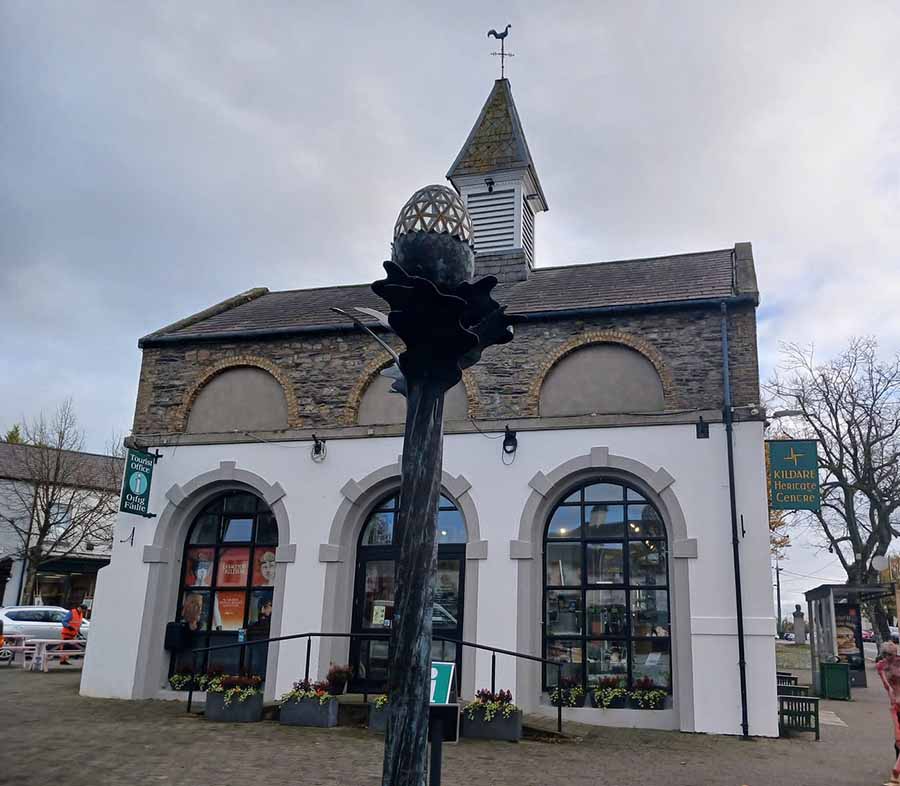
Start your walking tour of Kildare town in Ireland’s county Kildare at the Kildare Town Heritage Centre in Market Square. The town stands on a ridge once called Druim Criadh meaning the ridge of clay along the ancient Sli Dala one of five roads to Tara.
Saint Brigid born around 450 AD established a small wooden church under an oak tree on the site giving the place the name Cill Dara or church of the oak. She died around 524 AD and serves as patroness of Ireland. The perpetual flame of Saint Brigid, unveiled by President Mary McAleese on Saint Brigid’s Day 2006 burns in the square outside the heritage centre. Plaques in the square mark the Gordon Bennett Cup road race of 1903 the Kildare waterworks of 1885 and 1886 and on the eastern side an 18th-century well stands beside a Celtic cross unveiled in 1935 to seven republicans executed in the early Civil War.
A bronze bust of Lord Edward Fitzgerald United Irishmen leader who lived in the town with his wife Lady Pamela appears nearby. Across the street Virginia Lodge with ivy covering leads to a lane for People’s Park. Along the lane Thomas’s Chapter 16 restaurant occupies the former cinema building from 1942 to 1987. At the lane’s top the site of the Norman castle appears.
Strongbow Richard de Clare Earl of Pembroke built the first fortification in 1172. William Marshal his successor constructed the stone castle with four towers. Only one tower and fragments of town walls survive. Three abbeys once stood on the outskirts. The Black Abbey founded by the Knights Hospitallers in black habits dates before 1212 AD. The Grey Abbey Franciscan in grey habits founded around 1254 AD served as burial place for at least four Earls of Kildare.
The White Abbey Carmelite in white habits founded in 1290 AD completes the trio. In 1316 Edward Bruce besieged the castle without success. It passed to John FitzThomas Fitzgerald created Earl of Kildare. The Fitzgeralds rose to power as Barons of Offaly Earls of Kildare and Dukes of Leinster. The Silken Thomas public house recalls Thomas Fitzgerald tenth Earl who rebelled in 1534 with followers in silken plumes and execution followed in 1537 for him and five uncles. Beside the car park entrance the abandoned courthouse built in 1829 by grand jury for petty sessions closed in 2010.
Across the road Lislee is one of the oldest houses in the town housed veterinarian Stan Cosgrove part-owner of racehorse Shergar in recent times. The two-storey postmaster’s house stands next with the small red brick post office built around 1853 closed in 2007 now home to Kildare YouTube.
The Turf Club site in Leinster Square founded in 1790 sold as a hotel in 1903 became a residence and demolished in 1973. Behind walls is Beechgrove House built in 1757 counts as possibly the oldest inhabited house in Kildare with garden ruins of a gentleman’s folly. Ivy Dean House dates to around 1877, next to Bottom Nolan’s public house to distinguish from Top Nolan’s in Market Square. The new Garda station opened in Dublin Street in January 1980. From the corner of Hospital Street and Meadow Lane the former military barracks erected in 1901 for 1100 men and 600 horses of the Royal Field Artillery appears.
English forces evacuated on 15 April 1922. It served as training depot for the Civic Guard later Garda Síochána in 1923 then returned to Dublin. The Irish Artillery Corps occupied it in 1925. Gough Barracks opened on the site in 1938 closed in 1998 with forces moving to the Curragh.
The Kildare House Hotel originated as a hospital built in 1778 closed 1959 to 1960 sold in three lots in 1962 with the main house becoming Derby House Hotel nurses quarters Saint Rita’s BNB and sergeant’s house Kilgowan Lodge. On Meadow Road the Presentation Convent opened with the order’s arrival on 15 April 1830 and female national school running a week later. From 1969 it became a secondary school closed in 2011 when the new community school opened on Dunmurry Road.
At the bottom of Meadow Road Saint Brigid’s Church consecrated in 1833 hosted Daniel O’Connell at high mass during Catholic emancipation campaign where he presented a bell. Turn left down Tully Road over the motorway past Sullies Flee the Hermitage to the Black Abbey founded before 1212 AD by Knights Hospitallers who bred horses at Tully. In the mid-16th century the property belonged to the Sarsfield family with tradition that Patrick Sarsfield born here. Colonel Hall Walker bought Tully in 1899 for thoroughbred breeding.
The Irish government acquired it on 1 January 1946 forming the Irish National Stud Company. Hall Walker and Tassa Eida planned the Japanese Gardens from 1906 to 1910 to symbolise life from cradle to grave. The National Stud created Saint Fiachra’s Garden for the millennium to represent Irish monasticism. Tully holds Saint Brigid’s Well walled by the OPW in 1953 while another popular well at Grallagh renovated by Tully people in 1952 blessed on Saint Brigid’s Day 1953.
Continue 100 acres to Newtown Cross turn right down Nerney Road right again on old Grey Abbey Road to the Grey Abbey Franciscan foundation from around 1254 flourished under Fitzgeralds burial site for earls. A monument in the graveyard centre commemorates seven men executed December 1922 in the early Civil War re-interred 1924 the largest execution by Irishmen then.
At Pound Green and Saint Brigid Square the CYMS hall built on the old electrical power station site from 1904 opened new in July 1950 renamed Catholic Men’s and Women’s Society Hall in 2011. Opposite the church a gable end marks the former home of Bill ‘Squires’ Gannon Round Towers footballer All-Ireland medal winner 1927 and 1928 captain first to hold Sam Maguire Trophy aloft. Across Bride Street the restored parish centre holds a plaque to Father Benjamin Broughall the pilgrim priest who walked to the Holy Land 1822 to 1827.
The school and monastery, now part of Saint Brigid’s Primary School , wasbuilt for De La Salle brothers in 1884 and remained until 2004 brother’s house reopened as community centre 2012. Next is the Kildare Credit Union, founded and 1967 and moved in 1980 to the new ‘Rea House’ to honor Colonel William Rea, opened by President McAleese October 2000.
Across Bang Up Lane lettering on the wall reads Kildare Chilling Company established 1941 new premises on Dublin Curragh Road mid-1960s. Return to Market Square near traffic lights and pedestrian crossing, passing a monument to the 350 victims of the Gibbet Rath massacre 29 May 1798 when 85 widows were left destitute.
Pass old Hart’s Hotel to Nolan’s public house and next Verger’s House built 1864 to 1865 at gates of Saint Brigid’s Cathedral a functioning church with services. The cathedral Norman from 1223 refurbished opened 1896 holds stained glass counter organ stone effigies of Maurice Fitzgerald of Lackagh and tomb of Walter Wellesley Bishop of Kildare.
Outside the great west doorway leads to the round tower coins at base date to 12th century height about 108 feet views from top across Curragh plains and countryside. Other points include the reputed firehouse, various World War One graves and Saint Brigid’s Kitchen, a 14th-century burial vault. Return through the gates to Market Square and the heritage centre starting point.
Ireland county by county
Antrim – Armagh – Carlow – Cavan – Clare – Cork – Derry – Donegal – Down – Dublin – Fermanagh – Galway – Kerry – Kildare – Kilkenny – Laois – Leitrim – Limerick – Longford – Louth – Mayo – Meath – Monaghan – Offaly – Roscommon – Sligo – Tipperary – Tyrone – Waterford – Westmeath – Wexford – Wicklow
Largest town walking tour
Antrim – Armagh – Carlow – Cavan – Clare – Cork – Derry – Donegal – Down – Dublin – Fermanagh – Galway – Kerry – Kildare – Kilkenny – Laois – Leitrim – Limerick – Longford – Louth – Mayo – Meath – Monaghan – Offaly – Roscommon – Sligo – Tipperary – Tyrone – Waterford – Westmeath – Wexford – Wicklow
Towns
Antrim – Armagh – Carlow – Cavan – Clare – Cork – Derry – Donegal – Down – Dublin – Fermanagh – Galway – Kerry – Kildare – Kilkenny – Laois – Leitrim – Limerick – Longford – Louth – Mayo – Meath – Monaghan – Offaly – Roscommon – Sligo – Tipperary – Tyrone – Waterford – Westmeath – Wexford – Wicklow
Villages
Antrim – Armagh – Carlow – Cavan – Clare – Cork – Derry – Donegal – Down – Dublin – Fermanagh – Galway – Kerry – Kildare – Kilkenny – Laois – Leitrim – Limerick – Longford – Louth – Mayo – Meath – Monaghan – Offaly – Roscommon – Sligo – Tipperary – Tyrone – Waterford – Westmeath – Wexford – Wicklow