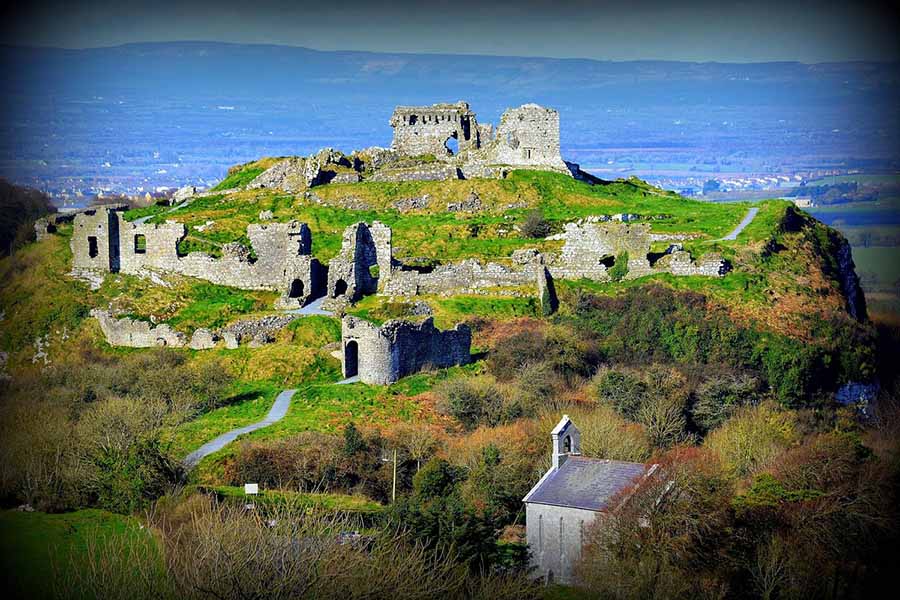
- Rock of Dunamase: Near Portlaoise, Co. Laois, R32 Y5N3. A dramatic hilltop fortress, originally an Iron Age fort (c. 500 BC), transformed into a 12th-century Norman castle by Dermot MacMurrough and later Strongbow. Its ruins include a great hall and gatehouse, reflecting Norman military architecture. Destroyed during the Cromwellian conquest, it’s managed by the OPW, freely accessible, and offers panoramic views.
- Emo Court (Archaeological Context): Emo, near Portarlington, Co. Laois, R32 R7DD. While primarily an 18th-century neo-classical mansion, the estate includes prehistoric features like a possible Bronze Age ring barrow and early medieval ringforts nearby (c. 2000 BC-800 AD). Built for the Earls of Portarlington, it’s managed by the OPW with accessible grounds and guided tours, blending prehistoric and Georgian heritage.
- Timahoe Round Tower and Church: Timahoe, Co. Laois, R32 XW68. An early Christian monastic site, founded c. 7th century by St. Mochua, featuring a 10th-century round tower with a unique Romanesque doorway and a later medieval church. The tower, 30m tall, served as a bell tower and refuge. A state-care monument managed by the OPW, it’s freely accessible, reflecting Laois’s monastic heritage.
- Aghaboe Abbey: Aghaboe, near Borris-in-Ossory, Co. Laois, R32 KX29. Founded c. 6th century by St. Canice, this monastic site was a major religious centre. The current ruins, including a 13th-century Dominican priory, feature Gothic arches and a carved effigy. Burned in 1346, it declined after the Reformation. A state-care monument, it’s accessible via public paths, showcasing Laois’s ecclesiastical history.
- Clonmacnoise and Clonkeen (Clonkeen Church): Clonkeen, near Mountrath, Co. Laois, R32 YK47. An early Christian site, c. 6th-10th century, with a ruined church, ogham stone, and possible bullaun stones, indicating monastic activity. Linked to St. Fintan, it reflects early religious practices. A state-care monument, it’s accessible on private land with permission, offering insight into Laois’s early Christian landscape.
- Castle Durrow (Archaeological Context): Durrow, Co. Laois, R32 EA02. A 1716 mansion built on a medieval site, likely a 13th-century Norman castle of the O’Mores. Nearby, a possible Iron Age ringfort and medieval earthworks suggest multi-period use. Now a hotel, the grounds are accessible with limited public tours, reflecting Laois’s Gaelic and Norman past.
- Ballyfin Demesne (Archaeological Context): Ballyfin, near Portlaoise, Co. Laois, R32 HC58. An 19th-century estate with prehistoric and medieval features, including a possible Bronze Age barrow and early Christian ringfort (c. 2000 BC-800 AD). Built by the Coote family, it’s now a luxury hotel with restricted public access to grounds, showcasing Laois’s layered archaeological history.
- Killeshin Church and Portal: Killeshin, near Carlow, Co. Laois, R93 X9V6. An early Christian site, c. 6th-12th century, with a ruined church featuring a 12th-century Romanesque doorway, one of Ireland’s finest, adorned with carvings. Linked to St. Comgan, it includes a holy well. A state-care monument, it’s accessible via public paths, highlighting Laois’s ecclesiastical art.
- Stradbally Church and Cross: Stradbally, Co. Laois, R32 XN22. An early Christian monastic site, c. 7th-10th century, with a ruined church and a 9th-century high cross fragment featuring interlace designs. Associated with St. Colman, it reflects monastic continuity. A state-care monument, it’s accessible via public paths, offering insight into Laois’s early Christian heritage.
- Lea Castle: Near Portarlington, Co. Laois, R32 YX83. A 13th-century Anglo-Norman castle, built c. 1260 by the de Vesci family, with a large enclosure and gatehouse. Controlled by the O’Mores until the 17th century, it was destroyed during the Cromwellian wars. A state-care monument, it’s accessible on private land with permission, showcasing Laois’s Norman military history.
Archaeological sites
Antrim – Armagh – Carlow – Cavan – Clare – Cork – Derry – Donegal – Down – Dublin – Fermanagh – Galway – Kerry – Kildare – Kilkenny – Laois – Leitrim – Limerick – Longford – Louth – Mayo – Meath – Monaghan – Offaly – Roscommon – Sligo – Tipperary – Tyrone – Waterford – Westmeath – Wexford – Wicklow
County Laois:
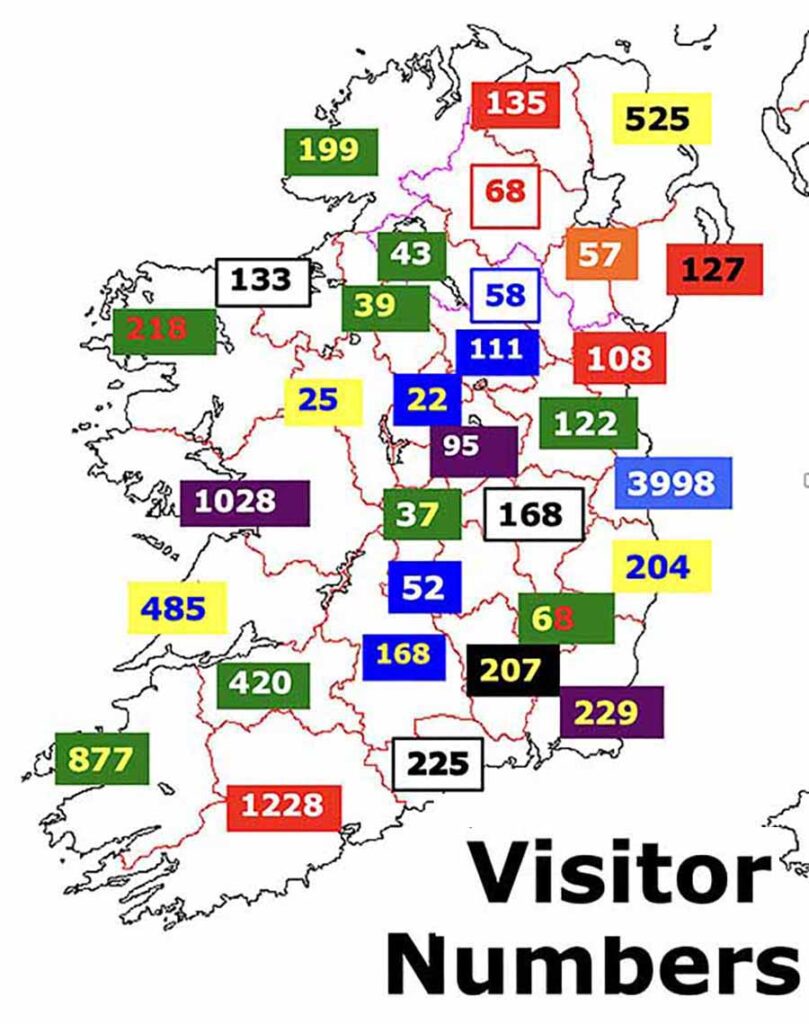
Ireland’s county Laois offers a serene blend of historic sites and natural landscapes, with the Rock of Dunamase providing panoramic views from its ancient castle ruins. Emo Court’s elegant Georgian mansion and gardens offer a peaceful retreat, while the Slieve Bloom Mountains provide hiking trails through rolling hills. Laois is Ireland’s ninth smallest county by size (1,719 square km) and tenth smallest by population (91,877). Population peaked at 153,930 in 1841 and reached its lowest point, 44,595 in 1966. In terms of hospitality, Laois is Ireland’s 27th most visited tourist county with around 52,000 international visitors per year.
Introduction – Adventure – Anthem – Archaeology – Attractions – Awards – Birdwatching – Camping – Castles – Churches – Contact list – Cycling – Dining – Equestrian – Festivals – Fishing – Folklore – Gardens – Golf – Graveyards – Happening – Haunted – Highest – Hiking – History – Holy Wells – Hotels – Hotels top 8 – Hunting & shooting – Instagrammable – Itineraries – Largest town – Luxury – MICE – Movies – Music – Name – New – Novelists – Off the beaten track – Poets – Pubs – Quotes – Random Facts – Restaurant Awards – Sacred Places – Saints – Songs – Spas – Sports – Sunsets – Sustainable – Things to do – Towns – Video – Villages – Walking – Wanderlist – Weddings – Wild swimming – Writers – 1837 – 1846 – 1852 – 1909 – 1955 – 1980 –