County Laois, in Ireland’s midlands, has a rich heritage of holy wells, reflecting pre-Christian and early Christian spiritual traditions. These wells, often linked to local saints or the Virgin Mary, were historically significant for healing, devotion, and community gatherings on pattern days (feast days of patron saints). Many have declined due to the Famine, Penal Laws, church reforms, and modern development, with some now neglected or on private land.
- Saint Kavan’s Well (Saint Kaban’s Well), Annatrim: Pattern day: November (exact date unknown), observed into the 1830s. Located at Annatrim, this freshwater spring is dedicated to Saint Kavan (likely Coemhan), associated with Saint Mochaemhog’s settlement. Known for general healing, it features an unusual “Saint’s Stone” with small holes, possibly a repurposed milling stone. Pilgrims performed rounds, but patterns ceased in the 19th century. Near Saint Jude’s Church (c. 1835) and a medieval parish church, it remains a tranquil site. Annatrim, Co. Laois.
- Saint Brigid’s Well, Ballintubbert: Pattern day: February 1 (Saint Brigid’s Day), though patterns are no longer active. In the grounds of Saint Brigid’s Church of Ireland (c. 1785), this well is dedicated to Saint Brigid. Once overgrown, it has been restored and is used for healing, particularly women’s ailments. Pilgrims left clooties on nearby trees. Its connection to poet Cecil Day-Lewis’ family adds cultural significance, though it’s now rarely visited for devotion. Ballintubbert, Co. Laois.
- Saint Fintan’s Well, Clonenagh: Pattern day: February 17 (Saint Fintan’s Day), historically observed but now rare. Near the monastic site founded by Saint Fintan in the 6th century, this well in Clonenagh was used for healing, especially rheumatism. Pilgrims performed rounds and left offerings like coins or rags. Its historical tie to one of Laois’ most important saints keeps it significant, though it’s now neglected and hard to access. Clonenagh, near Mountrath, Co. Laois.
- Tobar na Súl, Near Portlaoise: Pattern day: Unknown, possibly Lughnasa (August 1). Known as the “Eye Well,” this well near Portlaoise was famed for curing eye ailments. Pilgrims bathed their eyes with the water and tied clooties to nearby bushes, believing ailments would fade as the rags decayed. Its rural setting is now near urban development, reducing its prominence, but it retains local folklore value. Near Portlaoise, Co. Laois.
- Saint Colman’s Well, Near Stradbally: Pattern day: November 24 (Saint Colman’s Day), though patterns have lapsed. Dedicated to Saint Colman, this well near Stradbally was used for healing stomach ailments. Pilgrims performed rounds and left offerings like rosaries or rags on a nearby tree. Its rural location and association with a local saint preserve its historical charm, though it’s now rarely visited. Near Stradbally, Co. Laois.
- Tobar na nGealt, Near Mountmellick: Pattern day: Unknown, possibly summer festivals. The “Well of the Insane” near Mountmellick was believed to cure mental illnesses, reflecting pre-Christian Otherworldly beliefs. Pilgrims performed rounds, recited prayers, and left clooties. Its secluded setting keeps it obscure, with no modern use but strong ties to ancient healing traditions. Near Mountmellick, Co. Laois.
- Our Lady’s Well, Near Abbeyleix: Pattern day: August 15 (Feast of the Assumption), with past devotions. Dedicated to the Blessed Virgin Mary, this well near Abbeyleix was used for spiritual blessings and women’s health. Pilgrims performed rounds, recited the Rosary, and left candles or ribbons. Now in a quiet rural area, it’s maintained but sees minimal pilgrimage due to declining patterns. Near Abbeyleix, Co. Laois.
- Saint Patrick’s Well, Near Rathdowney: Pattern day: March 17 (Saint Patrick’s Day), though patterns are no longer active. Linked to Saint Patrick, this well near Rathdowney was used for general healing and baptisms. Pilgrims performed rounds and left offerings like coins. Its association with Ireland’s patron saint gives it historical weight, but it’s now neglected, with its location obscured by overgrowth. Near Rathdowney, Co. Laois.
- Tobar na Plaighe, Near Borris-in-Ossory: Pattern day: Unknown, possibly linked to plague-related rituals. The “Well of the Plague” near Borris-in-Ossory was visited during disease outbreaks for protection or healing. Pilgrims performed rounds and left clooties, believing the water held curative powers. Its historical role in community survival makes it poignant, though it’s now overgrown and rarely visited. Near Borris-in-Ossory, Co. Laois.
- Saint Molua’s Well, Near Ballinakill: Pattern day: August 4 (Saint Molua’s Day), though patterns have ceased. Dedicated to Saint Molua, a 6th-century monk, this well near Ballinakill was used for healing, particularly skin conditions. Pilgrims performed rounds and left offerings like medals or rags. Its rural setting near a historic church site adds to its significance, but it’s now largely forgotten. Near Ballinakill, Co. Laois.
- Saint Ciaran’s Well, Near Castletown: Pattern day: March 5 (Saint Ciaran’s Day), historically observed. Linked to Saint Ciaran, this well near Castletown was used for healing, especially headaches. Pilgrims performed rounds and left clooties on nearby trees. Its proximity to the River Nore and rural tranquility preserve its spiritual aura, though it’s now rarely visited due to declining devotionals. Near Castletown, Co. Laois.
- Saint Mochua’s Well, Near Timahoe: Pattern day: August 3 (Saint Mochua’s Day), though patterns are scarce. Dedicated to Saint Mochua, this well near Timahoe was used for healing joint ailments. Pilgrims performed rounds and applied water to afflicted areas, leaving offerings like coins. Near Timahoe’s iconic round tower, it retains historical monastic ties but is now neglected amidst modern land use. Near Timahoe, Co. Laois.
Practical Notes:
- Access and Condition: Many Laois wells are on private land (e.g., Saint Kavan’s Well) or neglected (e.g., Tobar na Plaighe); seek permission where needed (check www.laois.ie or local heritage groups). Saint Brigid’s and Saint Kavan’s are maintained, while others, like Saint Patrick’s, are hard to locate due to overgrowth.
- Visiting Tips: Use a map or GPS (www.ihwcbc.ie) (www.ihwcbc.ie), as signage is often absent. Wear waterproof boots for boggy sites, and respect offerings like clooties or stones. For Saint Brigid’s Well, check with Saint Brigid’s Church for access details.
- Pattern Days: Where unknown, visits likely peaked in summer (May-August), tied to saints’ feast days or Lughnasa. Most patterns ceased in the 19th century due to reforms, the Famine, and church disapproval of “excessive” festivities, with only informal devotions remaining.
- Cultural Context: Laois’ wells were Mass sites during Penal Times, with sunwise rounds (deiseal), Rosary prayers, and clooties to transfer ailments. Specialized cures (e.g., eyes, mental illness) reflect pre-Christian beliefs, often enhanced by sacred trees or stones, like the Saint’s Stone at Annatrim.
Holy Wells
Antrim – Armagh – Carlow – Cavan – Clare – Cork – Derry – Donegal – Down – Dublin – Fermanagh – Galway – Kerry – Kildare – Kilkenny – Laois – Leitrim – Limerick – Longford – Louth – Mayo – Meath – Monaghan – Offaly – Roscommon – Sligo – Tipperary – Tyrone – Waterford – Westmeath – Wexford – Wicklow
Sacred Places
Antrim – Armagh – Carlow – Cavan – Clare – Cork – Derry – Donegal – Down – Dublin – Fermanagh – Galway – Kerry – Kildare – Kilkenny – Laois – Leitrim – Limerick – Longford – Louth – Mayo – Meath – Monaghan – Offaly – Roscommon – Sligo – Tipperary – Tyrone – Waterford – Westmeath – Wexford – Wicklow
County Laois:
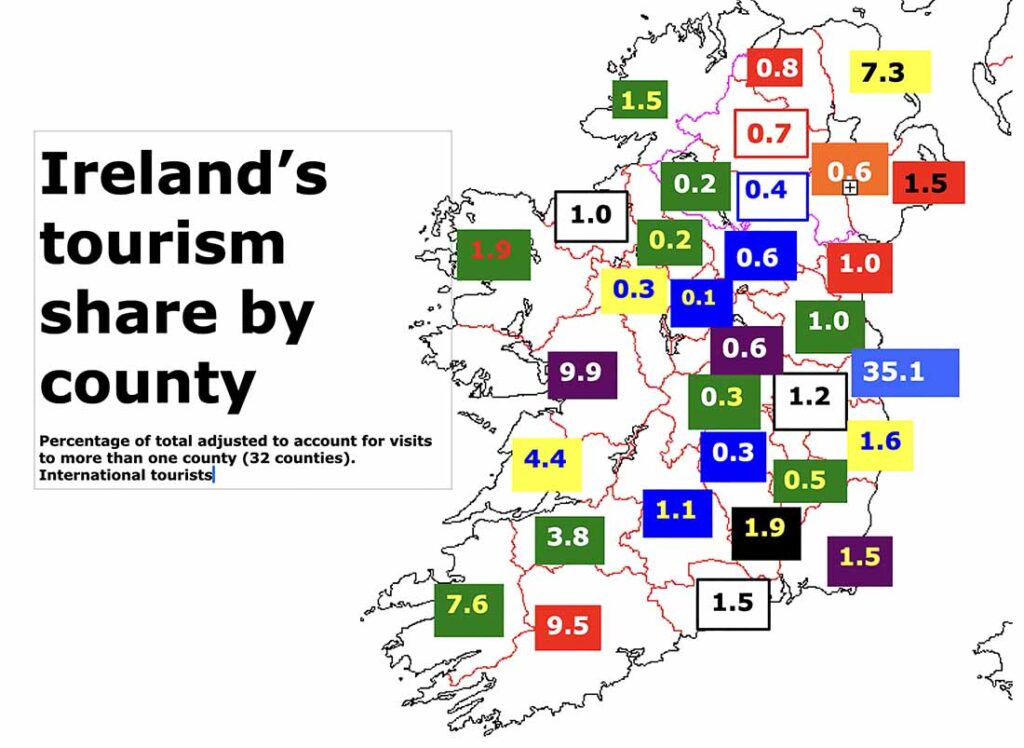
Ireland’s county Laois offers a serene blend of historic sites and natural landscapes, with the Rock of Dunamase providing panoramic views from its ancient castle ruins. Emo Court’s elegant Georgian mansion and gardens offer a peaceful retreat, while the Slieve Bloom Mountains provide hiking trails through rolling hills. Laois is Ireland’s ninth smallest county by size (1,719 square km) and tenth smallest by population (91,877). Population peaked at 153,930 in 1841 and reached its lowest point, 44,595 in 1966. In terms of hospitality, Laois is Ireland’s 27th most visited tourist county with around 52,000 international visitors per year.
Introduction – Adventure – Anthem – Archaeology – Attractions – Awards – Birdwatching – Camping – Castles – Churches – Contact list – Cycling – Dining – Equestrian – Festivals – Fishing – Folklore – Gardens – Golf – Graveyards – Happening – Haunted – Highest – Hiking – History – Holy Wells – Hotels – Hotels top 8 – Hunting & shooting – Instagrammable – Itineraries – Largest town – Luxury – MICE – Movies – Music – Name – New – Novelists – Off the beaten track – Poets – Pubs – Quotes – Random Facts – Restaurant Awards – Sacred Places – Saints – Songs – Spas – Sports – Sunsets – Sustainable – Things to do – Towns – Video – Villages – Walking – Wanderlist – Weddings – Wild swimming – Writers – 1837 – 1846 – 1852 – 1909 – 1955 – 1980 –