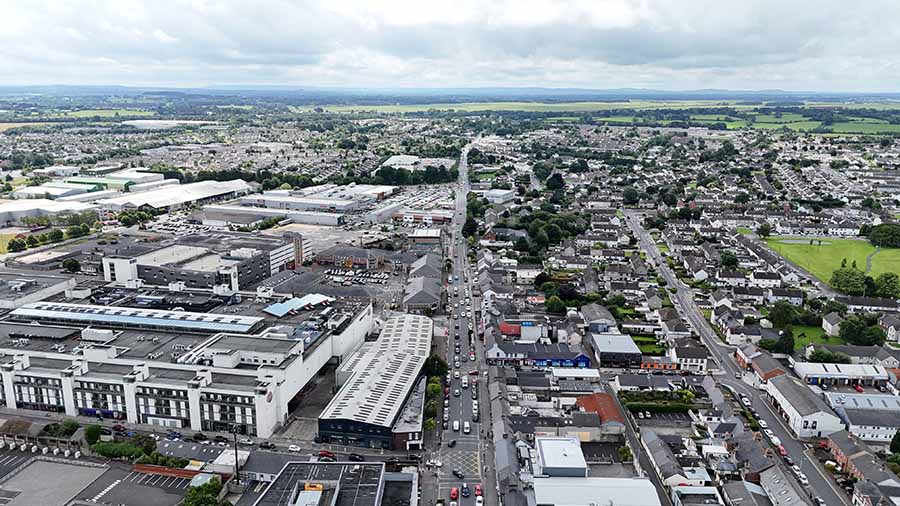
Start your walking tour of Newbridge in Ireland’s county Kildare at the Pfizer roundabout known as Buckley’s Cross. As the town is entered from the Dublin side the motte-and-bailey at Old Connell comes into view built by the Normans in the late 12th century.
Adjoining the motte stand remains of an ancient church and burial ground linked to Saint Conleth a hermit and goldsmith who lived there until Saint Brigid summoned him to become the first Bishop of Kildare patron saint of Newbridge parish. In 519 he set out on pilgrimage to Rome but died killed by wolves in woods near Dunlavin. His remains went to Old Connell later moved to Kildare Cathedral placed in a shrine beside those of Saint Brigid but lost during the Viking sacking of the monastic site in the 9th century. From Buckley’s Cross take Great Connell Road for one mile to a crossroads the lane right once the main highway from Naas to the Curragh now leads to a small graveyard with remnants of an old church all that survives of the magnificent abbey founded in 1202 by Milo FitzHenry grandson of England’s King Henry I.
On his death in 1220 he was buried in its chapter house the abbey suppressed in 1540 after the last prior Walter Wellesley Bishop of Kildare whose remarkable tomb is preserved in Kildare Cathedral. Return to Buckley’s Cross and proceed towards the bridge. When floods demolished the old bridge in 1789 the Duke of Leinster commissioned engineer William Chapman fresh from Grand Canal extension work at Naas to rebuild it downriver at the present location redirecting the high road at Buckley’s Cross to meet the new bridge continuing straight to meet the old road at Gandogue Lane this new road later became Main Street and Edward Street.
As the bridge approaches pass the Holy Family Convent built in Gothic style by architect J.J. O’Callaghan in 1875 next to Saint Conleth’s Parish Church constructed from 1847 to 1852 in early Norman Gothic style taking its present form in 1893 with added transepts doubling its size.
Chapel Lane connected the old and new high roads until the old road closed around 1860 named after the chapel or mass house on the riverbank by the old bridge serving the parish from 1730 until the new church opened in 1852 before which parishioners attended mass at Ballymany but that ancient chapel was demolished by the vicar of Naas claiming it stood too close on the direct road to his church.
The present bridge dates from 1936 modernised in 2006 with walls removed and walkways added on either side replacing a narrower five-arch stone bridge built in 1790 by William Chapman. On the bridge looking upriver appear the Watering Gates used by cavalry from Newbridge Barracks to water horses also site of the first bridge from around 1690 giving the town its name an old gas pipe crosses the river all that remains of the town’s gas works erected in Chapel Lane in 1859 gas lamps replaced by electric lights in 1929 the works closed in 1937.
Looking downriver the view ends with Dominican College. Tradition holds that in 1756 the first friar Father Hugh Reynolds arrived by boat from Athy at the invitation of the parishioners’ and was given three acres of Roseberry Commons forming the friary. The nucleus the commons enclosed soon after the railway crossed in 1845. Three churches stood on the site all dedicated to Saint Eustace. The college admitted its first pupils in 1852 as an all-boys boarding school now open to both sexes.
Up Main Street the entire left side once formed one of the largest cavalry barracks under English rule, built between 1813 to 1818 on land leased from local landowners Eyre Powell of Great Connell and Ponsonby Moore of Moorefield. Demolition began in the 1930s continued through the 1970s.
A county library in art deco style opened August 1936 as did Newbridge Vocational School the following year next to the library the Riverbank Arts Centre now stands on that site. Liffey Terrace built just before the First World War as married soldiers quarters lay inside the barrack wall. The Newbridge or Nowhere mural appears on the wall of the old barrack schoolmaster residence at the entrance to Saint Conleth’s Park the county GAA grounds opened in 1931 previously cricket and parade grounds of the barracks.
The Town Hall built in 1859 as the garrison church for Protestant soldiers until military departure in 1922 first stone laid 30 March 1859 by Lieutenant General Sir James Chatterton commanding officer of the Curragh district behind this church stood main barrack blocks accommodating over one thousand officers and men with stabling for similar number of horses Bord na Móna occupied the central portion of the old barrack site the west side taken by Irish Ropes and Newbridge Cutlery.
The right side of the bridge as far as Moorefield Road formed the commercial heart of the town until recent times houses on Main Street here built over twenty years from 1815 to 1835 on plots leased from Eyre Powell the town consisted of one street until the Curragh Camp opened in 1855 sparking a building boom leading to development of Eyre Street Charlotte Street and Edward Street 1855 to 1870.
From the bridge the first lane is Francis Street formerly Harrigan’s Lane after the one-time proprietor of the Prince of Wales Hotel now the Eyre Powell. Next Thomas Street formerly Ramblers Alley one of the more notorious thoroughfares under English rule, also known as the She Barracks after ladies of easy virtue serving barracks men.
Pass John Street beside Coffey’s pub formerly Lumpert Lane and Anne Street formerly Taylor named after Anne Farrell one-time postmistress of Newbridge and mother of the chairman of the Newbridge Town Commission during street renaming in 1882. Robert Street was formerly Morrigan’s Alley both names referring to businessmen on either side Morgan’s Bakery in existence over sixty years today O’Rourke’s public house next door the Arch Bar from which in 1859 Robert Gough started auctioneering business becoming premier bloodstock auctioneers now headquartered at Kill.
George Street named in honour of England’s King George IV passing through on way to Curragh races on a wet August day in 1821 the view up George Street ended with the fine courthouse erected by Eyre Powell in 1858 burned in 2002 deemed uneconomic to repair and demolished.
Reach the west boundary of the civil parish of Great Connell at Charlotte Street named after Eyre Powell’s sister who succeeded him as landlord on his death in 1871 previously known as the Robberstown Road suggesting importance of the Grand Canal town some two hundred years ago, later Station Road after arrival of the railway in 1846, the name is still in use.
Edward Street was supposedly named after Albert Edward Prince of Wales, wo came to training on the Curragh in 1861 and ghot involved in trouble with local actress Nelly Clifden. He was recalled to London by an irate mother.
The last street Henry Street named after Henry Moore eldest son of Ponsonby Moore succeeding to his father’s estate on death in 1868 here the former Oscar Cinema opened 1908 at Sheridan’s Picture Palace before the Town Hall in 1927 and the Audience Cinema in 1940.
The last house on Edward Street the Crown Hotel opened 1870.It was a favourite with army officers from Curragh Camp later Grand Hotel and Rockingham today Judge Roy Bean’s. Reach Moorefield Road once a row of pretty thatched cottages extending from the Crown Hotel westwards with little gardens in front enclosed by low walls overhung with perfumed roses as described by a traveller in 1855 directly opposite the Lancers Field where cavalry exercised horses later Abbin’s Field. It became Irish Ropes car park in 1972 developed as the Courtyard Shopping Centre in 2000 the British Legion Hall. It stood here from 1922 until late 1960s.
Just beyond Gandogue Lane name perhaps of Irish origin last remnant of the old high road on the border of the infamous Wrens those unfortunate women finding ditches convenient for nests transacting business with barracks troops next door a tollgate stood at entrance to Gandogue until 1848 removed due to competition from newly opened Great Southern and Western Railway.
A little further up Moorefield Road arrive at Poetry Lodge formerly residence of William Bourne holding contract for mail coach service Dublin to Limerick operating toll gates on this route opposite Poetry Lodge Doll’s Hotel now Murphy’s Lodge. The final destination Saint Patrick’s Church of Ireland or Moorefield Church built in 1828 with support of local landlord Ponsonby Moore once standing in rural countryside midway between his domain house and the new town opposite the barracks the church field to the rear, once forested favourite haunt of the Wrens, as the comfort women for the soldiers were affectionately known, and now site of the Crescent and other newer housing developments.
Ireland county by county
Antrim – Armagh – Carlow – Cavan – Clare – Cork – Derry – Donegal – Down – Dublin – Fermanagh – Galway – Kerry – Kildare – Kilkenny – Laois – Leitrim – Limerick – Longford – Louth – Mayo – Meath – Monaghan – Offaly – Roscommon – Sligo – Tipperary – Tyrone – Waterford – Westmeath – Wexford – Wicklow
Largest town walking tour
Antrim – Armagh – Carlow – Cavan – Clare – Cork – Derry – Donegal – Down – Dublin – Fermanagh – Galway – Kerry – Kildare – Kilkenny – Laois – Leitrim – Limerick – Longford – Louth – Mayo – Meath – Monaghan – Offaly – Roscommon – Sligo – Tipperary – Tyrone – Waterford – Westmeath – Wexford – Wicklow
Towns
Antrim – Armagh – Carlow – Cavan – Clare – Cork – Derry – Donegal – Down – Dublin – Fermanagh – Galway – Kerry – Kildare – Kilkenny – Laois – Leitrim – Limerick – Longford – Louth – Mayo – Meath – Monaghan – Offaly – Roscommon – Sligo – Tipperary – Tyrone – Waterford – Westmeath – Wexford – Wicklow
Villages
Antrim – Armagh – Carlow – Cavan – Clare – Cork – Derry – Donegal – Down – Dublin – Fermanagh – Galway – Kerry – Kildare – Kilkenny – Laois – Leitrim – Limerick – Longford – Louth – Mayo – Meath – Monaghan – Offaly – Roscommon – Sligo – Tipperary – Tyrone – Waterford – Westmeath – Wexford – Wicklow
Ireland’s County Kildare:
Introduction – Adventure – Anthem – Archaeology – Attractions – Awards – Birdwatching – Camping – Castles– Churches – Contact list – Cycling – Dining – Equestrian – Festivals – Fishing – Folklore – Gardens – Golf – Graveyards – Happening – Haunted – Highest – Hiking – History – Holy Wells – Hotels – Hotels top 8 – Hunting & shooting – Instagrammable – Itineraries – Largest town – Luxury – MICE – Movies – Music – Name – New – Novelists – Off the beaten track – Poets – Pubs – Quotes – Random Facts – Restaurant Awards – Sacred Places – Saints – Songs – Spas – Sports – Sunsets – Sustainable – Things to do – Towns – Video – Villages – Walking – Wanderlist – Weddings – Wild swimming – Writers – 1837 – 1846 – 1852 – 1909 – 1955 – 1980 –