- Molly Keane (1904-1996) Born in Skrine, Kildare, Keane was a novelist and playwright who often wrote under the pseudonym M.J. Farrell. Her works, such as Good Behaviour (1981), a Booker Prize nominee, satirized Anglo-Irish society and the “Big House” lifestyle. Her novels, including Devoted Ladies (1934) and Time After Time (1983), explore social dynamics with wit and insight, reflecting her Kildare upbringing.
- James Sullivan (1813-1882) Born in Ladytown, near Naas, Sullivan was a journalist and historian who edited the Nation newspaper and wrote historical works like Speeches from the Dock (1867), which documented Irish nationalist oratory. His journalism and books, rooted in Kildare’s political landscape, championed Irish independence and cultural identity.
- Emily Lawless (1845-1913) Born in Lyons House near Ardclough and grand-daughter of a 1798 revolutionary, Lawless was a novelist and poet known for historical novels like Hurrish (1886) and Grania (1892), which depicted Irish rural life and the Land War. Her work, often set in western Ireland, reflected her Kildare Anglo-Irish heritage and explored themes of identity and conflict.
- Lord Edward FitzGerald (1763-1798) Born in Carton House, Maynooth, FitzGerald was a revolutionary and writer whose political pamphlets and letters contributed to the 1798 Rebellion. Though better known as a United Irishman, his writings on Irish liberty and his memoir-like correspondence are significant in Irish literary and historical contexts.
- John O’Donovan (1806-1861) Born in Atateemore, near Kilcullen, O’Donovan was a scholar, historian, and topographer whose works, such as Annals of the Four Masters (1848-51), preserved Irish history and language. His translations and writings on Irish culture, rooted in his Kildare background, were foundational for Irish scholarship.
- Thomas Moore (1779-1852) Born in Dublin but with strong Kildare connections through his family in Prosperous, Moore was a poet, singer, and songwriter famous for Irish Melodies (1808-34), including “The Last Rose of Summer.” His lyrical poetry and ballads, often nostalgic for Ireland, earned him the title of Ireland’s national bard.
- Katharine Tynan (1859-1931) Born in Whitehall, Clondalkin, Tynan was a poet, novelist, and memoirist whose works, like Shamrocks (1887) and Ballads and Lyrics (1891), contributed to the Irish Literary Revival. A friend of W.B. Yeats, her writing often reflected her Catholic faith and Kildare’s rural beauty.
- A.E. (George William Russell) (1867-1935) Born in Lurgan, raised in Dublin, but with significant Kildare connections through his time in Rathfarnham, Russell was a poet, mystic, and editor. His works, like The Divine Vision (1904), blended mysticism with Irish nationalism. He edited the Irish Homestead and influenced the Irish Literary Revival.
- Dermot Bolger (1959-) Born in Finglas, Dublin, but with strong Kildare ties through his family and residence in Maynooth, Bolger is a novelist, playwright, and poet. His works, such as The Journey Home (1990) and A Second Life (1994), explore working-class Irish life and identity, often reflecting Dublin and Kildare settings. He founded Raven Arts Press.
- Teresa Brayton (1868-1943) Born in Kilbrook, near Enfield, Brayton was a poet and nationalist whose poem “The Old Bog Road” became an iconic Irish ballad. Her collections, like Songs of the Dawn (1913), celebrated Irish rural life and emigration, resonating with the Irish diaspora. She later lived in America, promoting Irish culture.
Writers
Antrim – Armagh – Carlow – Cavan – Clare – Cork – Derry – Donegal – Down – Dublin – Fermanagh – Galway – Kerry – Kildare – Kilkenny – Laois – Leitrim – Limerick – Longford – Louth – Mayo – Meath – Monaghan – Offaly – Roscommon – Sligo – Tipperary – Tyrone – Waterford – Westmeath – Wexford – Wicklow
County Kildare:
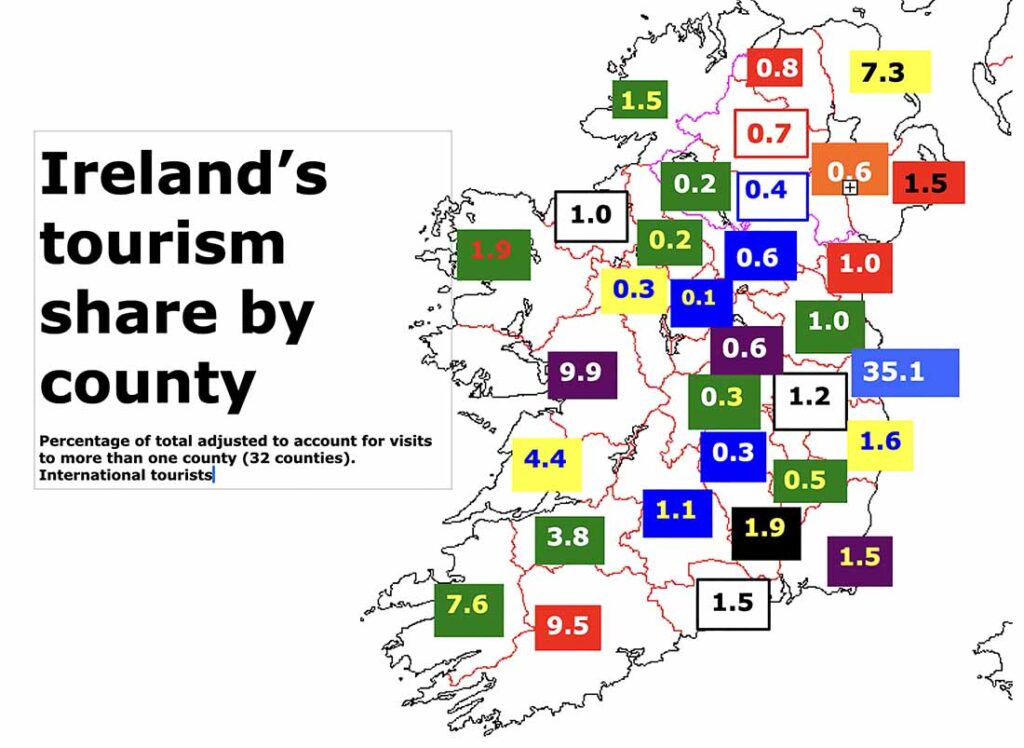
Ireland’s county Kildare blends historic sites with lush countryside, with the National Stud and Japanese Gardens offering a unique mix of equine heritage and serene landscapes. Castletown House, a grand Palladian mansion, provides historical insights, while the Curragh’s open plains are ideal for walking. The ancient Hill of Allen adds archaeological depth, making Kildare an engaging stop for culture and nature. The new Shackleton Experience has opened in Athy. Kildare is Ireland’s eighth smallest county by size (1,694 square km) and seventh largest by population (247,774). Population reached its lowest point, 57,892 in 1936. In terms of hospitality, Kildare is Ireland’s 15th most visited tourist county with around 168,000 international visitors per year.
Introduction – Adventure – Anthem – Archaeology – Attractions – Awards – Birdwatching – Camping – Castles– Churches – Contact list – Cycling – Dining – Equestrian – Festivals – Fishing – Folklore – Gardens – Golf – Graveyards – Happening – Haunted – Highest – Hiking – History – Holy Wells – Hotels – Hotels top 8 – Hunting & shooting – Instagrammable – Itineraries – Largest town – Luxury – MICE – Movies – Music – Name – New – Novelists – Off the beaten track – Poets – Pubs – Quotes – Random Facts – Restaurant Awards – Sacred Places – Saints – Songs – Spas – Sports – Sunsets – Sustainable – Things to do – Towns – Video – Villages – Walking – Wanderlist – Weddings – Wild swimming – Writers – 1837 – 1846 – 1852 – 1909 – 1955 – 1980 –