A maritime county of Ulster, the most northerly in Ireland, bounded on the north and west by the Atlantic Ocean, on the east by the counties of Derry and Tyrone, and on the south by the counties of Tyrone, Fermanagh, and Leitrim. Its greatest length, from Malin Head on the north to Ballyshannon on the south, is about 80 English miles; and its greatest breadth, from Lough Swilly on the east to the vicinity of Gweedore on the west, is about 50 miles. Its area is computed at 1,865,461 acres, or 2,915 square miles; of which about 1,000,000 acres are arable land. Its outline is very irregular, deeply indented by numerous bays, inlets, and loughs; and its surface is diversified with lofty mountains, extensive plains, fertile valleys, large tracts of bog, and numerous lakes.
The principal elevations are the Derryveagh mountains in the centre, including Errigal, rising to 2,466 feet; the Glendowan mountains near Gweedore, attaining an altitude of about 2,000 feet; the Bluestack mountains in the southeast, rising to about 2,200 feet; and several detached groups along the western coast, none of which exceed 2,000 feet. The general aspect of the county is wild and grand; the northern and western districts are mountainous, barren, and in many places desolate; but the eastern and southern districts are in general fertile, well cultivated, and in some places beautifully wooded.The principal rivers are the Foyle, the Swilly, the Finn, the Reelan, the Gweedore, the Gweebarra, the Eske, and the Erne. The Foyle rises in the county of Tyrone, enters Donegal near Lifford, flows northward past Strabane, receives the Mourne from Tyrone, and falls into Lough Foyle. It is navigable for vessels of considerable burden as far as Lifford. The Swilly rises near Letterkenny, flows northward past Letterkenny, expands into Lough Swilly, and discharges itself into the Atlantic. Lough Swilly is navigable for vessels of large burden to Letterkenny. The Finn rises in the Bluestack mountains, flows northward past Ballybofey, and falls into the Foyle near Lifford. The Reelan rises near Glenties, and falls into the Atlantic near Gweebarra. The Gweedore rises in the Derryveagh mountains, and falls into the Atlantic near Gweedore. The Eske rises near Donegal town, and falls into Donegal Bay. The Erne rises in the county of Cavan, enters Donegal near Ballyshannon, expands into Lower Lough Erne, and falls into the Atlantic at Ballyshannon. The county contains numerous lakes, the principal of which are Lough Eske near Donegal, Lough Salt near Milford, Lough Fern near Milford, and several others of smaller size.
The navigation of Lough Foyle, Lough Swilly, and Donegal Bay is of great importance to the trade of the county.The soils are exceedingly various. The eastern and southern districts consist chiefly of a rich loam and clay, well adapted to tillage and pasturage; the central districts are a mixture of clay, loam, and gravel; and the northern and western districts exhibit a strong clay, moorish, and boggy soils, with large tracts of mountain land. Limestone is abundant in the east and southeast; freestone, granite, and slate occur in various parts; marble is found near Ballyshannon; and lead, copper, and silver mines exist in small quantities near Donegal and Ardara. The agriculture is in a backward state compared with the more favoured counties of Leinster and Munster; the farms are in general small, and the system of husbandry rude; but considerable improvement has taken place within the last twenty years, particularly in the eastern districts.
The principal crops are oats, potatoes, barley, wheat, and flax; and large quantities of butter, pork, and kelp are produced for exportation. The linen manufacture, which was formerly extensive, has greatly declined; but frieze, drugget, and coarse woollens are still made to a considerable extent. The fisheries on the northern and western coasts are very productive; and large quantities of cod, ling, haddock, herrings, and salmon are caught and cured for exportation.The population in 1841 was 289,272; of whom 140,845 were males, and 148,427 females; 225,318 were returned as living in rural districts, and 63,954 in towns and villages. The principal towns are Donegal, the county town, Letterkenny, Ballyshannon, Raphoe, Lifford, Milford, Buncrana, Moville, Carndonagh, and Glenties.
The county contains 46 parishes, and parts of 8 others; and is divided into the baronies of Banagh, Boylagh, Inishowen East, Inishowen West, Kilmacrenan, Raphoe, and Tirconnell. The estates are in general small, and much subdivided; but there are several large and well-managed properties. The Grand Jury presentments for 1843 amounted to £24,567 18s. 4d. The assizes are held at Lifford; and quarter-sessions at Lifford, Letterkenny, Ballyshannon, and Donegal. The county returns two members to parliament for the county at large. The ecclesiastical arrangements will be noticed in the next article. The bays and loughs on the coast afford excellent shelter; and in Lough Swilly, Lough Foyle, and Donegal Bay, vessels may ride in safety in almost any weather.
Ireland in 1846
Antrim – Armagh – Carlow – Cavan – Clare – Cork – Derry – Donegal – Down – Dublin – Fermanagh – Galway – Kerry – Kildare – Kilkenny – Laois – Leitrim – Limerick – Longford – Louth – Mayo – Meath – Monaghan – Offaly – Roscommon – Sligo – Tipperary – Tyrone – Waterford – Westmeath – Wexford – Wicklow
County Donegal:
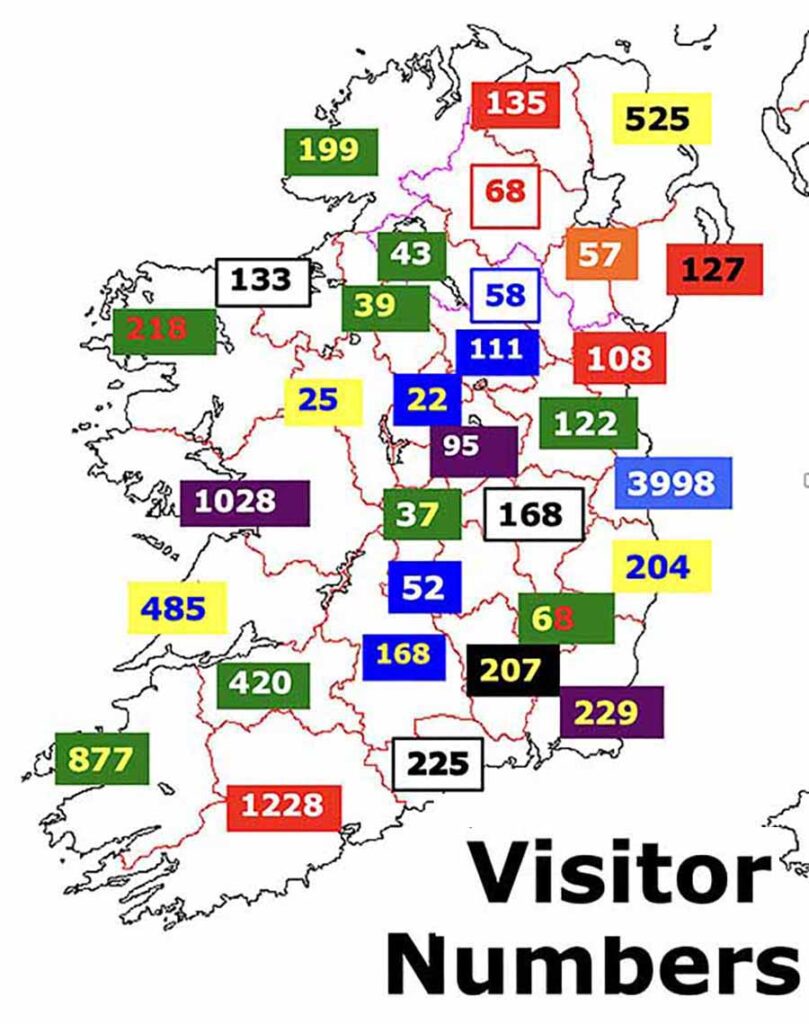
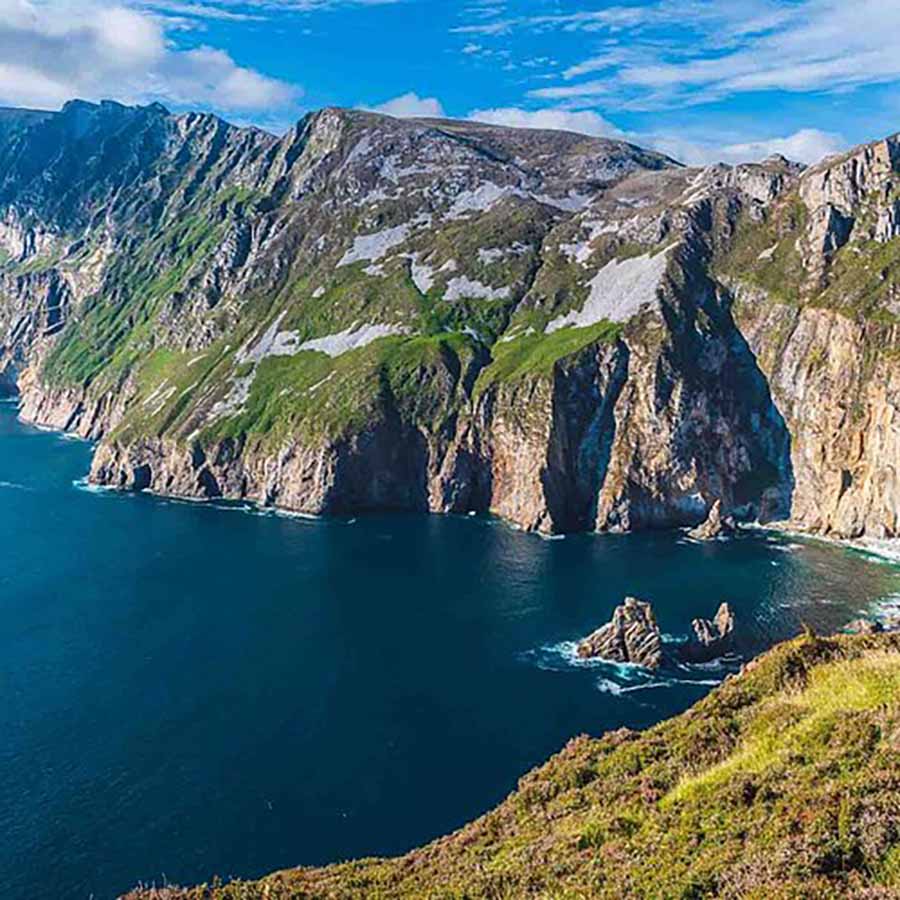
Ireland’s county Donegal is a land of wild coastlines and Gaelic heritage, with Slieve League’s towering sea cliffs offering some of Europe’s highest coastal views. Glenveagh National Park features a historic castle and sprawling gardens amidst rugged mountains. The beaches of Bundoran and the traditional tweed workshops of Ardara make Donegal an engaging destination for nature and cultural enthusiasts. The Grianan of Aileach stone fort adds ancient intrigue and splendid views. Donegal is Ireland’s fourth largest county by size (4,830 square km) and 13th largest by population (167,084). Population peaked at 296,448 in 1841 and reached its lowest point, 108,344 in 1971. In terms of hospitality, Donegal is also Ireland’s 13th most visited tourist county with around 199,000 international visitors per year.
Introduction – Adventure – Anthem – Archaeology – Attractions – Awards – Birdwatching – Camping – Castles – Churches – Contact list – Cycling – Dining – Equestrian – Festivals – Fishing – Folklore – Gardens – Golf – Graveyards – Happening – Haunted – Highest – Hiking – History – Holy Wells – Hotels – Hotels top 8 – Hunting & shooting – Instagrammable – Itineraries – Largest town – Luxury – MICE – Movies – Music – New – Name – Novelists – Off the beaten track – Poets – Pubs – Quotes – Random Facts – Restaurant Awards – Sacred Places – Saints – Songs – Spas – Sports – Sunsets – Sustainable – Things to do – Towns – Video – Villages – Walking – Wanderlist – Weddings – Wild swimming – Writers – 1837 – 1846 – 1852 – 1909 – 1955 – 1980 –