- Donegal Castle: Donegal Castle, situated in the heart of Donegal Town on the River Eske, is a 15th-century fortress built around 1474 by Red Hugh O’Donnell I, leader of the powerful O’Donnell clan, rulers of Tír Conaill. Originally a rectangular keep, it was considered one of Ireland’s finest Gaelic castles. After the 1607 Flight of the Earls, when the O’Donnells fled, the castle was granted to English Captain Sir Basil Brooke, who added a Jacobean manor house wing in 1616, featuring a decorative fireplace and mullioned windows. Restored in the 1990s by the Office of Public Works, it’s now a well-preserved historical site. Open to the public year-round, managed by Heritage Ireland, with guided and self-guided tours available. Visitors can explore the castle’s restored interiors, including the Banqueting Hall, History Room with O’Donnell exhibits, and the unique “Trip Stairs” (uneven spiral steps designed to thwart invaders). The Jacobean wing showcases ornate furnishings, French tapestries, and Persian rugs. Tours, lasting about 45 minutes, cost €5 for adults, €3 for seniors, and €2 for children/students, with informative leaflets provided. The castle’s central location makes it easy to combine with Donegal Town’s shops, pubs, and the nearby Franciscan friary ruins. Accessibility is limited to the ground floor for wheelchair users due to steep stairs. Allow 30-60 minutes for a visit. The castle’s rich history, restored Gothic stonework, and Jacobean features, set against the scenic River Eske, make it a must-visit for history enthusiasts. The staff’s knowledgeable and friendly service enhances the experience. Parking can be tricky; use pay-and-display lots near the visitor center. Check seasonal hours on heritageireland.ie.
- Glenveagh Castle: Glenveagh Castle, located in Glenveagh National Park near Letterkenny, is a 19th-century castellated mansion built between 1867 and 1873 by Captain John George Adair in the Scottish Baronial style. Unlike medieval fortresses, it was a hunting lodge, later owned by Henry McIlhenny, whose decorative arts expertise is evident in its interiors. Surrounded by 16,000 hectares of mountains, lakes, and gardens, it’s a picturesque retreat rather than a defensive structure. Open seasonally (typically March-November), managed by the Office of Public Works, with access via shuttle bus from the visitor center. Visitors take a 4km shuttle bus (€3 return) or walk through the national park to reach the castle. Guided tours (included in admission, ~€7 adults, €5 seniors, €2 children) explore opulent rooms, showcasing Victorian decor and McIlhenny’s art collection. The 27-acre gardens, including walled and Victorian designs, are a highlight, with vibrant blooms and scenic lake views. A tea room and gift shop are available at the castle, though the visitor center’s café has limited staffing. Allow 2-3 hours for the castle, gardens, and park trails. The park offers hiking, cycling, and wildlife spotting. The castle’s fairy-tale architecture, stunning parkland, and meticulously curated gardens make it ideal for nature lovers and those seeking a romantic historical experience. Staff, including shuttle drivers and gardeners, are noted for their warmth. The shuttle is recommended for those with mobility issues, as the walk is lengthy. Check tide times for garden visits, as some areas are tide-dependent.
- Doe Castle: Doe Castle, perched on Sheephaven Bay near Creeslough, is a 15th-century tower house built in the 1440s by the MacSweeney clan, Scottish mercenaries who settled in Donegal. Surrounded by water on three sides and a rock-cut moat, it was a strategic stronghold, reportedly sheltering Spanish Armada survivors. Its rectangular keep and bawn (defensive wall) remain intact, offering a glimpse into medieval life. Open daily with free admission to the grounds; guided tours of the tower are available in summer (check heritageireland.ie for schedules). Visitors can explore the castle’s exterior and grounds year-round, enjoying its dramatic coastal setting. Summer tours (~€5) provide access to the tower’s interiors, highlighting MacSweeney history and architectural features like gun loops and arched ceilings. The site lacks formal facilities, so bring water and snacks. The nearby village of Creeslough offers dining options. Allow 1 hour for a visit, longer if combining with coastal walks or the Wild Atlantic Way. The castle’s secluded, scenic location and historical significance make it a hidden gem for those interested in Gaelic and maritime history. The gate arch and bay views are particularly photogenic. Check tide times, as high tides enhance the bay’s beauty. Summer tours require booking due to limited availability.
- Carrickabraghy Castle: Carrickabraghy Castle, located on a rocky outcrop on the Isle of Doagh in the Inishowen Peninsula, is a 16th-century ruin built by the O’Doherty clan. Positioned to guard Trawbreaga Bay, it offers sweeping views of Malin Head and Fanad Head. Once a key defensive site, it was abandoned by 1665 and partially conserved in 2013 with local funding. Its rugged setting along the Wild Atlantic Way adds to its allure. Open to the public with free access, though it’s a ruin on a remote site with no formal facilities. Visitors can reach the castle via the “Causeway to the Castle” walking route, accessible at low tide. The ruins, including remnants of walls and towers, evoke the O’Doherty clan’s legacy. The site offers stunning coastal views, ideal for photography and hiking enthusiasts. No guided tours or amenities are available, so visits are self-guided. Allow 30-60 minutes, ideally combined with the nearby Doagh Famine Village. The castle’s dramatic promontory, panoramic views, and connection to Inishowen’s history make it a rewarding stop for adventurers and those exploring the Wild Atlantic Way. Tide times are critical for access; check local schedules. Wear sturdy shoes for the rocky terrain.
- Lough Eske Castle: Lough Eske Castle, near Donegal Town, is a 15th-century castle with O’Donnell clan ties, rebuilt in the 19th century as a Tudor-Baronial mansion. Now a 5-star hotel, it’s set on 43 acres of woodland with views of the Bluestack Mountains. Unlike traditional castles, it emphasizes luxury over defense, with award-winning spa and dining facilities. Operates as a luxury hotel, open to guests and non-guests for dining, spa visits, or afternoon tea. Visitors can book stays in elegant rooms or suites, dine at Cedars Restaurant (noted for culinary excellence), or enjoy spa treatments at the award-winning Cara Organic Spa. Non-guests can explore the grounds, featuring native woodlands and Lough Eske’s shores, or partake in afternoon tea (~€40/person). Historical tours may be available upon request, focusing on the castle’s O’Donnell roots and 19th-century restoration. Activities include cycling, fishing, and hiking. Expect a 2-3 hour visit for dining or grounds exploration, longer for overnight stays. The castle’s blend of historical charm and modern luxury, coupled with its scenic setting, appeals to those seeking a high-end experience. The spa and dining are standout features. Reservations are essential for dining or spa visits; check lougheskecastlehotel.com for availability and pricing.
Visiting
- Access and Facilities: Donegal Castle and Glenveagh Castle offer the most developed visitor experiences, with tours, tickets, and amenities. Doe Castle and Carrickabraghy Castle are more remote, with minimal facilities, appealing to those seeking authentic ruins. Lough Eske Castle provides a luxury hotel experience, accessible to non-guests for specific activities.
- Donegal’s castles reflect Gaelic (Donegal, Doe, Carrickabraghy), Plantation (Donegal’s Jacobean wing), and Victorian (Glenveagh, Lough Eske) influences, showcasing the county’s layered history from the O’Donnell era to English rule and beyond.
- Activities: Combine castle visits with Donegal’s attractions, such as Slieve League cliffs, Malin Head, or the Wild Atlantic Way. Donegal Town’s pubs and craft village enhance a visit to Donegal Castle, while Glenveagh National Park offers extensive outdoor activities.
- Practical Tips: Check opening hours for Donegal and Glenveagh Castles, as they vary seasonally (heritageireland.ie). Tide times are crucial for Doe and Carrickabraghy. Book Lough Eske services in advance. Wear weather-appropriate clothing and sturdy shoes for ruins and park visits. Visit www.donegaltourism.ie for planning resources.
Castles
Antrim – Armagh – Carlow – Cavan – Clare – Cork – Derry – Donegal – Down – Dublin – Fermanagh – Galway – Kerry – Kildare – Kilkenny – Laois – Leitrim – Limerick – Longford – Louth – Mayo – Meath – Monaghan – Offaly – Roscommon – Sligo – Tipperary – Tyrone – Waterford – Westmeath – Wexford – Wicklow
County Donegal:
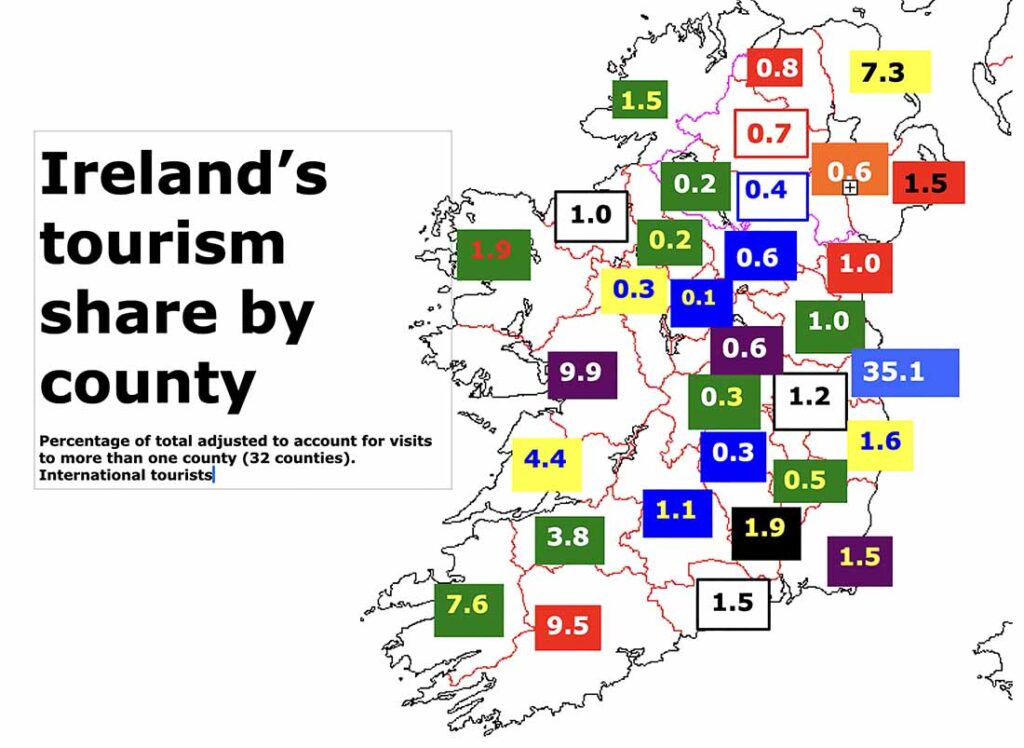
Ireland’s county Donegal is a land of wild coastlines and Gaelic heritage, with Slieve League’s towering sea cliffs offering some of Europe’s highest coastal views. Glenveagh National Park features a historic castle and sprawling gardens amidst rugged mountains. The beaches of Bundoran and the traditional tweed workshops of Ardara make Donegal an engaging destination for nature and cultural enthusiasts. The Grianan of Aileach stone fort adds ancient intrigue and splendid views. Donegal is Ireland’s fourth largest county by size (4,830 square km) and 13th largest by population (167,084). Population peaked at 296,448 in 1841 and reached its lowest point, 108,344 in 1971. In terms of hospitality, Donegal is also Ireland’s 13th most visited tourist county with around 199,000 international visitors per year.
Introduction – Adventure – Anthem – Archaeology – Attractions – Awards – Birdwatching – Camping – Castles – Churches – Contact list – Cycling – Dining – Equestrian – Festivals – Fishing – Folklore – Gardens – Golf – Graveyards – Happening – Haunted – Highest – Hiking – History – Holy Wells – Hotels – Hotels top 8 – Hunting & shooting – Instagrammable – Itineraries – Largest town – Luxury – MICE – Movies – Music – New – Name – Novelists – Off the beaten track – Poets – Pubs – Quotes – Random Facts – Restaurant Awards – Sacred Places – Saints – Songs – Spas – Sports – Sunsets – Sustainable – Things to do – Towns – Video – Villages – Walking – Wanderlist – Weddings – Wild swimming – Writers – 1837 – 1846 – 1852 – 1909 – 1955 – 1980 –