- William Allingham (1824-1889) A poet born in Ballyshannon, Allingham is best known for his poem The Fairies (“Up the airy mountain, Down the rushy glen…”), which gained fame through its use in Willy Wonka and the Chocolate Factory. His lyrical works often drew on Donegal’s landscapes and folklore. He worked as a customs officer and later moved to London, where he edited Fraser’s Magazine and published poetry collections like Day and Night Songs (1854). His ashes were interred in Ballyshannon.
- Brian Friel (1929-2015) A renowned dramatist and short story writer born in Killyclogher, near Omagh, but raised in Donegal. Friel is celebrated for plays like Dancing at Lughnasa (1990) and Translations (1980), which explore Irish identity, language, and history. He co-founded the Field Day Theatre Company and is considered one of Ireland’s greatest playwrights. His Donegal upbringing, especially in Glenties, deeply influenced his work.
- Frank McGuinness (1953-) A playwright, poet, and novelist born in Buncrana, McGuinness is known for plays such as Observe the Sons of Ulster Marching Towards the Somme (1985) and Someone Who’ll Watch Over Me (1992), which address themes of conflict and identity. He has also translated classics by Ibsen and Sophocles and published poetry collections. McGuinness is a Professor of Creative Writing at University College Dublin.
- Seamus Deane (1940-2021) A poet, novelist, and critic born in Derry but with strong Donegal connections through family and residence in Buncrana. Deane’s novel Reading in the Dark (1996) is a semi-autobiographical work set in Derry and Donegal, exploring the Troubles and family secrets. A key figure in Irish literary criticism, he co-founded the Field Day Theatre Company with Brian Friel and published poetry collections like Gradual Wars (1972).
- Patrick MacGill (1889-1963) Known as the “Navvy Poet,” MacGill was born in Glenties and wrote about the lives of Irish laborers in Scotland and England. His works include the novel Children of the Dead End (1914) and poetry collections like Songs of the Dead End (1912). His autobiographical writings vividly depict the struggles of migrant workers and his Donegal roots.
- Micí Mac Gabhann (1865-1948) A seanchaí (traditional storyteller) and memoirist born in Cloughaneely, Mac Gabhann is best known for his memoir Rotha Mór an tSaoil (The Hard Road to Klondike), which recounts his adventures during the Klondike Gold Rush. Written in Irish, it was dictated to his son and published posthumously, offering a unique perspective on Donegal’s Gaeltacht culture.
- John Kells Ingram (1823-1907) A poet, economist, and scholar born near Killygordon, Ingram is best known for his patriotic poem The Memory of the Dead (1843), often called “Who Fears to Speak of ‘98?” about the 1798 Rebellion. A professor at Trinity College Dublin, he also wrote on economics and history, blending intellectual rigor with Irish nationalism.
- Peadar O’Donnell (1893-1986) A novelist and socialist born in Dungloe, O’Donnell wrote works like Islanders (1927) and Adrigoole (1929), which depict the harsh realities of rural Donegal life. A committed republican and social activist, he edited The Bell magazine with Sean O’Faolain and infused his writing with themes of social justice and Irish identity.
- Cahir Healy (1877-1970) A journalist and nationalist politician born near Mountcharles, Healy wrote extensively for newspapers and published works on Irish history and politics. While better known as a politician, his journalistic output, including articles on Irish nationalism, contributed to Donegal’s literary and political discourse.
- Frank Hugh O’Donnell (1848-1916) A journalist, politician, and writer born in Donegal town, O’Donnell wrote political pamphlets and historical works, including A History of the Irish Parliamentary Party (1910). His journalism in London and Dublin focused on Irish home rule and cultural identity, reflecting his Donegal background and nationalist views.
Writers
Antrim – Armagh – Carlow – Cavan – Clare – Cork – Derry – Donegal – Down – Dublin – Fermanagh – Galway – Kerry – Kildare – Kilkenny – Laois – Leitrim – Limerick – Longford – Louth – Mayo – Meath – Monaghan – Offaly – Roscommon – Sligo – Tipperary – Tyrone – Waterford – Westmeath – Wexford – Wicklow
County Donegal:
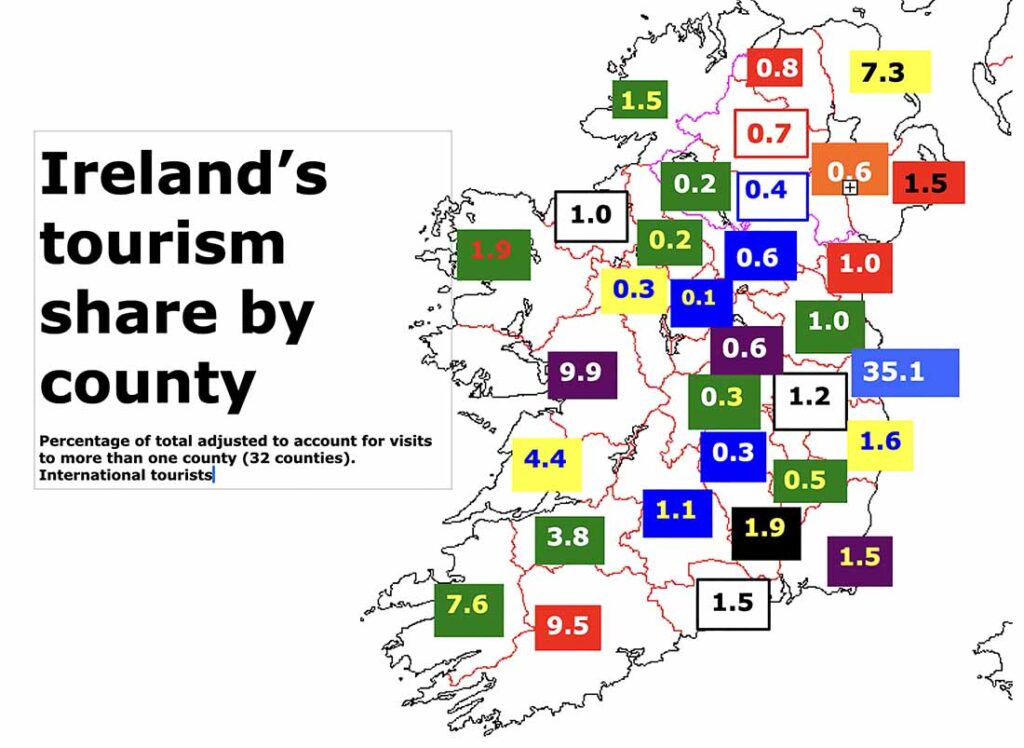
Ireland’s county Donegal is a land of wild coastlines and Gaelic heritage, with Slieve League’s towering sea cliffs offering some of Europe’s highest coastal views. Glenveagh National Park features a historic castle and sprawling gardens amidst rugged mountains. The beaches of Bundoran and the traditional tweed workshops of Ardara make Donegal an engaging destination for nature and cultural enthusiasts. The Grianan of Aileach stone fort adds ancient intrigue and splendid views. Donegal is Ireland’s fourth largest county by size (4,830 square km) and 13th largest by population (167,084). Population peaked at 296,448 in 1841 and reached its lowest point, 108,344 in 1971. In terms of hospitality, Donegal is also Ireland’s 13th most visited tourist county with around 199,000 international visitors per year.
Introduction – Adventure – Anthem – Archaeology – Attractions – Awards – Birdwatching – Camping – Castles – Churches – Contact list – Cycling – Dining – Equestrian – Festivals – Fishing – Folklore – Gardens – Golf – Graveyards – Happening – Haunted – Highest – Hiking – History – Holy Wells – Hotels – Hotels top 8 – Hunting & shooting – Instagrammable – Itineraries – Largest town – Luxury – MICE – Movies – Music – New – Name – Novelists – Off the beaten track – Poets – Pubs – Quotes – Random Facts – Restaurant Awards – Sacred Places – Saints – Songs – Spas – Sports – Sunsets – Sustainable – Things to do – Towns – Video – Villages – Walking – Wanderlist – Weddings – Wild swimming – Writers – 1837 – 1846 – 1852 – 1909 – 1955 – 1980 –