KILDARE, a county of the province of Leinster, is bounded, on the north, by Meath and Westmeath; on the east, by Dublin and Wicklow; on the south, by Carlow and Laois; and on the west, by Offaly and Laois. Its greatest length, from north-east to south-west, is about 36 miles; its greatest breadth, from east to west, is about 24 miles; and its area is 595,279 statute acres, or about 930 square miles, of which about 450,000 acres are arable, 100,000 uncultivated (chiefly bog), 10,000 planted, and the rest towns, villages, roads, and water.
POPULATION, In 1831, 99,065; in 1841, 114,488, showing an increase of 15,423, or about 15.6 per cent. Houses in 1841, 18,922. Families chiefly employed in agriculture, 14,922; in manufactures and trade, 2,922; in other pursuits, 1,922. Families dependent chiefly on property and professions, 922; on the direction of labour, 6,922; on their own manual labour, 10,922; on means not specified, a small number.
The county is divided into 9 baronies: Allen, Carbury, Clane, Connell, East Offaly, Ikeathy and Oughterany, Kilcock, Kilcullen, Naas North, Naas South, Narragh and Reban East, Narragh and Reban West, North Salt, South Salt, and Upper Kells (wait, standard 9: Carbury, Clane, Connell, Ikeathy, Kilcullen, Naas North, Naas South, Offaly East, Offaly West). It contains 115 civil parishes, and parts of others; 1,922 townlands and parts. Poor Law Unions: Athy (part), Edenderry (part), Naas, Newbridge. The Poor-Law valuation is £284,922.
SURFACE AND TOPOGRAPHY, The surface is an undulating champaign, generally level or gently diversified with low hills and shallow valleys; the mean elevation above sea-level is about 200 feet; the highest grounds are the Hill of Allen (about 670 feet), Cupidstown Hill (1,248 feet), and some eminences in the south-west not exceeding 1,300 feet. The north-west and central districts contain extensive tracts of bog (the Bog of Allen, extending into Offaly, covers a large area, with sub-divisions such as Lullymore, Rathangan, etc.); the east and south-east are more elevated and dry; the Curragh is a celebrated plain of about 4,000 acres, firm greensward, used for military camps, races, and training. The county is well-watered, but has no large lakes; small loughs and canal reservoirs occur.
RIVERS AND CANALS, The chief rivers are the Liffey (rises in the Wicklow Mountains, but traverses the county eastward, forming part of the northern boundary, navigable in parts); the Barrow (forms the south-western and southern boundary, navigable from Athy to the sea); the Boyne (rises near Carbury, flows northward); smaller streams: the Rye Water, Greese, Morrel, Finnery, etc. The Grand Canal traverses the county from east to west, with branches to Naas and to Athy; the Royal Canal skirts the northern border. These afford excellent means of conveyance for agricultural produce to Dublin.
SOIL AND AGRICULTURE, The soil is generally fertile: deep rich loam in the centre and east; light sandy loam in the south-east (good for grain); strong clayey in the west and north (adapted for pasture and potatoes); gravelly and limestone-based in many districts. Limestone abounds, affording excellent manure; freestone, granite (south-east), trap-rock (hills). Crops: wheat, barley, oats (chief), potatoes, turnips (increasing), flax (limited). Pasture supports superior dairy cattle; butter of high quality produced; cheese formerly made but now rare. Farms mostly small to medium; husbandry improving, with better rotation, liming, and green crops; drainage needed in boggy tracts. Reclamation of bog progressing slowly.
CLIMATE, Mild and moist; more humid than average inland county; rainfall moderate; salubrious, free from extremes.
MINERALS, Limestone chief; building stone; some granite, trap, schist; no coal or metals worked to extent.
TRADE AND MANUFACTURES, Chiefly agricultural; trade at Naas, Athy, Newbridge (grain, butter, live stock to Dublin); minor manufactures: coarse linen, woollens, brewing, distilling.
TOWNS, Naas (county town, assize and market town, pop. about 3,800); Athy (market town on Barrow, pop. about 4,000); Newbridge (military depot, pop. about 2,500); Maynooth (Royal College of Maynooth, pop. about 1,800); Kildare (ancient ecclesiastical town, pop. about 2,000); Kilcock, Celbridge, Leixlip, Kilcullen, Monasterevin, Clane, etc.
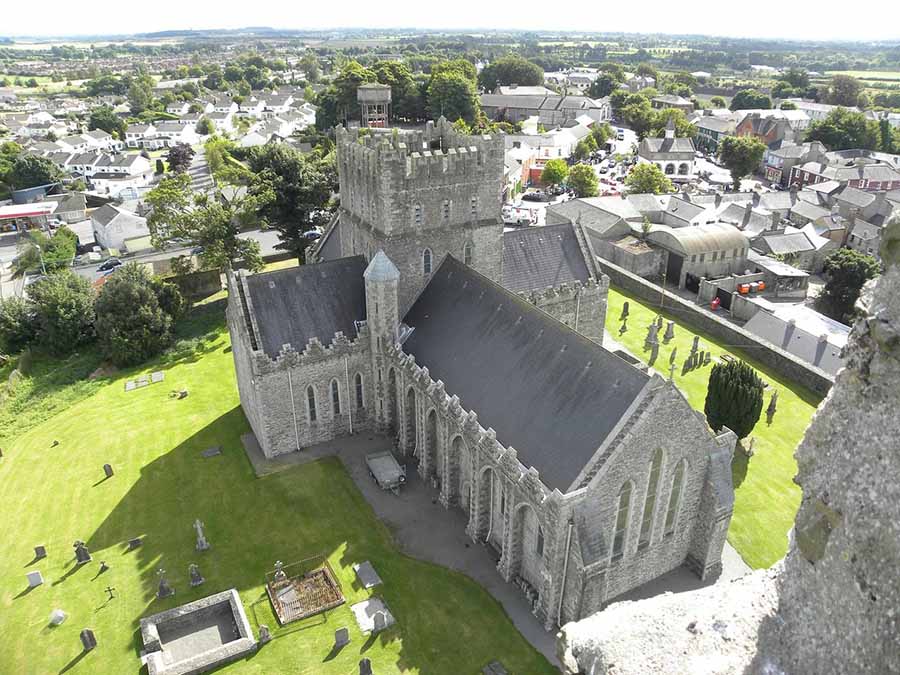
ECCLESIASTICAL, Diocese of Kildare and Leighlin (Roman Catholic); united sees of Dublin, Kildare, and Glendalough (Protestant, but Kildare bishopric suppressed). Cathedral ruins at Kildare; numerous Roman Catholic chapels; Protestant churches in principal towns. Tithes commuted.ANTIQUITIES, Very numerous: round tower at Kildare (112 feet high, near cathedral ruins founded by St. Brigid); fire-house or chapel of St. Brigid; Franciscan abbey ruins; castles (Naas, Athy, Woodstock, Kilkea, Carlow border); raths, moats, cromlechs; ancient churches at Castledermot, Timolin, Moone (high cross); Curragh earthworks and camps.
Ireland in 1846
Antrim – Armagh – Carlow – Cavan – Clare – Cork – Derry – Donegal – Down – Dublin – Fermanagh – Galway – Kerry – Kildare – Kilkenny – Laois – Leitrim – Limerick – Longford – Louth – Mayo – Meath – Monaghan – Offaly – Roscommon – Sligo – Tipperary – Tyrone – Waterford – Westmeath – Wexford – Wicklow
County Kildare:
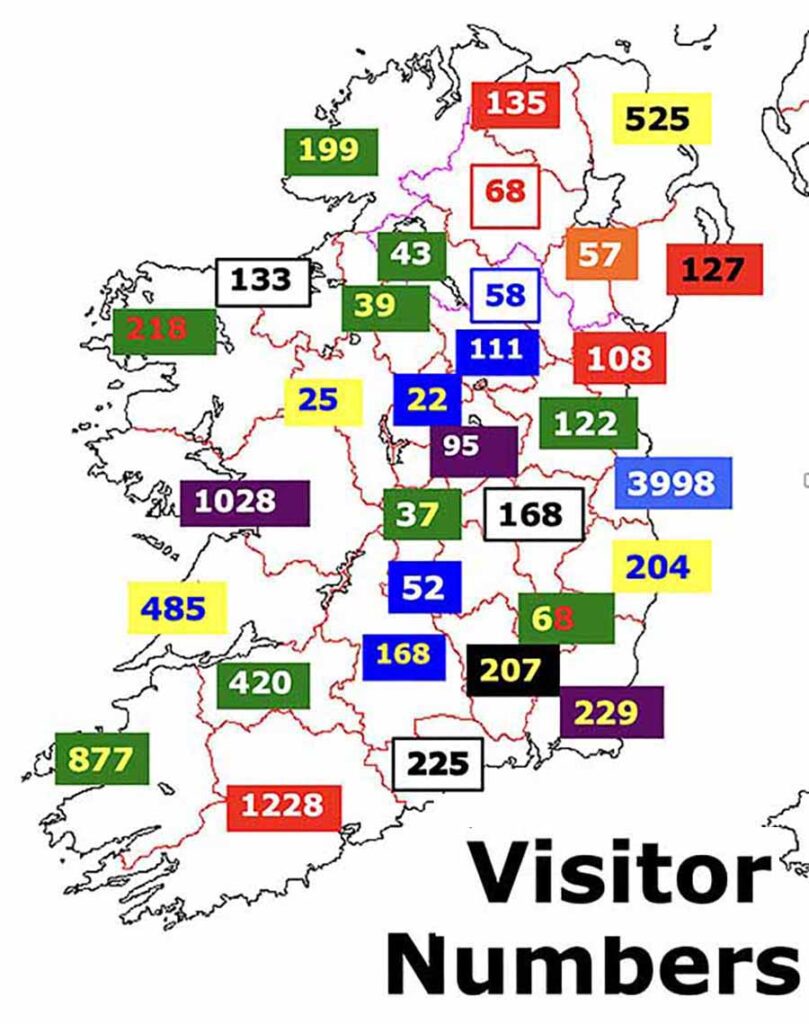
Ireland’s county Kildare blends historic sites with lush countryside, with the National Stud and Japanese Gardens offering a unique mix of equine heritage and serene landscapes. Castletown House, a grand Palladian mansion, provides historical insights, while the Curragh’s open plains are ideal for walking. The ancient Hill of Allen adds archaeological depth, making Kildare an engaging stop for culture and nature. The new Shackleton Experience has opened in Athy. Kildare is Ireland’s eighth smallest county by size (1,694 square km) and seventh largest by population (247,774). Population reached its lowest point, 57,892 in 1936. In terms of hospitality, Kildare is Ireland’s 15th most visited tourist county with around 168,000 international visitors per year.
Introduction – Adventure – Anthem – Archaeology – Attractions – Awards – Birdwatching – Camping – Castles– Churches – Contact list – Cycling – Dining – Equestrian – Festivals – Fishing – Folklore – Gardens – Golf – Graveyards – Happening – Haunted – Highest – Hiking – History – Holy Wells – Hotels – Hotels top 8 – Hunting & shooting – Instagrammable – Itineraries – Largest town – Luxury – MICE – Movies – Music – Name – New – Novelists – Off the beaten track – Poets – Pubs – Quotes – Random Facts – Restaurant Awards – Sacred Places – Saints – Songs – Spas – Sports – Sunsets – Sustainable – Things to do – Towns – Video – Villages – Walking – Wanderlist – Weddings – Wild swimming – Writers – 1837 – 1846 – 1852 – 1909 – 1955 – 1980 –