An inland county of the province of Leinster, is bounded, on the north, by Offaly; on the east, by Kildare and Carlow; on the south, by Carlow and Kilkenny; and on the west, by Tipperary and Offaly. Its greatest length, from north to south, is about 32 miles; its greatest breadth, from east to west, is about 28 miles; and its area is 432,844 statute acres, or about 676 square miles, of which about 320,000 acres are arable, 60,000 bog and waste, 20,000 woodland, and the rest towns, villages, roads, and water.
POPULATION, In 1831, 103,234; in 1841, 108,890, showing an increase of 5,656, or about 5.5 per cent. Houses in 1841, 17,922. Families chiefly employed in agriculture, 14,000; in manufactures and trade, 2,500; in other pursuits, 1,422. Families dependent chiefly on property and professions, 800; on the direction of labour, 5,500; on their own manual labour, 10,500; on means not specified, small number.
The county is divided into 8 baronies: Ballyadams, Clandonagh, Clarmallagh, Cullenagh, Maryborough East, Maryborough West, Slievemargue, and Stradbally. It contains 46 civil parishes, and parts of others; about 800 townlands. Poor Law Unions: Abbeyleix, Athy (part), Carlow (part), Mountmellick. The Poor-Law valuation is about £180,000 to £200,000.
SURFACE AND TOPOGRAPHY, The surface is chiefly level or gently undulating champaign, part of the great central limestone plain of Ireland; diversified with low hills, ridges, and isolated eminences; mean elevation about 250 feet above sea-level. The principal elevations are the Slieve Bloom Mountains (on the north-west border, rising to 1,730 feet in Arderin), the Dysart Hills, the Ridge of Maryborough, and some detached hills in the south. Extensive bogs occur, especially in the north and centre (part of the great Bog of Allen extends into it); limestone prevails generally; good building stone, freestone, and some granite.
RIVERS AND CANALS, The chief rivers are the Barrow (forms much of the eastern and southern boundary, navigable from Athy); the Nore (traverses the south-east, navigable in lower parts); the Owenass, Owenbeg, Whitehorse, Triogue, and smaller streams. The Grand Canal passes through the north, with a branch to Mountmellick; affords communication to Dublin for agricultural produce.
SOIL AND AGRICULTURE, The soil is generally fertile: rich limestone loam in the centre and east; strong clay in parts; lighter sandy loam in south; bog in low tracts. Limestone abundant for manure. Crops: oats (principal), barley, wheat, potatoes, turnips (increasing), flax (small quantity). Pasture good for cattle and sheep; dairy produce fair; tillage improving with better rotations and liming. Farms mostly small; husbandry advancing, though backward in mountainous districts.
CLIMATE, Mild, moist, equable; rainfall moderate for inland; salubrious, no extremes.
MINERALS, Limestone chief; freestone, granite, some coal seams (not worked extensively); ironstone traces.
TRADE AND MANUFACTURES, Chiefly agricultural; trade at Portlaoise, Mountmellick, Stradbally, Portarlington (grain, butter, cattle to Dublin). Manufactures limited: coarse linen, woollens, brewing, distilling, malt.
TOWNS, Portlaoise (county town, market and assize town, pop. about 3,500); Mountmellick (manufacturing, pop. about 3,000); Stradbally (pop. about 2,000); Portarlington (pop. about 2,500); Abbeyleix, Ballinakill, Rathdowney, Mountrath, etc.
ECCLESIASTICAL, Diocese of Leighlin (Roman Catholic, united with Kildare); part of Ossory; Protestant diocese of Leighlin and Ferns. Numerous Roman Catholic chapels; Protestant churches in towns. Tithes commuted.
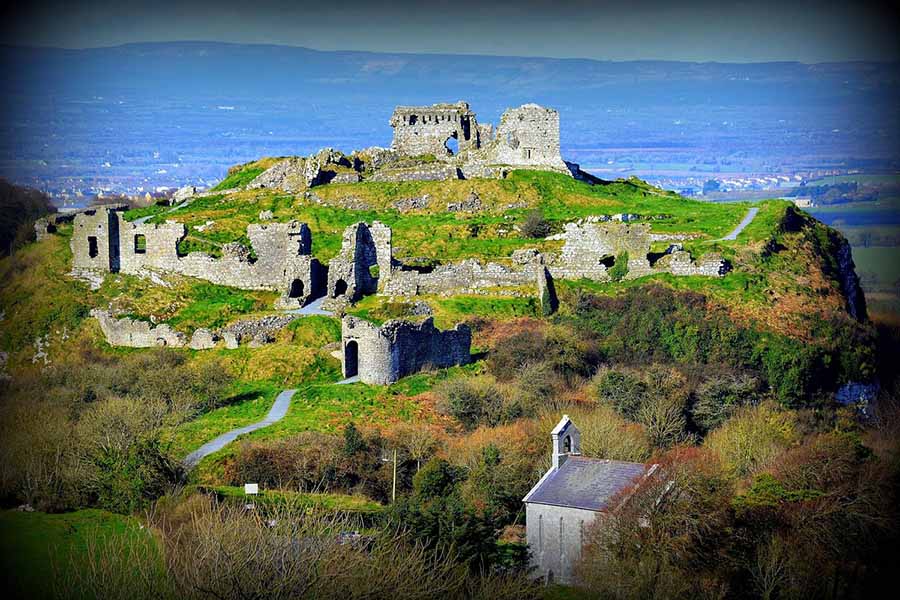
ANTIQUITIES, Numerous: castles (Rock of Dunamase, important ruins; Timahoe round tower and church; castles at Ballyadams, Clonkeen, etc.); raths, moats, cromlechs; ancient abbeys and churches (Timahoe, Clonenagh, etc.); high crosses in parts.
Ireland in 1846
Antrim – Armagh – Carlow – Cavan – Clare – Cork – Derry – Donegal – Down – Dublin – Fermanagh – Galway – Kerry – Kildare – Kilkenny – Laois – Leitrim – Limerick – Longford – Louth – Mayo – Meath – Monaghan – Offaly – Roscommon – Sligo – Tipperary – Tyrone – Waterford – Westmeath – Wexford – Wicklow
County Laois:
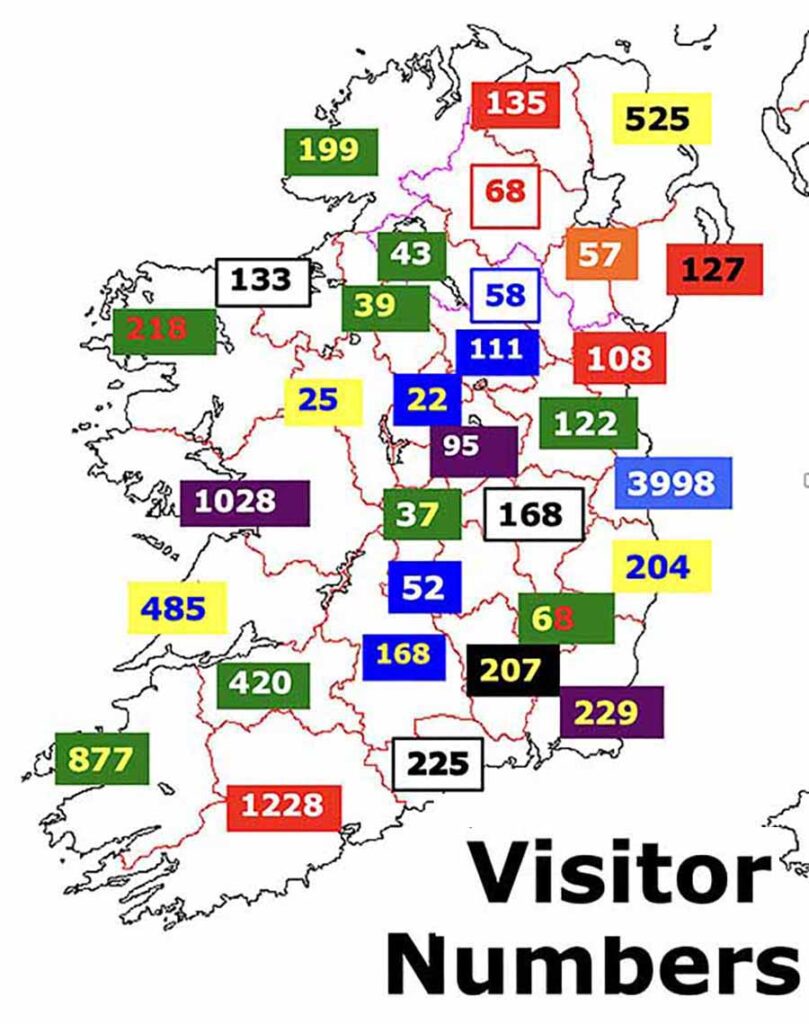
Ireland’s county Laois offers a serene blend of historic sites and natural landscapes, with the Rock of Dunamase providing panoramic views from its ancient castle ruins. Emo Court’s elegant Georgian mansion and gardens offer a peaceful retreat, while the Slieve Bloom Mountains provide hiking trails through rolling hills. Laois is Ireland’s ninth smallest county by size (1,719 square km) and tenth smallest by population (91,877). Population peaked at 153,930 in 1841 and reached its lowest point, 44,595 in 1966. In terms of hospitality, Laois is Ireland’s 27th most visited tourist county with around 52,000 international visitors per year.
Introduction – Adventure – Anthem – Archaeology – Attractions – Awards – Birdwatching – Camping – Castles – Churches – Contact list – Cycling – Dining – Equestrian – Festivals – Fishing – Folklore – Gardens – Golf – Graveyards – Happening – Haunted – Highest – Hiking – History – Holy Wells – Hotels – Hotels top 8 – Hunting & shooting – Instagrammable – Itineraries – Largest town – Luxury – MICE – Movies – Music – Name – New – Novelists – Off the beaten track – Poets – Pubs – Quotes – Random Facts – Restaurant Awards – Sacred Places – Saints – Songs – Spas – Sports – Sunsets – Sustainable – Things to do – Towns – Video – Villages – Walking – Wanderlist – Weddings – Wild swimming – Writers – 1837 – 1846 – 1852 – 1909 – 1955 – 1980 –