- Aughrim Castle and the Soldier’s Ghost: Aughrim Castle is haunted by a spectral soldier, seen wandering the ruins, believed to be a casualty of the 1691 Battle of Aughrim. The castle was a focal point in the Williamite War. Dúchas.ie mentions ghostly warriors tied to Aughrim’s violent history. Aughrim, County Galway.
- Ballinasloe and the Ghostly Horseman: Ballinasloe’s roads are haunted by a ghostly horseman, believed to be a soldier killed in a 17th-century battle, seeking his lost home. The area saw conflicts during the Williamite War. Dúchas.ie records tales of spectral riders tied to Ballinasloe’s turbulent past. Ballinasloe, County Galway.
- Clifden and the Phantom Ship: Clifden’s coast is haunted by a ghostly ship, crewed by spectral sailors, believed to be a cursed vessel lost in a storm. Connemara’s maritime history includes shipwrecks. Dúchas.ie notes tales of phantom ships tied to Clifden’s coastal tragedies. Clifden, County Galway.
- Dunguaire Castle and the Phantom Coach: Dunguaire Castle is haunted by a ghostly horse-drawn coach, driven by a spectral figure, believed to be a cursed O’Hynes clan member. The 16th-century tower house was an O’Hynes stronghold. Dúchas.ie includes tales of phantom coaches tied to its aristocratic past. Dunguaire Castle, near Kinvara, County Galway.
- Galway Bay and the Drowned Fisherman: Galway Bay’s shores are haunted by a drowned fisherman, whose ghostly moans and wet footsteps are heard during storms. The bay’s fishing communities faced frequent sea tragedies. Dúchas.ie includes tales of spectral fishermen tied to Galway’s maritime history. Galway Bay, near Galway city, County Galway.
- Inishmore and the Spectral Monk: Inishmore’s monastic ruins are haunted by a spectral monk, seen near Saint Enda’s church, guarding ancient relics. Founded by Saint Enda in the 5th century, the site faced Viking raids. Dúchas.ie records tales of ghostly monks tied to its early Christian past. Inishmore, Aran Islands, County Galway.
- Kilconnell Abbey and the Phantom Bell: Kilconnell Abbey is haunted by a phantom bell that tolls at midnight, rung by a ghostly monk lost in a storm. The 14th-century Franciscan abbey faced dissolution during the Reformation. Dúchas.ie mentions spectral bells linked to its monastic history. Kilconnell Abbey, near Ballinasloe, County Galway.
- Menlo Castle and the Lady in White: Menlo Castle is haunted by a Lady in White, seen in the ruins, believed to be a Blake family member mourning a tragic loss. The 16th-century castle burned down in 1910, killing residents. Local lore links the ghost to the fire’s victims, per oral tradition. Menlo Castle, near Galway city, County Galway.
- Moyode Castle and the Spectral Warrior: Moyode Castle is haunted by a spectral warrior, seen near the ruins, believed to be a knight killed during a clan feud. The 16th-century castle was a Burke stronghold. Dúchas.ie records tales of ghostly warriors linked to Moyode’s violent past. Moyode, near Athenry, County Galway.
- Oranmore Castle and the Banshee’s Wail: Oranmore Castle is haunted by a banshee, her cry foretelling death for the Blake family, heard in the castle’s towers. Built in the 15th century, the castle was a Blake family seat. Dúchas.ie records banshee tales linked to its Gaelic heritage. Oranmore Castle, Oranmore, County Galway.
- Saint Enda’s Well in Inishmore: Saint Enda’s Well offers cures for ailments, particularly eye diseases, when pilgrims perform rituals with its water and nearby sacred stones. Saint Enda, a 6th-century saint, founded a monastery on Inishmore. Dúchas.ie documents the well’s healing reputation, blending Christian and pagan traditions. Inishmore, Aran Islands, County Galway.
- The Banshee of Oranmore Castle: Oranmore Castle is haunted by a banshee, whose wail foretells death for the Blake family, former lords of the castle. Banshees are female spirits tied to Gaelic families. Dúchas.ie notes banshee cries near Oranmore, reflecting its history as a Blake stronghold. Oranmore Castle, Oranmore, County Galway.
- The Cursed Stone of Menlo: A standing stone in Menlo is cursed, causing misfortune to those who touch or move it, as it marks a druidic site protected by ancient spells. Megalithic stones are linked to druids or fairies in Irish lore. Dúchas.ie notes local fears of disturbing stones in Galway’s rural areas. Menlo, near Galway city, County Galway.
- The Fairy Fort of Moyode: A ring fort in Moyode is a fairy fort, home to the aos sí (fairy folk), who curse those who disturb it with illness or misfortune. Ring forts, Iron Age structures, are seen as Otherworld portals in Celtic folklore. Dúchas.ie records local fears in Moyode of fairy retribution for trespassing. Moyode, near Athenry, County Galway.
- The Fairy Hawthorn of Ballinasloe: A lone hawthorn tree in Ballinasloe is a fairy tree, sacred to the aos sí, and cutting it invites curses like illness or livestock death. Fairy trees are rooted in Celtic beliefs about the Otherworld. Dúchas.ie records farmers in Ballinasloe avoiding such trees to prevent fairy retribution. Ballinasloe, County Galway.
- The Fairy Music of Connemara: Connemara’s hills echo with fairy music at dusk, luring listeners into the Otherworld if they follow the sound. Fairy music is a common motif in Irish folklore, tied to enchanted landscapes. Dúchas.ie mentions supernatural sounds in Connemara, enhancing its mystical reputation. Connemara, near Clifden, County Galway.
- The Ghost of Aughrim Castle: Aughrim Castle is haunted by the ghost of a soldier killed during the 1691 Battle of Aughrim, seen wandering the ruins in search of his comrades. The castle was a focal point in the Williamite War, fueling ghost stories. Dúchas.ie includes accounts of spectral figures tied to Aughrim’s violent past. Aughrim, County Galway.
- The Mermaid of Galway Bay: A mermaid haunts Galway Bay, luring fishermen to their deaths with her song or warning them of storms. Mermaids in Irish folklore blend beauty and danger, tied to coastal communities. Dúchas.ie includes tales of mermaids in Galway’s maritime culture. Galway Bay, near Galway city, County Galway.
- The Phantom Coach of Dunguaire Castle: A ghostly horse-drawn coach roams Dunguaire Castle’s grounds, driven by a spectral figure, believed to be a cursed O’Hynes clan member. Dunguaire, a 16th-century tower house, has a history of clan conflicts. Dúchas.ie records tales of phantom coaches tied to its aristocratic past. Dunguaire Castle, near Kinvara, County Galway.
- The Púca of Inishbofin: Inishbofin’s cliffs are home to a púca, a shape-shifting creature appearing as a black horse or goat, tricking travellers or offering cryptic warnings. The púca is a mischievous figure in Irish mythology, suited to Galway’s wild islands. Dúchas.ie mentions púca sightings on Inishbofin’s rugged terrain. Inishbofin, County Galway.
Haunted
Antrim – Armagh – Carlow – Cavan – Clare – Cork – Derry – Donegal – Down – Dublin – Fermanagh – Galway – Kerry – Kildare – Kilkenny – Laois – Leitrim – Limerick – Longford – Louth – Mayo – Meath – Monaghan – Offaly – Roscommon – Sligo – Tipperary – Tyrone – Waterford – Westmeath – Wexford – Wicklow
County Galway:
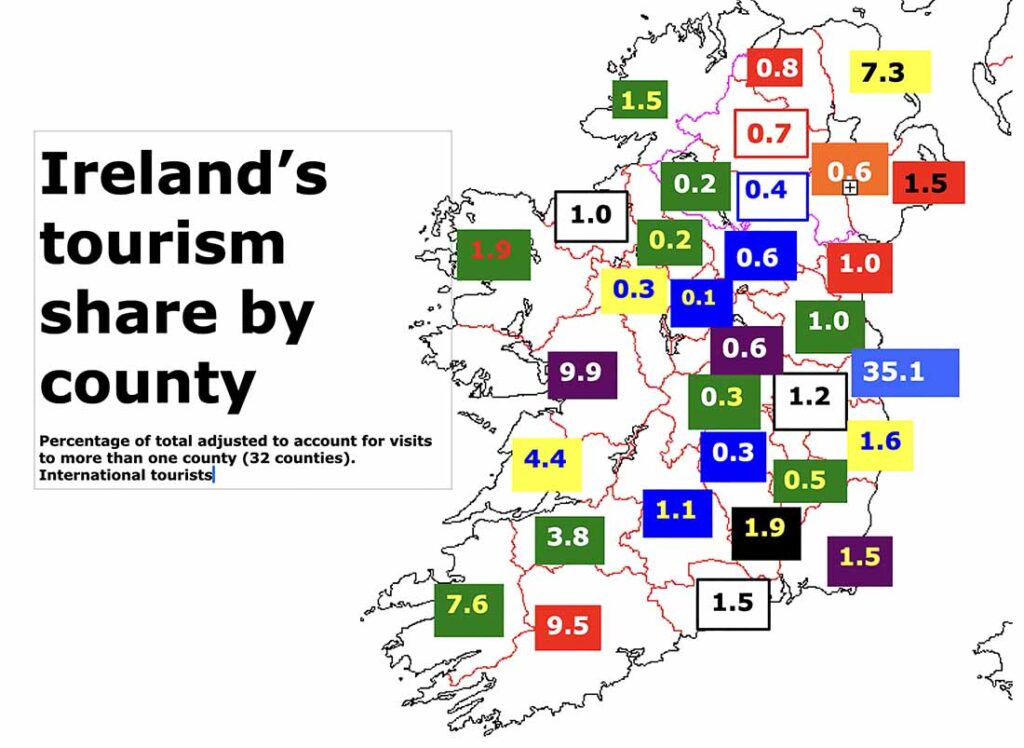
Ireland’s county Galway offers a delightful mix of cultural heritage and coastal beauty, with Galway City’s Latin Quarter showcasing historic streets and traditional music venues. The Connemara National Park provides hiking trails through rugged mountains and bogs, while the Aran Islands offer ancient stone forts like Dún Aonghasa. Other favourite stop is ithe Kylemore Abbey’s Victorian gardens and coastal cliffs. Galway is Ireland’s second largest county by size (5,939 sq km) and fifth largest by population (277,737). Population peaked at 440,198 in 1841 and reached its lowest point, 148,340 in 1966. In terms of hospitality, Galway is Ireland’s third most visited tourist county with around 1,028,000 international visitors per year.
Introduction – Adventure – Anthem – Archaeology – Attractions – Awards – Birdwatching – Camping – Castles – Churches – Contact list – Cycling – Dining – Equestrian – Festivals – Fishing – Folklore – Gardens – Golf – Graveyards – Happening – Haunted – Highest – Hiking – History – Holy Wells – Hotels – Hotels top 8 – Hunting & shooting – Instagrammable – Itineraries – Largest town – Luxury – MICE – Movies – Music – Name – New – Novelists – Off the beaten track – Poets – Pubs – Quotes – Random Facts – Restaurant Awards – Sacred Places – Saints – Songs – Spas – Sports – Sunsets – Sustainable – Things to do – Towns – Video – Villages – Walking – Wanderlist – Weddings – Wild swimming – Writers – 1837 – 1846 – 1852 – 1909 – 1955 – 1980 –