An inland county nearly in the centre of Leinster, bounded on the north by Kildare and Wicklow, on the east by Wicklow and Wexford, on the south by Wexford, and on the west by Kilkenny and Laois. Its greatest length, from the northern extremity near Athy to the southern near Borris, is about 32 English miles; and its greatest breadth, from the eastern confines near Hacketstown to the western near Leighlin-bridge, is about 26 miles. Its area is computed at 221,485 acres, or 346 square miles; of which about 190,000 acres are arable land. Its outline is irregular; and its surface, though nowhere mountainous, is agreeably diversified with gentle hills, fertile valleys, and numerous small streams. The principal elevations are the ridge of hills which traverses the eastern and southeastern districts, rising in some places to about 800 feet above sea-level; Mount Leinster, on the southern frontier, attaining an altitude of 2,610 feet; and the Blackstairs mountains, which form part of the boundary with Wexford, rising to about 2,400 feet. The general aspect of the county is highly pleasing; the northern and central districts are richly cultivated and well wooded; and the southern districts, though more hilly, are in general fertile and picturesque.
The principal rivers are the Barrow, the Slaney, and the Lerr. The Barrow rises in the Slieve Bloom mountains in Offaly, enters Carlow a little to the south of Athy, flows southward along the western boundary, receives the Burren river near Leighlin-bridge, and continues its course into Wexford. It is navigable for boats of considerable burden as far as Athy, and is connected with Dublin by the Grand canal. The Slaney rises in the Wicklow mountains, enters Carlow near Hacketstown, flows southward through a rich and beautiful valley, receives the Derreen river, and falls into the sea at Wexford. The Lerr rises near Baltinglass, and falls into the Slaney near Tullow. The county is intersected by no canal except the short branch of the Grand canal which terminates at Athy.
The soils are various, but in general fertile. The northern districts consist chiefly of a rich loam, well adapted to tillage; the central districts are a mixture of loam and clay, admirably suited both to tillage and pasturage; and the southern districts exhibit a strong clay and gravelly soils. Limestone is abundant in the north and northwest; freestone and granite occur in various parts. The agriculture is in a very advanced state; the farms are in general small, but are well cultivated; and the system of green-cropping, stall-feeding, and irrigation is extensively practised. The principal crops are oats, wheat, barley, potatoes, and turnips; and large quantities of excellent butter and pork are produced for exportation. The cotton manufacture is carried on to some extent in Carlow town; and there are several flour-mills, breweries, and distilleries.
The population in 1841 was 86,161; of whom 42,906 were males, and 43,255 females; 57,293 were returned as living in rural districts, and 28,868 in towns and villages. The principal towns are Carlow, the county town, Tullow, Leighlin-bridge, Bagenalstown, Hacketstown, and Myshall. The county contains 18 parishes, and parts of 5 others; and is divided into the baronies of Carlow, Catherlogh, Forth, Idrone East, Idrone West, Rathvilly, and St. Mullin’s Upper and Lower. The estates are in general of moderate size; and several are well managed. The Grand Jury presentments for 1843 amounted to £13,456 12s. 3d. The assizes are held at Carlow; and quarter-sessions at Carlow and Tullow. The county returns two members to parliament for the county at large, and one for the borough of Carlow. The ecclesiastical arrangements will be noticed in the next article. The board of guardians of the Carlow poor-law union allow their medical officer £50 a year from the board.
Ireland in 1846
Antrim – Armagh – Carlow – Cavan – Clare – Cork – Derry – Donegal – Down – Dublin – Fermanagh – Galway – Kerry – Kildare – Kilkenny – Laois – Leitrim – Limerick – Longford – Louth – Mayo – Meath – Monaghan – Offaly – Roscommon – Sligo – Tipperary – Tyrone – Waterford – Westmeath – Wexford – Wicklow
County Carlow:
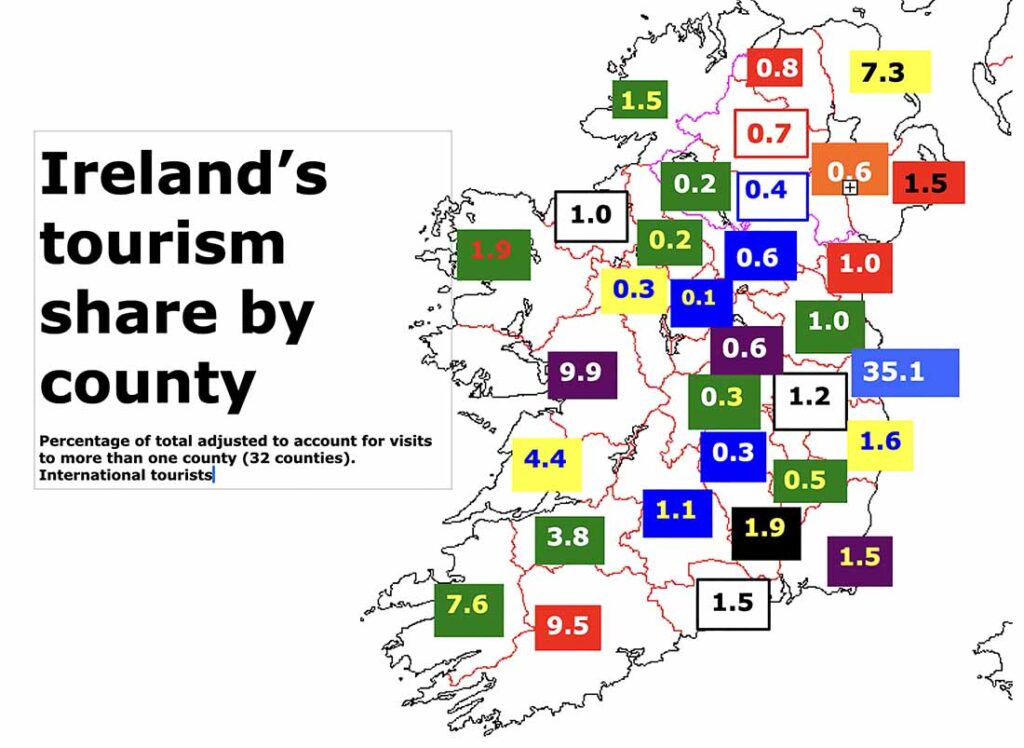
Ireland’s County Carlow combines historic landmarks with serene landscapes, with the Carlow Castle ruins and the nearby Altamont Gardens offering a mix of medieval and botanical appeal. The Barrow Way provides scenic riverside walks, while the Brownshill Dolmen, a prehistoric portal tomb, adds ancient history. Carlow is Ireland’s second smallest county by size (896 square km) and third smallest by population (61,968). Population peaked at 86,228 in 1841 and reached its lowest point, 33,342 in 1961.In terms of hospitality, Carlow is Ireland’s 23rd most visited tourist county with around 68,000 international visitors per year.
Introduction – Adventure – Anthem – Archaeology – Attractions – Awards – Birdwatching – Camping – Castles – Churches – Contact list – Cycling – Dining – Equestrian – Festivals – Fishing – Folklore – Gardens – Golf – Graveyards – Happening – Haunted – Highest – Hiking – History – Holy Wells – Hotels – Hotels top 8 – Hunting & shooting – Instagrammable – Itineraries – Largest town – Luxury – MICE – Movies – Music – Name – New – Novelists – Off the beaten track – Poets – Pubs – Quotes – Random Facts – Restaurant Awards – Sacred Places – Saints – Songs – Spas – Sports – Sunsets – Sustainable – Things to do – Towns – Video – Villages – Walking – Wanderlist – Weddings – Wild swimming – Writers – 1837– 1846 – 1852 – 1909 – 1955 – 1980 –