- Carlow Castle: Built between 1207 and 1213 by William Marshal, Earl of Pembroke, Carlow Castle is a 13th-century Anglo-Norman fortress on the River Barrow. It was a pioneering towered keep with a rectangular tower and four smaller three-quarter-circular towers at each corner, a rare design in Ireland possibly inspired by Norman castles in western France. Once a key administrative center, it survived sieges but was heavily damaged in 1814 when a physician used explosives to remodel it for an asylum, leaving only the west wall and two towers. It’s a National Monument. Located in Carlow town center, the castle ruins are free to visit and accessible year-round, though fenced off for safety due to recent storm damage. Visitors can view the imposing west wall and two towers from a small urban garden, with information panels detailing its history. Expect a quick 15–30 minute visit, ideal for history buffs. The nearby Carlow County Museum offers deeper historical context. Parking is available, but the site lacks facilities like restrooms or guided tours. Its central location makes it a convenient stop, but the ruins are minimal, and the surrounding urban setting may detract from the historical ambiance.
- Huntington Castle (Clonegal Castle): Built in 1400 as a fortress for the Caviness family in Clonegal village, Huntington Castle was rebuilt in 1625 by Laurence Esmonde, becoming the seat of the Esmonde family. This well-preserved castle, still inhabited by the Durdin-Robertson family, blends medieval and 17th-century architecture. It’s a rare intact castle in Carlow, voted one of Ireland’s top 20 Hidden Gems by The Guardian. Open for guided tours (summer months, check huntingtoncastle.com for dates), visitors can explore the dining room, tapestry room, and the unique Temple of Isis in the basement, reflecting the family’s spiritual history. The tour, often led by a local or family descendant, lasts about 45 minutes (€10–€12 adults). The grounds feature a tearoom, gift shop, and gardens needing some upkeep but with potential for beauty. Family-friendly activities include a playground and occasional events like painting courses. Expect a 1–2 hour visit with parking, WiFi, and toilets available. Its lived-in charm and guided tours make it Carlow’s most engaging castle experience.
- Ballymoon Castle: A 13th-century Norman castle near Muine Bheag (Bagenalstown), Ballymoon Castle is a mysterious ruin with a unique open courtyard design. Possibly built by the Bigod or Carew families, its history is unclear, but it features a twin-towered gatehouse and partial walls. As a National Monument, it’s less visited but striking in its rural setting. Located in a field behind a church, the ruins are free to access but may require permission from nearby landowners due to a gate. Visitors can explore the gatehouse, hall foundations, and courtyard, enjoying the pastoral setting with grazing sheep. Information boards provide historical context. Expect a 30–45 minute visit, with no facilities like restrooms or a visitor center. The site can be muddy, so wear sturdy shoes. Parking is limited, and it’s best for those seeking quiet, off-the-beaten-path ruins. Its enigmatic history and rural charm appeal to adventurers and photographers.
- Ballyloughan Castle: A 13th-century Anglo-Norman castle near Bagenalstown, Ballyloughan Castle is a National Monument with a twin-towered gatehouse, hall, and one corner tower’s foundations. Once a fortified residence, it’s now a picturesque ruin in a rural field, reflecting Carlow’s medieval past. Access may require permission from local landowners, as it’s on private property near a church. The ruins are free to visit, offering a glimpse of medieval architecture with minimal remains. Expect a 20–30 minute visit, with no facilities or guided tours. The site’s open courtyard and scenic surroundings suit history enthusiasts and those exploring the Barrow Valley. Parking is limited, and the terrain may be uneven. Best for those comfortable with rustic, less-accessible sites.
- Black Castle (Leighlinbridge Castle): Located in Leighlinbridge on the River Barrow, Black Castle is a 13th-century ruin, rebuilt by Edward Bellingham in the 1540s and later damaged by Rory Óg O’More in 1577 and Cromwell’s forces in 1650. Only a 50-foot tower and part of a bawn wall remain, making it a National Monument with a dramatic history tied to the Butler family and Irish Confederate Wars. Accessible via the Barrow towpath near Valerian Bridge (one of Europe’s oldest, built 1320), the castle is free to visit but dilapidated. Visitors can see the tower and partial wall, with views of the river and bridge. Expect a 15–30 minute visit, with no facilities or guided tours. The site’s rural setting and historical significance appeal to those exploring Carlow’s heritage. Parking is available near the bridge. Its proximity to the scenic Barrow Walk makes it a worthwhile stop for hikers. Carlow has other minor ruins like Tinnahinch Castle (1615, burnt in 1700, on private property) and Clonmore Castle (13th-century, with high crosses, limited remains). These are less prominent and often inaccessible or have minimal visitor appeal due to their state and private ownership.
Visitor Tips:
- Accessibility: Carlow Castle is easily reached in Carlow town by car or public transport (bus/train to Carlow). Huntington Castle is accessible by car, while Ballymoon, Ballyloughan, and Black Castle require a car and may involve navigating rural roads or seeking landowner permission.
Castles
Antrim – Armagh – Carlow – Cavan – Clare – Cork – Derry – Donegal – Down – Dublin – Fermanagh – Galway – Kerry – Kildare – Kilkenny – Laois – Leitrim – Limerick – Longford – Louth – Mayo – Meath – Monaghan – Offaly – Roscommon – Sligo – Tipperary – Tyrone – Waterford – Westmeath – Wexford – Wicklow
County Carlow:
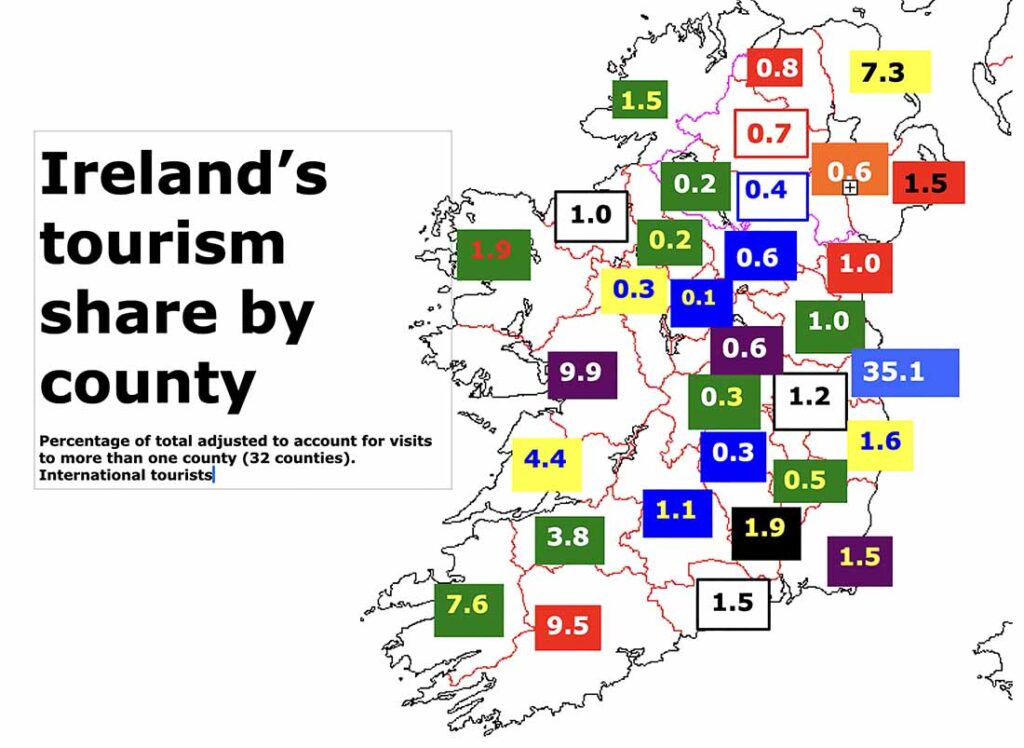
Ireland’s County Carlow combines historic landmarks with serene landscapes, with the Carlow Castle ruins and the nearby Altamont Gardens offering a mix of medieval and botanical appeal. The Barrow Way provides scenic riverside walks, while the Brownshill Dolmen, a prehistoric portal tomb, adds ancient history. Carlow is Ireland’s second smallest county by size (896 square km) and third smallest by population (61,968). Population peaked at 86,228 in 1841 and reached its lowest point, 33,342 in 1961.In terms of hospitality, Carlow is Ireland’s 23rd most visited tourist county with around 68,000 international visitors per year.
Introduction – Adventure – Anthem – Archaeology – Attractions – Awards – Birdwatching – Camping – Castles – Churches – Contact list – Cycling – Dining – Equestrian – Festivals – Fishing – Folklore – Gardens – Golf – Graveyards – Happening – Haunted – Highest – Hiking – History – Holy Wells – Hotels – Hotels top 8 – Hunting & shooting – Instagrammable – Itineraries – Largest town – Luxury – MICE – Movies – Music – Name – New – Novelists – Off the beaten track – Poets – Pubs – Quotes – Random Facts – Restaurant Awards – Sacred Places – Saints – Songs – Spas – Sports – Sunsets – Sustainable – Things to do – Towns – Video – Villages – Walking – Wanderlist – Weddings – Wild swimming – Writers – 1837– 1846 – 1852 – 1909 – 1955 – 1980 –