The highest point in County Carlow is Mount Leinster, standing at 795 meters (2,608 feet). Mount Leinster is located in the Blackstairs Mountains, straddling the border between County Carlow and County Wexford, making it the highest point for both counties. It dominates the skyline of southern Carlow, offering a prominent landmark visible from miles around.
- Elevation: At 795 meters, it is the fifth highest peak in the province of Leinster, characterized by its rugged terrain and open summit.
- Terrain: The mountain features a mix of forest tracks, open moorland, and rocky paths. The summit is marked by a trig pillar and a large transmission mast, with expansive views across the surrounding countryside.
Starting Point and Access:
- Driving Route: The most popular trailhead is at The Nine Stones, a scenic viewpoint on the Carlow side, accessible via the R702 road from Kiltealy or Borris. The Nine Stones car park is well-known, with space for vehicles and picnic facilities. From Carlow town, it’s about a 30–40 minute drive (approximately 25–30 km). The route is well-signed, and the mountain is easily accessible from Dublin (about 90 minutes) or Waterford.
- Alternative Access: Another starting point is from Kilbrannish Forest, near Bunclody, which offers looped walks that can include Mount Leinster. For a longer approach, hikers can start from Borris or Kildavin and follow sections of the South Leinster Way.
- Public Transport: Public transport options are limited. The nearest major town, Carlow, is served by buses and trains from Dublin, but reaching the trailhead typically requires a car or private taxi. Guided hikes with transport from Carlow town are available through operators like Mountain Adventures 74.
The Nine Stones Route:
- Distance: Approximately 7–10 km round trip, depending on the path taken.
- Duration: Allow 4–6 hours for a return trip, including time at the summit.
- Description: This is the most popular route, starting at The Nine Stones car park. The trail follows a clear, consistent path along forest tracks and open moorland. It begins with a gentle ascent, transitioning to steeper sections as you approach the summit. The path is reliable but can be exposed, with poor visibility in bad weather. Hikers may encounter road cyclists on the lower slopes, as the road to The Nine Stones is one of Ireland’s steepest.
- Difficulty: Moderate, suitable for hikers with good fitness. Sure-footedness is required on rocky and boggy sections. The trail is well-trodden but not waymarked, so a map (e.g., Ordnance Survey Discovery Series Sheet 68) or GPS is recommended.
Kilbrannish Forest Loop:
- Distance: Varies (3–14 km, depending on the loop).
- Duration: 1–4 hours.
- Description: Starting at Kilbrannish Forest, this route offers shorter, undulating trails with views of Mount Leinster and nearby Croaghaun (455 meters). It’s less strenuous and ideal for families or less experienced hikers, with fire roads and forest paths. The summit of Mount Leinster can be reached by extending the loop.
- Difficulty: Easy to moderate, with well-maintained paths suitable for most abilities.
South Leinster Way:
- Distance: Part of a 105 km long-distance trail from Kildavin to Carrick-on-Suir.
- Description: This route incorporates Mount Leinster and is ideal for experienced hikers seeking a multi-day trek. The Carlow section starts in Kildavin and ascends through the Blackstairs Mountains, showcasing the peak’s prominence.
- Difficulty: Challenging, requiring navigation skills and stamina for longer sections.
Navigation Tips:
- Use an Ordnance Survey Discovery Series Map (Sheet 68) or a GPS app like PeakVisor or HiiKER for accurate navigation.
- The summit can be shrouded in mist, reducing visibility, so check weather forecasts and bring a compass or GPS device.
- Wear sturdy, waterproof hiking boots, as the upper slopes can be rocky and wet, especially after rain.
Scenery and Views:
- Summit Views: On clear days, Mount Leinster offers breathtaking 360-degree views of the Carlow and Wexford plains, with sights of the Wicklow Mountains, the Irish Sea, and even the Welsh hills on exceptionally clear days. The villages of Myshall, Tullow, and Bunclody are visible below, located in the rolling countryside.
- Landscape: The lower slopes feature lush forests and farmland, while the summit is open and rugged, with heather-covered moorland and rocky outcrops. The transmission mast is a prominent landmark, though it doesn’t detract from the natural beauty.
- Unique Features: Hang gliders often launch from the summit, adding an exciting element to the visit. The Nine Stones, a line of granite stones, is a local landmark with folklore connections.
Hiking Experience:
- Duration: The Nine Stones route takes 4–6 hours, while shorter Kilbrannish loops range from 1–4 hours. The South Leinster Way is a multi-day commitment.
- Conditions: The trail is consistent but exposed, with potential for strong winds and fog at the summit. Spring and summer (April–September) offer the best conditions, with longer daylight and milder weather. Winter hikes are possible but require extra caution due to slippery paths and shorter days.
- Cultural Significance: Mount Leinster is linked to St. Colombanus, a 6th-century monk born near Myshall, and is part of the Colomban Way, a pilgrimage route from Carlow to Bangor, County Down. The area is also steeped in Ireland’s Ancient East heritage, with nearby Stone Age artifacts and medieval sites.
- Weather: The summit is susceptible to poor visibility and strong winds. Check forecasts and avoid hiking in extreme conditions.
- Access: Some routes cross private land, so respect “No Trespassing” signs and stick to established paths.
- Safety: Inform someone of your plans, as there are no rangers. Solo hikers should be confident in navigation, and beginners may prefer guided hikes. Bring water, snacks, and layers for changing weather.
- Wildlife: Expect to see red deer, hares, foxes, and birds like buzzards or kestrels. The Blackstairs Mountains are known for biodiversity, especially in forested areas.
Additional Attractions:
- Nearby Sites: Combine the hike with visits to Altamont Gardens (gentle walks through historic gardens), Borris House, or the River Barrow towpath for a mix of cultural and natural experiences. The Barrow Way, a 113 km flat trail along the river, is ideal for casual walkers.
- Events: The Carlow Autumn Walking Festival (typically early October) offers guided hikes on Mount Leinster and other Blackstairs trails, including history, flora, and navigation walks.
- Activities: The Blackstairs Eco Trails near Borris offer foraging workshops, glamping, and eco-friendly experiences, enhancing a visit with environmental education.
Highest point in county
Antrim – Armagh – Carlow – Cavan – Clare – Cork – Derry – Donegal – Down – Dublin – Fermanagh – Galway] – Kerry – Kildare – Kilkenny – Laois – Leitrim – Limerick – Longford – Louth – Mayo – Meath – Monaghan – Offaly – Roscommon – Sligo – Tipperary – Tyrone – Waterford – Westmeath – Wexford – Wicklow
County Carlow:
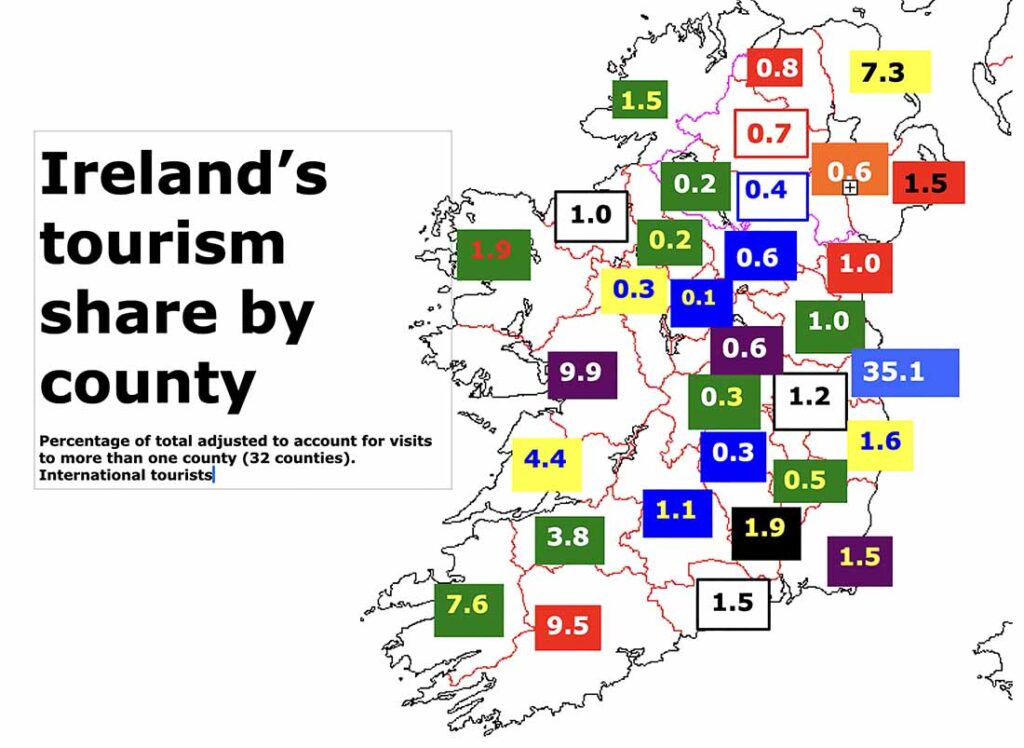
Ireland’s County Carlow combines historic landmarks with serene landscapes, with the Carlow Castle ruins and the nearby Altamont Gardens offering a mix of medieval and botanical appeal. The Barrow Way provides scenic riverside walks, while the Brownshill Dolmen, a prehistoric portal tomb, adds ancient history. Carlow is Ireland’s second smallest county by size (896 square km) and third smallest by population (61,968). Population peaked at 86,228 in 1841 and reached its lowest point, 33,342 in 1961.In terms of hospitality, Carlow is Ireland’s 23rd most visited tourist county with around 68,000 international visitors per year.
Introduction – Adventure – Anthem – Archaeology – Attractions – Awards – Birdwatching – Camping – Castles – Churches – Contact list – Cycling – Dining – Equestrian – Festivals – Fishing – Folklore – Gardens – Golf – Graveyards – Happening – Haunted – Highest – Hiking – History – Holy Wells – Hotels – Hotels top 8 – Hunting & shooting – Instagrammable – Itineraries – Largest town – Luxury – MICE – Movies – Music – Name – New – Novelists – Off the beaten track – Poets – Pubs – Quotes – Random Facts – Restaurant Awards – Sacred Places – Saints – Songs – Spas – Sports – Sunsets – Sustainable – Things to do – Towns – Video – Villages – Walking – Wanderlist – Weddings – Wild swimming – Writers – 1837– 1846 – 1852 – 1909 – 1955 – 1980 –