CLARE, a maritime county, forming the north-west district of the province of Munster. It is bounded, on the north, by Galway bay and the county of Galway; on the north-east, by the county of Galway; on the east, by the county of Tipperary; on the south-east by the county of Limerick; on the south, by the counties of Limerick and Kerry; and, on the west, by the Atlantic ocean. The river Shannon, from the broadest part of its expansion of Lough Derg, down to its embouchure at the Atlantic ocean, forms all the eastern and southern boundary-line; the rivulet Bow, which falls into Lough Derg, traces the north-eastern boundary; and a rivulet which falls into Galway bay traces part of the northern boundary; so that the county is completely peninsulated, and has but a comparatively small extent of artificial boundary-line. Its outline is irregular; yet may be regarded as oblong, extending east and west, and sending out, between the Shannon and the Atlantic, a triangular projection. Its greatest length, from east to west, is about 52 miles; its greatest breadth, from north to south, is about 33 miles; and its area comprises 455,009 acres of arable land, 296,033 of uncultivated land, 8,304 of plantations, 728 of towns, and 67,920 of water, in all, 827,994 acres.
Surface, The surface of the county is exceedingly irregular. Mountains are, for the most part, so uncontinuous, groups of heights are so broken, twisted, and mutually dissevered, and plains, bogs, valleys, moors, lakes, and uplands are, in so many instances, flung together in confused intermixation, that only a very minute description, one so minute as to be perplexing and even scarcely intelligible, could be strictly accurate. In a general view, a grand group of mountains covers an area of about 150 square miles in the north-east and east, a great champaign district forms the centre of the county, from the northern boundary, along the Fergus, to the Shannon, and a vast district of about 400 square miles, between the champaign country and the Atlantic, consists, for the most part, of high grounds, which are now mountainous, now a series of bold broken swells, and now a mass of spreading, flattened, moorish, bleak, and semi-chaotic hills. The chief portion of the mountain-group in the east of the county consists of the Slieve Baghta mountains, which raise their principal summits to the altitude of from 2,000 to 2,500 feet, and are prolonged across the northern boundary a considerable distance into the county of Galway; and the chief single mass in the western region, is Callan mountain, a huge conglomeration nearly in the centre of the district, lumpish, broad-based, many-summited, and many-spurred. A succinct view of the county’s intricate surface in sections, may be obtained by reference to our articles on its several baronies.
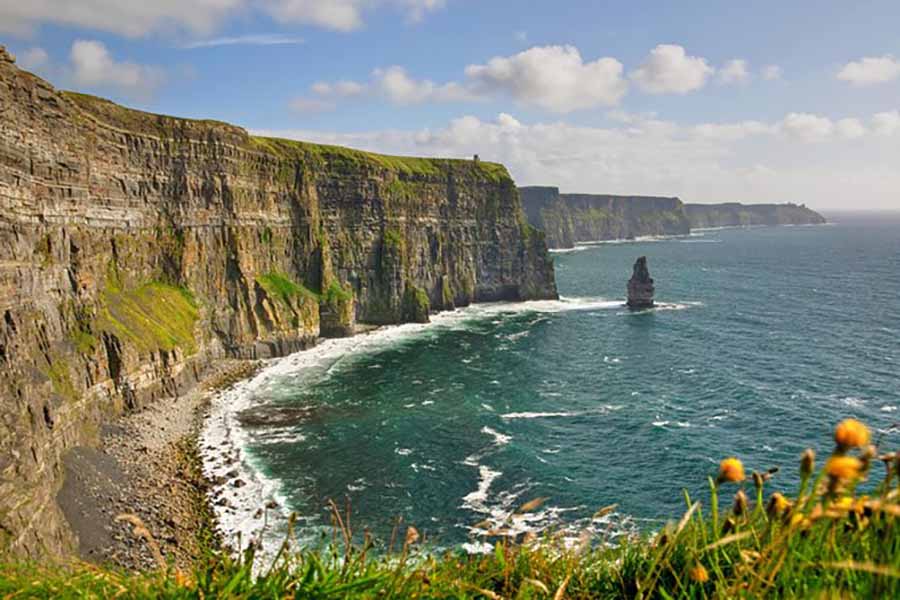
Coasts, The extent of coast on Galway bay, from the boundary with the county of Galway westward to Black Head, is 9 miles; the extent on what is called the South Sound, from Black Head, south-south-westward to Haggs Head, is 13 miles; the extent directly upon the Atlantic round the long gentle curvature of Mal bay, from Haggs Head south-south-westward to Loop Head, is about 38 miles; and the extent on the Shannon, along the general but not the numerous subordinate sinuosities, from Loop Head eastward to the termination of the estuary at Limerick, is about 48 miles. The northern coast is so indented and serrated by ramifications of Black Head bay, that, if measured along sinuosities, it might probably prove to be treble the extent we have stated; and it abounds in coves, creeks, and small natural harbours, which might be made richly subservient, and have already been in part made so, to the prolific fisheries of Galway bay, and the seas immediately north of the Arran Islands. The coast of both South Sound and Mal bay, or all the extent from Black Head to Loop Head, is prevailingly bold, rocky, and iron-bound; it is indented by only the inconsiderable bays of Liscanor and Dunbeg, and a few very small creeks; and, though possessing capacities for the somewhat general prosecution of fisheries, it frowns destruction upon merchant-vessels, and demands great precaution, and some peculiar contrivances on the part of fishing-boats. Its cliffs average about 100 feet in height; but frequently rise to 400 or 500 feet, and occasionally to near or quite 1,000; they are variously mural, precipitous, shelving, and shattered; they display, in their rents, caverns, escarpments, and ponderous debris, the memorials of many a sublime and terrific conflict with the Atlantic; they are extensively flanked with islets, stacks, and massive rocks, which have been torn from them by the violence of surge and gale; and, in their lower parts, or even where they have 100 feet of altitude, they are sometimes overleaped and submerged by the tremendous mountain-billows which assail them in a storm. “Some faint idea,” says Mr. Hely Dutton, “may be formed of the force with which the waves of the sea are impelled by the western storms, when it is known, that cubes of limestone rock 10 or 12 feet in diameter are thrown up on ledges of rock several feet high near Doolen; and at the same place may be seen a barrier of water-worn stones, some of them many tons weight, thrown up above 20 feet high across a small bay, into which fishermen used to land from their small boats, and where their former quay, surrounded with huts, remains many yards from the sea: this has occurred in the memory of many living at present.” Nearly all the great prevailing extent of rocky coast is suffering a demolition which, though slow, is as steady as the terrible abrasion by the sea; but the few parts which have a fine sandy beach receive constant accessions of debris from the restless surf, and are observably pushing an invasion of land upon the ocean. So characteristically are the numerous islets along the coast mere skerries and stacks, that the only noticeable ones are Mutton-Island and the Enniskerry-Isles, both situated off the north side of the entrance of Dunbeg bay. The coast on the Shannon, from Loop Head to the entrance of the estuary of the Fergus, or over a distance of about 32 miles in a straight line, varies in character from bold and precipitous to low and meadowy, possesses numerous creeks and the three bays of Carrigaholt, Kilrush, and Clonderalaw, is subtended by Hog and Scattery Islands, and several inconsiderable islets, suffers, up to Kilrush, the careering and tumultuous sweep of the “rollers” of the Atlantic, sends out, nearly opposite Tarbert, the large peninsula of Clonderalaw, to produce the pent-up rush of the tides called “the Race of Tarbert,” and, though possessing some harbours, and many considerable fishing communities, is very slenderly subordinated to enterprises of navigation and traffic. The estuary of the Fergus opens from the Shannon with a width of 5 miles; penetrates the county northward to the extent of 7 miles; is sprinkled over with numerous islets and islands, 9 or 10 of which are of noticeable magnitude; and has almost everywhere silty shores, and a low and meadowy sea-board. But a fair notice of this estuary, and of the Shannon above it, as well as a fuller view of the Shannon below, properly belongs to separate articles: FERGUS and SHANNON.
Climate, The strong gales from the Atlantic are supposed to be more frequent and severe than at a period within the recollection of persons who were alive at the commencement of the present century. So unfriendly are these gales to the growth of timber, and so far is their influence felt, that trees upwards of 50 miles from the sea, if not sheltered, lean to the east. The air, though moist near the sea, is not unhealthy, and does not occasion any inconvenience to the inhabitants. Slow fevers sometimes run through whole parishes, and sweep away many of the population; but they are supposed to proceed chiefly from want of cleanliness; and may have had no additional causes except the free use of ardent spirits, and the exhalation of miasmata from undrained and unplanted morasses. The average climate appears to be salubrious, and even has the fame of promoting many instances of longevity. Frost or snow is seldom of long continuance.
Waters, The river Fergus rises in the barony of Corcomroe; runs through the lakes of Inchiquin, Tedane, Dromore, Ballyally, and several smaller lakes; flows past the town of Ennis; receives various tributaries, the chief of which is the Clareen; and begins to expand into its beautifully outlined and picturesquely isleted estuary a little below the village of Clare. A stream issues from Lough Terroig, on the boundary with the county of Galway; runs southward to the beautiful Lough Graney or Lake of the Sun; pursues a serpentine course of 4 miles to Lough O’Grady; collects there the waters which several rivulets bring down from the mountains; and then runs eastward to Lough Derg, at the picturesque bay of Scariff. The river Ougarnee collects its headwaters in Lough Breedy, 2 miles south-south-west of Lough O’Grady; runs southward to Lough Doon; receives an affluent from Lough Clonlea; forms a small lake near Mountcashel; and pursues its southerly course past Six-mile-Bridge, to the Shannon opposite the embouchure of the Maig. Ardsallas rivulet rises in the barony of Bunratty; receives a considerable affluent from the barony of Tulla; and falls into the north-east extremity of the estuary of the Fergus. The Blackwater rises in Tulla, and has a course of about 6 miles southward to the Shannon, a little above Limerick. The Clareen rises in the barony of Islands; and, after a very devious course of 10 or 11 miles, falls into the Fergus a little north of Ennis. A stream of about 16 miles in length of course, rises on the west side of Mount Callan; forms Lough Dulogh; runs chiefly southward in a line parallel with the coast; and then proceeds westward to the Atlantic at the head of Dunbeg bay. A stream rises near the source of the Clareen, in the barony of Islands; and runs about 8 miles southward to the Shannon, at the head of Clonderalaw bay. The Innistymon or Forsett river rises on the south side, and circles round the east side of Mount Callan; divides for 2 miles the baronies of Ibrickane and Islands; runs across Inchiquin, and between that barony and Corcomroe; falls over a very large ledge of rocks at Innistymon; careers thence into the head of Liscanor bay, forming a very dangerous passage at high water; and has altogether a length of course of about 16 or 17 miles. The Bow rises a little east of Lough Terroig, has most of its course on the boundary with Galway, and falls into Lough Derg, 1 mile north-east of Scariff. Very many rivulets and brooks traverse almost every part of the county, except the barony of Burren; but they generally take their names from the villages or other most remarkable localities which they wash, and, in consequence, are changeful in designation, and not very distinctly known to topography. Lakes and loughlets are so numerous, that upwards of 100 figure in topographical nomenclature; and several, such as those of Graney, O’Grady, Tedane, Inchiquin, Cloonlea, and Inishcronan, are of considerable size. Turloughs, as in Galway, are numerous; they are temporary or periodical lakes, formed either by the accumulation of surface-water, or the forcing up of subterranean water by the flow of high absorbed rills; and they usually present an alternation of winter-lake, and rich summer meadow. Mineral springs, chiefly chalybeate, are numerous; the principal, or those whose medicinal properties have, in any degree, become known to local or more general fame, are at Lisdounvarna, at Scool, in Inchiquin, at Cloneen, about a mile north-west of Lemenagh-castle, at Kilkisshen, and at Cassino, near Milltown-Malbay.
Minerals, Three fields of schistose rocks, chiefly argillaceous, occur in the eastern mountain division of the county: the smallest measures about 8 statute square miles in area, and extends, east and west, on a narrow belt, upon a line about 5 miles north of Limerick; the largest measures about 55 statute square miles in area, and extends 15 miles south-south-westward from the Shannon, in the immediate northern vicinity of Killaloe; and the third measures about 40 square miles in area, lies north of the former, surrounds Lough Graney, and touches both the western and the northern, but not the north-western, boundary. Three or four small patches of the same schistose formation occur near the outskirts of the last or most northerly of the three fields. An old red sandstone formation, partly stratified and partly conglomerate, completely surrounds and insulates all the schistose fields, and, of course, follows the outskirts of the two larger beyond the limits of the county; yet it is divided into two great sections by a long tongue or peninsula of carboniferous limestone, which comes down to Lough Derg at Scariff; and it probably measures, in aggregate area, very little if any more than the aggregate extent of the schistose formations. A very narrow zone of yellow sandstone, partly stratified and partly conglomerate, engirds the northern section of the old red sandstone; and follows it, as that formation follows the schists, beyond the limits of the county. The Slieve Baughta mountain region, or eastern upland territory, has, in consequence, been not very inaccurately, though somewhat vaguely, described as “a great field of transition rocks.” The carboniferous limestone, which sends a tongue up to Lough Derg, and which probably extends in considerable masses under the old red sandstone, appears in numerous places at the surface, particularly in the champaign district, in the barony of Burren, and in some parts of the western high grounds; it forms, in the Burren district, singular naked pavements, called “pavements of the Burren,” and elsewhere it is the substratum of fertile land. Lead ore occurs in the limestone near Tulla, and in some other places; and iron ore is found in several localities. Marl is abundant in the limestone districts; and excellent building-stone, flags, and slates are quarried in various parts.
The county is divided into the baronies of Burren, Corcomroe, Inchiquin, Islands, Ibrickane, Bunratty Upper, Bunratty Lower, Tulla Upper, and Tulla Lower.
The population in 1841 was 286,394.
The county has long been notorious for agrarian outrage and crime, occasioned in great measure by the peculiar circumstances of land-tenure, and by systematic agrarian disturbance.
Ireland in 1846
Antrim – Armagh – Carlow – Cavan – Clare – Cork – Derry – Donegal – Down – Dublin – Fermanagh – Galway – Kerry – Kildare – Kilkenny – Laois – Leitrim – Limerick – Longford – Louth – Mayo – Meath – Monaghan – Offaly – Roscommon – Sligo – Tipperary – Tyrone – Waterford – Westmeath – Wexford – Wicklow
County Clare:
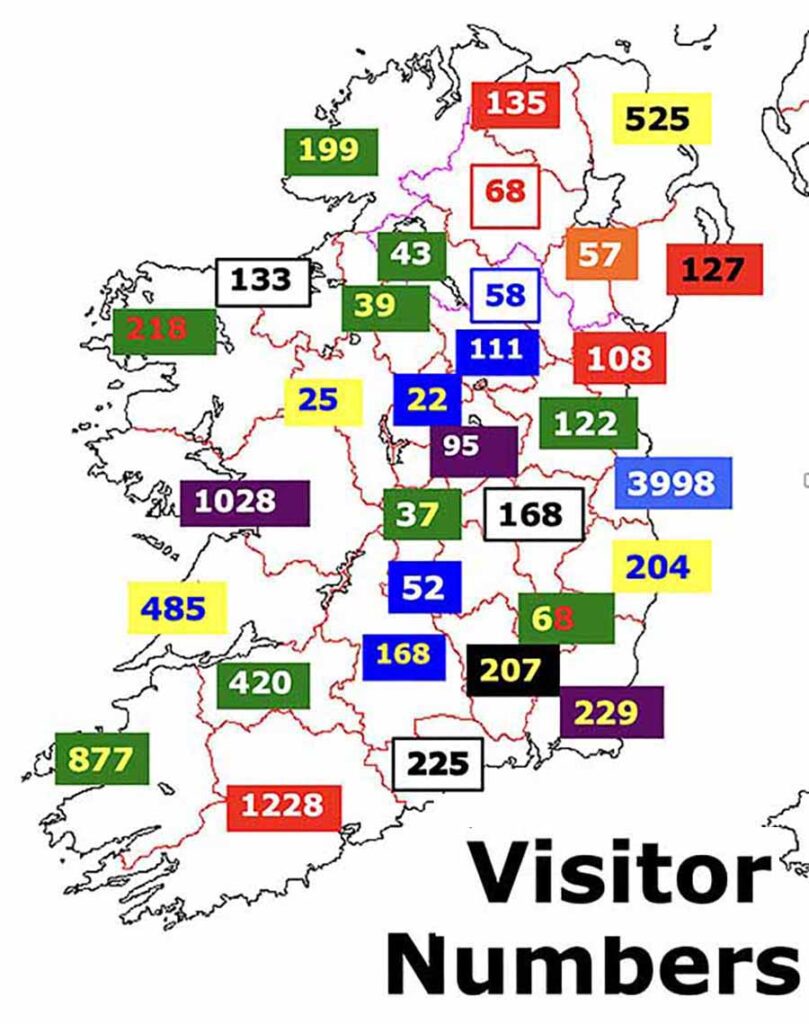
Ireland’s county Clare is renowned for its dramatic cliffs and traditional heritage, with the Cliffs of Moher offering breathtaking views over the Atlantic. The Burren’s unique limestone landscape provides hiking and rare flora, while Bunratty Castle offers medieval history with its restored interiors. Check out the traditional music scene in Doolin and the county’s coastal beaches. Clare is Ireland’s eighth largest county by size (3,188 square km) and 19th largest by population (127,938). Population peaked at 286,394 in 1841 and reached its lowest point, 73,597 in 1966. In terms of hospitality, Clare is Ireland’s sixth most visited tourist county with around 485,000 international visitors per year.
Introduction – Adventure – Anthem – Archaeology – Attractions – Awards – Birdwatching – Camping – Castles – Churches – Contact list – Cycling – Dining – Equestrian – Festivals – Fishing – Folklore – Gardens – Golf – Graveyards – Happening – Haunted – Highest – Hiking – History – Holy Wells – Hotels – Hotels top 8 – Hunting & shooting – Instagrammable – Itineraries – Largest town – Luxury – MICE – Movies – Music – New – Name – Novelists – Off the beaten track – Poets – Pubs – Quotes – Random Facts – Restaurant Awards – Sacred Places – Saints –Songs – Spas – Sports – Sunsets – Sustainable – Things to do – Towns – Video – Villages – Walking – Wanderlist – Weddings – Wild swimming – Writers – 1837– 1846 – 1852 – 1909 – 1955 – 1980 –