- “No tree to hang a man, no water to drown a man, no soil to bury a man. Yet it is a savage land, their cattle are very fat.” Famous Burren paradox, oft misquoted line from Benjamin Worsley, Cromwell’s surveyor in the 1650s.
- “Everybody needs a break, climb a mountain or jump in a lake, Sean Doherty goes to the Rose of Tralee, Oliver J. Flanagan goes swimming in the Holy Sea, but I like the music and the open air, so every Summer I go to Clare, cause Woodstock, Knock, nor the Feast of Cana, cannot hold a candle to Lisdoonvarna.” – Christy Moore (b1945).
- “And some time make the time to drive out west / Into County Clare, along the Flaggy Shore, / In September or October, when the wind / And the light are working off each other / So that the ocean on one side is wild…” — Seamus Heaney (1939–2013), from the poem “Postscript”
- Darling Girl form Clasre.There’s not one girl in the wide, wide world / like the girl from the County Clare.
- “I will arise and go now, and go to Ennis free, as the man said on the day he got his pension with the free travel.” – Breandán Ó hEithir. (1930-1990)
- Oh it’s along, long way, it gets further day by day/ It’s a long, long way from Clare to here. – Ralph McTell.(b1944).
- Take a view o’er the Shannon, fine sights you’ll see there/ You’ll see the high rocky mountains on the West Coast of Clare. – Cliffs of `Dooneen.
- The Burren, with Mount Elva as its most striking feature, can be said to be famous and infamous, beloved and abhorred – Bryan MacMahon 1909-1998), Here’s Ireland (1971).
- The coast from Kilrush, on the mainland opposite the island, a pretty and fashionable bathing-place, round to Kilkee, which faces the Atlantic, may vie for sublime grandeur with that of any part of the kingdom – Samuel Carter Hall and Anna Maria Hall, Ireland, its scenery and character (1841-43)
- the number of remarkable hills that surround the town in all directions are in themselves worth a visit. The river, which winds through them, descends in foam below the bridge over continued beds of rock, like stairs, for thirty or forty feet, and presents a most picturesque view when seen from the woody bank. – Mary John Knott, Two Months at Kilkee (1836).
- The following hints may be of service in descending the path at the Cliffs of Moher: To avoid looking down at the sea, or letting the eye wander off the path to keep the guide close in front, and the party together, as from the steepness and winding of the descent, those who are left behind soon lose sight of their companions, and often get alarmed. – Mary John Knott, Two Months at Kilkee (1836).
- Though infamous, because of its apparent barrenness, the wealth of its antiquities includes cairns and chamber tombs. Its subterranean lakes have lately been surveyed for the first time by a team from Bristol University. It is beloved of botanists because of the rare flowers-adantium capillus veneris is one-that grow in the crevices of its rocks. – Bryan MacMahon 1909-1998), Here’s Ireland (1971).
- The mouth of the Shannon is grand almost beyond conception. Its inhabi¬ tants point to a part of the river, within the headlands, over which the tides rush with extraordinary rapidity and violence. They say it is the site of a lost city, long buried beneath the waves, and that its towers and spires and turrets, acting as breakers against the tide-water, occasion the roughness of this part of the estuary. with extraordinary rapidity and violence. They say it is the site of a lost city, long buried beneath the waves, and that its towers and spires and turrets, acting as breakers against the tide-water, occasion the roughness of this part of the estuary. The whole city becomes visible on every seventh year, and has been often seen by the fishermen sailing over it; but the sight bodes ill luck, for within a month after, the ill-fated sailor is a corpse. – Samuel Carter Hall and Anna Maria Hall, Ireland, its scenery and character (1841-43)
- In the north, Galway Bay, the Aran Islands, and the distant Twelve Pins of Connemara are ranged out for my delight. Beside me are trim cottages; some are thatched but each has its outhouse roofed with flagstone. Fisherstreet village lies below; beyond it is Doolin Point with boulders everywhere strewn and barbarous parallelograms of nude stone. At Doolin the Aran Islanders come ashore walking quietly on rawhide shoes to drink and dance a step maybe at gentle Gus O’Connor’s pub. From this area I find it difficult to drag myself away. Once I spent a whole day here saving hay in a meadow: as I worked in the air shot with larksong I felt as rich as Darner – Bryan MacMahon 1909-1998), Here’s Ireland (1971).
- “Clare has always been an exceptional county. Clare returned Daniel O’Connell, by him secured Catholic Emancipation, it returned the Liberator and keeps its own counsel.” —Frederick Martin.
- The tableland that is Clare is shaped like an equilateral triangle having as its base the estuary of the Shannon, on which Shannon Airport stands; freshwater Shannon and wide-spreading Lough Derg form the eastern side, while the western flank, bounded by the growling Atlantic, is guarded on the north by epic cliffs. Its most striking single feature is the Burren, an apparently barren karsttype area of amorphous limestone riddled with caves and subterranean streams which forms the apex of this triangular county. – Bryan MacMahon 1909-1998), Here’s Ireland (1971).
- “You are in the kingdom of Thomond, the ancient barony of the Burren, the province of Munster and the county of Clare.” — Literary travelogue
- If the sun happens to shine, the continual iris from the descending mists, following the discharges in beautiful prismatic clouds, resembling the rainbow; but in stormy weather one cannot go near its mouth, from the height and extent of its spouting. Outside some of the most frightful ridges of rock on the coast present their dark heads through the foam. – Mary John Knott, Two Months at Kilkee (1836).
- “The earthed lightning of a flock of swans.” – Seamus Heaney (1939–2013),
- Some miles north of Kilkee are the famous cliffs of Moher — the highest of which is said to be nine hundred and thirty feet above the level of the sea. To supply even a faint description of the wonderful scenery in this vicinity would exceed the space to which we are limited – Samuel Carter Hall and Anna Maria Hall, Ireland, its scenery and character (1841-43)
- So far as the eye can reach in the distance to the west, the waves of the Atlantic impart their beautiful emerald tinge along an extended horizon; and on the north may be seen the Islands of Aran, and this broken coast for thirty miles, with many a frowning headland overlooking the ceaseless billow that foams against its rocky base. The perspective of this gigantic boundary of nature, wisely set to resist the encroachment of the ocean, (whose waves, when urged on by the westerly tempests for hundreds of miles, break against the rocks with a force and effect beyond de- scription,) is in itself worth a visit. From this magnificent scene the mind reluctantly turns as from a great panorama of nature combining much in which the works of the Creator are strikingly displayed, whether we contemplate the boundless ocean, islands, mountains, cliffs, or the noble river studded with sails, and bearing its abundant shoals of the finny tribes, as blessings to the inhabitants. – Mary John Knott, Two Months at Kilkee (1836).
- “County Clare: where the Atlantic whispers secrets to the stones.” — Brian O’Higgins (1882–1963), Irish poet, author, and politician known by the pseudonym “Brian na Banban”..
- Lisdoonvarna Spa then with its singing pubs, its inordinate consumption of water that smells of hard-boiled eggs or rusty nails and the wonderful air of its uplands. Lisdoonvarna with its parish priests, its farmers, its rural officials holy, whole and wholesome. It stands out in affection like an old church (or, indeed, an old pub) that in its Gothic mahogany conveys a sense of security that elsewhere the novel years have set at nought. Match-making in the old astringent sense is no longer a feature of the town’s natural life but the place does still vouch for quiet and gracious romance. – Bryan MacMahon 1909-1998), Here’s Ireland (1971).
- “In County Clare, the landscape looks like it was designed by a mad geologist with a sense of humor.” — Billy Connolly.
- “Clare people: maimed, stark, and misshapen like the trees, but they don’t complain – they just outlast you.” —Edna O’Brien’s (1930–2024).
- “Driving the Flaggy Shore in October: suddenly swans explode into flight, and you realise County Clare has been holding out on you all along.” — Nuala Ó Faoláin.
- “The Burren in County Clare: nature’s way of saying ‘I can do rock better than anyone’ – and then making grass grow anyway.” — Derek Davis.
- The road between Ennis and Kilrush is straight, long and lonely; you may if you wish take the coast road which twists south west • by Killadysert and Labasheeda. West Clare was once served by a belovedly humorous narrow-gauge railway – Bryan MacMahon 1909-1998), Here’s Ireland (1971).
- Three or four miles to the east are the enormous ruins of the O’Brien castle of Leamaneh where once Red Mary MacMahon, on being confronted with the corpse of her husband Conor O’Brien, slain in battle, said, ‘Take him away! Dead men are no use to me!’ She held her lands for Sir Donat O’Brien, her son, by offering to marry any Cromwellian officer nominated by General Ludlow-and nominated is not an inapposite stud-word! Red Mary later married an English soldier called Cooper and thus preserved the O’Brien inheritance. – Bryan MacMahon 1909-1998), Here’s Ireland (1971).
- The ocean, whose breakers, when viewed from the top, appear like silvery fringes against the foot of those amazing cliffs. The traveller is now in a situation to look over a precipice higher than the pyramids of Egypt, the most elevated works of man; and from the gigantic scale of nature’s operations around, he is not prepared at once to appreciate the effect, without a canoe or some other craft should chance at the time to pass beneath. To the left of the Telegraph the cliff projects into the sea: the sides, which slope part of the way down, are covered with large fragments of rock: amongst them are paths by which the guides conduct the more adventurous visiters 200 to 300 feet down to a little green spot on the top of the last precipice, on the south, whence new views are obtained of the face of those surprising boundaries; but to accomplish the descent requires courage. – Mary John Knott, Two Months at Kilkee (1836).
- “Clare: short on trees, long on legends, and very good at holding grudges since the Cromwell times.” — Sarcastic/humorous take on historical resilience.
- “If County Clare were a person, it’d be the quiet one at the pub who suddenly recites poetry and wins the night.” — Seán Mac Réamoinn.
- Where was it I bought that tweed hat? In Lahinch of the long beach of course. ‘It will make you dashing’ Margaret Barry had said. The ‘dashing’ decided me, so I bought the tweed hat. It was made out of a purple, green and gold tweed woven I’d say, by Albert Millar of Clifden, and as Margaret placed it on my head she smiled archly and said, ‘When it gets old and battered you’ll simply love it.’ – Bryan MacMahon 1909-1998), Here’s Ireland (1971).
- I roved to make an oval shaped detour through Kilfenora, Killinaboy, Corofin and Dysert O’Dea thence almost due east again to Ennistymon. This oval in the heart of Clare encloses a series of archaeological pleasures that can barely be hinted at. – Bryan MacMahon 1909-1998), Here’s Ireland (1971).
- “Visited the Cliffs of Moher – now I understand why they call it County Clare: you stare in Clare disbelief at the drop.” — Brendan Grace.
- As we advanced, the crops and the cultivated appearance of the country gave fresh interest to the scene. We observed few potato gardens, however small, without a strip being appropriated to the growth of flax, whose delicate stalks gently waving with the breeze, supported their beautiful blue flowers in rich abundance – Mary John Knott, Two Months at Kilkee (1836).
- Sure there never was another land like Ireland/ It’s the dearest land in the world to me/ For my heart is always there way back in County Clare/ In that little cabin far over the sea – Back in county Clare.
- Around the coast they took a steer/ From Poolbeg lighthouse to cape Clear/ Killarney town and sweet Tralee/ And then crossed into Clare/ When they landed ion the shore/ They searched Kilrush from top to toe/ The bathing places in Miltown or otherwise Malbay/ And Galway being a place of fame/ They thought ’twas there I was concealed/ But still their search was all in vain/ For I gave them leg bail. – The Fox Chase
- Oh, the west county Clare is a beautiful place,/ Its people a charming and musical race./ ‘Tis pleasant to view it by car or by coach,/ But a blot on the landscape is the Miltown cockroach. – Con O Drisceoil.
- The first of my rambles that ever was known/ I straight took my way to the County Tyrone/ Where among pretty fair maids they used me well there/ They called me the stranger, the rambler from Clare. – The rambler from Clare
- I’ve heard of a fair in the county Clare/ In a place they call Spancilhill/ Where my brother James got a rap of the hames/ And poor Paddy he tried to kill/ They loaded him up on an ass and car/ While Katie and big Mary looked on/ Oh bad luck to the day when I went away/ To join with the tinker’s band. – Sullivan John by Pecker Dunne (1933-2012)
- “In Clare, the wind off the Atlantic doesn’t just blow – it audits your soul and finds you wanting.” — John O’Donoghue.
Famous quotes from Ireland’s counties
Antrim – Armagh – Carlow – Cavan – Clare – Cork – Derry – Donegal – Down – Dublin – Fermanagh – Galway – Kerry – Kildare – Kilkenny – Laois – Leitrim – Limerick – Longford – Louth – Mayo – Meath – Monaghan – Offaly – Roscommon – Sligo – Tipperary – Tyrone – Waterford – Westmeath – Wexford – Wicklow
Musicians
Antrim – Armagh – Carlow – Cavan – Clare – Cork – Derry – Donegal – Down – Dublin – Fermanagh – Galway – Kerry – Kildare – Kilkenny – Laois – Leitrim – Limerick – Longford – Louth – Mayo – Meath – Monaghan – Offaly – Roscommon – Sligo – Tipperary – Tyrone – Waterford – Westmeath – Wexford – Wicklow
Novelists
Antrim – Armagh – Carlow – Cavan – Clare – Cork – Derry – Donegal – Down – Dublin – Fermanagh – Galway – Kerry – Kildare – Kilkenny – Laois – Leitrim – Limerick – Longford – Louth – Mayo – Meath – Monaghan – Offaly – Roscommon – Sligo – Tipperary – Tyrone – Waterford – Westmeath – Wexford – Wicklow
Poets
Antrim – Armagh – Carlow – Cavan – Clare – Cork – Derry – Donegal – Down – Dublin – Fermanagh – Galway – Kerry – Kildare – Kilkenny – Laois – Leitrim – Limerick – Longford – Louth – Mayo – Meath – Monaghan – Offaly – Roscommon – Sligo – Tipperary – Tyrone – Waterford – Westmeath – Wexford – Wicklow
Writers
Antrim – Armagh – Carlow – Cavan – Clare – Cork – Derry – Donegal – Down – Dublin – Fermanagh – Galway – Kerry – Kildare – Kilkenny – Laois – Leitrim – Limerick – Longford – Louth – Mayo – Meath – Monaghan – Offaly – Roscommon – Sligo – Tipperary – Tyrone – Waterford – Westmeath – Wexford – Wicklow
County Clare:
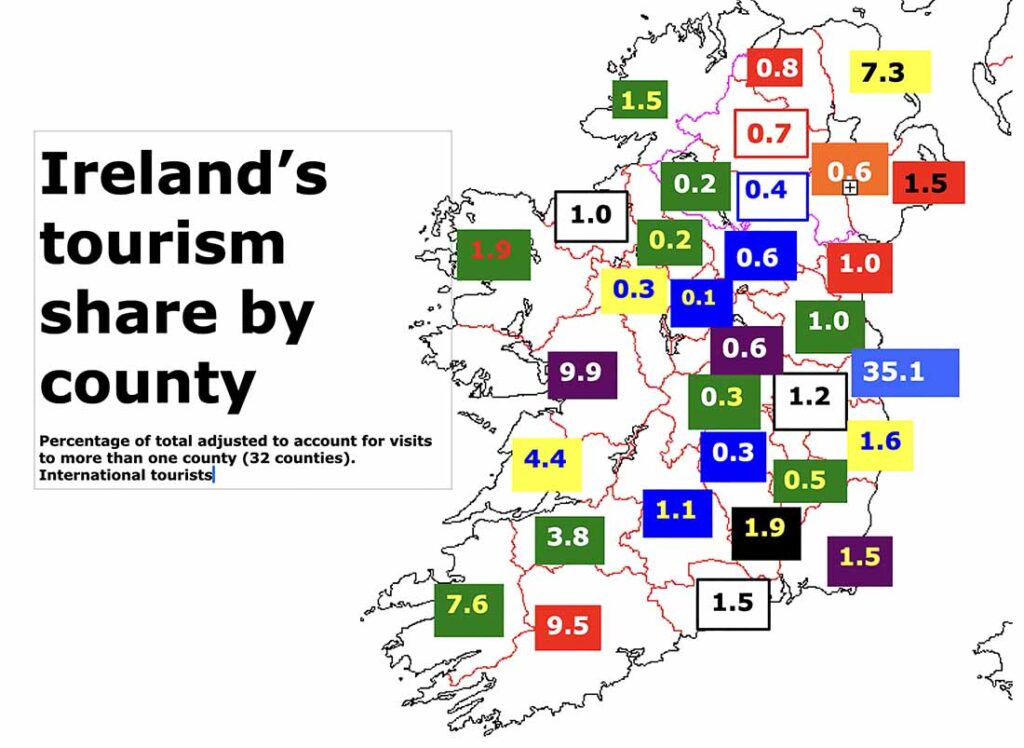
Ireland’s county Clare is renowned for its dramatic cliffs and traditional heritage, with the Cliffs of Moher offering breathtaking views over the Atlantic. The Burren’s unique limestone landscape provides hiking and rare flora, while Bunratty Castle offers medieval history with its restored interiors. Check out the traditional music scene in Doolin and the county’s coastal beaches. Clare is Ireland’s eighth largest county by size (3,188 square km) and 19th largest by population (127,938). Population peaked at 286,394 in 1841 and reached its lowest point, 73,597 in 1966. In terms of hospitality, Clare is Ireland’s sixth most visited tourist county with around 485,000 international visitors per year.
Introduction – Adventure – Anthem – Archaeology – Attractions – Awards – Birdwatching – Camping – Castles – Churches – Contact list – Cycling – Dining – Equestrian – Festivals – Fishing – Folklore – Gardens – Golf – Graveyards – Happening – Haunted – Highest – Hiking – History – Holy Wells – Hotels – Hotels top 8 – Hunting & shooting – Instagrammable – Itineraries – Largest town – Luxury – MICE – Movies – Music – New – Name – Novelists – Off the beaten track – Poets – Pubs – Quotes – Random Facts – Restaurant Awards – Sacred Places – Saints –Songs – Spas – Sports – Sunsets – Sustainable – Things to do – Towns – Video – Villages – Walking – Wanderlist – Weddings – Wild swimming – Writers – 1837– 1846 – 1852 – 1909 – 1955 – 1980 –