- Bunratty Castle: Built in 1425 by the MacNamara family and later strengthened by the O’Briens, Bunratty Castle is one of Ireland’s best-preserved medieval fortresses. Located near the River Shannon, this 15th-century tower house replaced earlier Norman structures and was restored in the 1950s. It’s part of Bunratty Castle and Folk Park, a major tourist attraction showcasing medieval life and 19th-century Irish village culture. Open daily (9:30 AM–5:30 PM, last entry 4 PM), visitors can explore the castle’s Great Hall, banquet rooms, and furnished chambers with period artifacts. The adjacent Folk Park features reconstructed 19th-century buildings, costumed interpreters, and farm animals. Admission (€15 adults, €9 children, €40 family) includes both castle and park. Expect a 2–3 hour visit with guided or self-guided tours, a gift shop, tea rooms, and Mac’s Pub. Medieval banquets (€63–€73, twice nightly at 5:30 PM and 8:45 PM) offer dining, music, and storytelling. Parking is ample, and the site is wheelchair-accessible with lifts. Located 15 km from Shannon Airport, it’s ideal for families and history enthusiasts. Its comprehensive restoration and lively Folk Park make it Clare’s top castle attraction.
- Dromoland Castle: Originally a 15th-century O’Brien stronghold, Dromoland Castle was rebuilt in the early 19th century as a grand neo-Gothic mansion. Located near Newmarket-on-Fergus, it’s the ancestral home of the O’Brien family, descendants of Brian Boru, High King of Ireland. Today, it’s a luxury 5-star hotel but retains its historical charm with baronial architecture. Non-guests can visit for dining (Earl of Thomond Restaurant or afternoon tea, €55–€85), spa treatments, or activities like falconry, archery, and golf on the 450-acre estate. Public access to the castle interior is limited unless staying or dining, but the grounds, including a walled garden, are explorable. Expect a refined experience with high-end amenities like WiFi, parking, and accessible facilities. Guided historical tours may be available for groups by arrangement. A visit can last 1–3 hours, depending on activities. Prices are premium, reflecting the luxury setting. Best for those seeking a luxurious experience rather than a traditional castle tour.
- Knappogue Castle: Built in 1467 by Seán MacNamara, Knappogue Castle near Quin is a well-preserved 15th-century tower house, later expanded by the MacNamaras and owned by the O’Briens. Restored in the 1960s, it served as a residence until 1996 and is now a visitor attraction known for its medieval banquets and historical significance. Open April–October (10 AM–4:30 PM, check knappoguecastle.ie for exact dates), visitors can take guided tours (€10 adults, €5 children) of the castle’s interior, including the banquet hall and chapel, showcasing medieval and Victorian features. The 1.7-acre walled garden is a highlight, with roses and restored landscaping. Medieval banquets (€60–€70, April–October, 6:30 PM) feature food, music, and costumed performers. Expect a 1–2 hour visit, with a gift shop, parking, and toilets available. The site is less crowded than Bunratty, offering a quieter experience. Ideal for those interested in medieval banquets and gardens, with a more intimate feel.
- Dunguaire Castle: Located on Galway Bay near Kinvara, Dunguaire Castle is a 16th-century tower house built by the O’Hynes clan in 1520, later owned by the Martyns. Named after the mythical King Guaire, it was restored in the 1920s by Oliver St. John Gogarty and in the 1950s as a cultural hub. Its picturesque seaside location makes it one of Clare’s most photographed castles. Open April–October (10 AM–4 PM, €8 adults, €5 children), visitors can explore the castle via guided tours, climbing the tower for panoramic views of Galway Bay. The small museum displays local history. Medieval banquets (€60–€70, May–October, 5:30 PM and 8:45 PM) offer dining and entertainment. Expect a 1-hour visit, with a gift shop, parking, and toilets. The castle’s compact size and scenic setting appeal to photographers and those on the Wild Atlantic Way route. Its coastal charm and banquets make it a romantic and cultural stop.
- Leamaneh Castle: Built around 1480 as a tower house by Turlough O’Brien near Kilfenora, Leamaneh Castle was expanded in the 1640s by Conor O’Brien and his wife, Máire Rua O’Brien, into a fortified mansion. Now a ruin, it’s famous for Máire Rua’s colorful legends (e.g., her alleged ruthlessness). Located in the Burren, it’s a National Monument with a striking but dilapidated structure. The castle is a roadside ruin, free to view but not enterable due to its unsafe condition and private ownership. Visitors can see the tower house, gatehouse, and remnants of the 17th-century mansion from the roadside, with the Burren’s karst landscape as a backdrop. Expect a 15–30 minute stop, with no facilities or guided tours. Parking is limited, and the site suits those exploring the Burren’s archaeological sites, like Caherconnell Stone Fort. Best for history buffs and those comfortable with minimal amenities in a rugged setting. Clare has numerous smaller ruins, such as Doonagore Castle (16th-century, near Doolin, privately owned, viewable from afar for its conical tower), Ballinalacken Castle (15th-century, a ruin near a hotel, limited access but scenic), and Newtown Castle (16th-century, restored, part of Burren College of Art, occasionally open for tours). These are less prominent but add to Clare’s castle-rich landscape.
Castles
Antrim – Armagh – Carlow – Cavan – Clare – Cork – Derry – Donegal – Down – Dublin – Fermanagh – Galway – Kerry – Kildare – Kilkenny – Laois – Leitrim – Limerick – Longford – Louth – Mayo – Meath – Monaghan – Offaly – Roscommon – Sligo – Tipperary – Tyrone – Waterford – Westmeath – Wexford – Wicklow
County Clare:
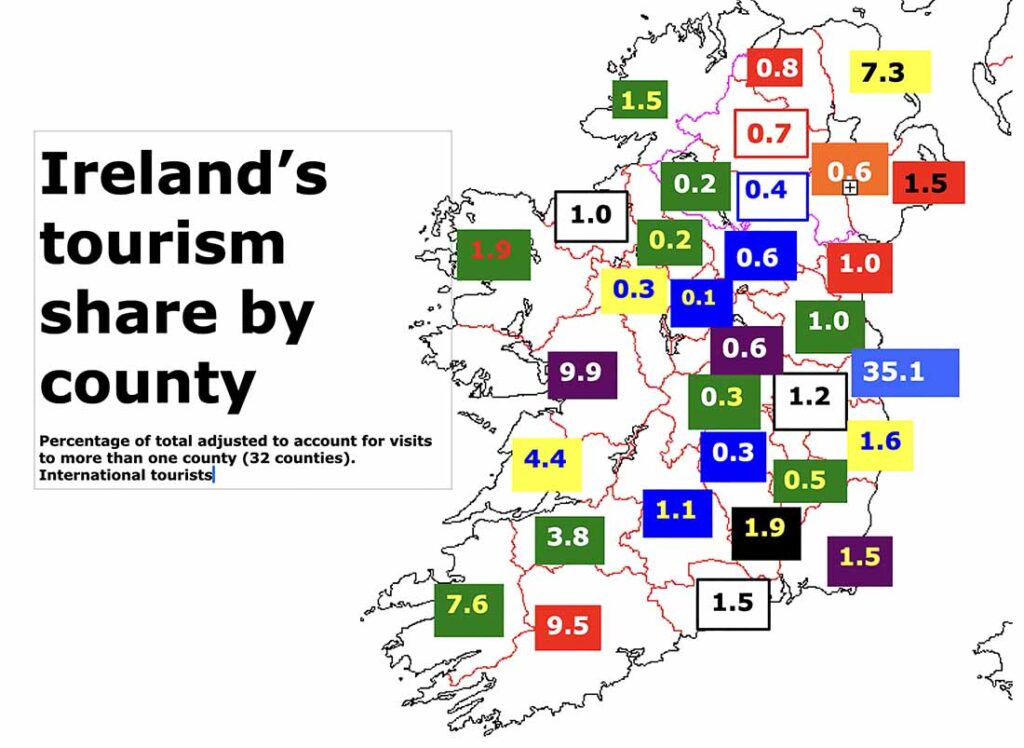
Ireland’s county Clare is renowned for its dramatic cliffs and traditional heritage, with the Cliffs of Moher offering breathtaking views over the Atlantic. The Burren’s unique limestone landscape provides hiking and rare flora, while Bunratty Castle offers medieval history with its restored interiors. Check out the traditional music scene in Doolin and the county’s coastal beaches. Clare is Ireland’s eighth largest county by size (3,188 square km) and 19th largest by population (127,938). Population peaked at 286,394 in 1841 and reached its lowest point, 73,597 in 1966. In terms of hospitality, Clare is Ireland’s sixth most visited tourist county with around 485,000 international visitors per year.
Introduction – Adventure – Anthem – Archaeology – Attractions – Awards – Birdwatching – Camping – Castles – Churches – Contact list – Cycling – Dining – Equestrian – Festivals – Fishing – Folklore – Gardens – Golf – Graveyards – Happening – Haunted – Highest – Hiking – History – Holy Wells – Hotels – Hotels top 8 – Hunting & shooting – Instagrammable – Itineraries – Largest town – Luxury – MICE – Movies – Music – New – Name – Novelists – Off the beaten track – Poets – Pubs – Quotes – Random Facts – Restaurant Awards – Sacred Places – Saints –Songs – Spas – Sports – Sunsets – Sustainable – Things to do – Towns – Video – Villages – Walking – Wanderlist – Weddings – Wild swimming – Writers – 1837– 1846 – 1852 – 1909 – 1955 – 1980 –