A maritime county in the province of Munster. It is bounded, on the north, by the river Shannon and the counties of Limerick and Cork; on the east, by the counties of Limerick and Cork; on the south, by the county of Cork and Kenmare river; and on the west, by the Atlantic Ocean. Its greatest length, from north-east to south-west, is about 85 miles; its greatest breadth, from east to west, about 55 miles; but its average dimensions are considerably less. Its area is computed at 1,186,833 acres, or about 1,854 square miles, of which a large proportion is mountain, bog, and water.
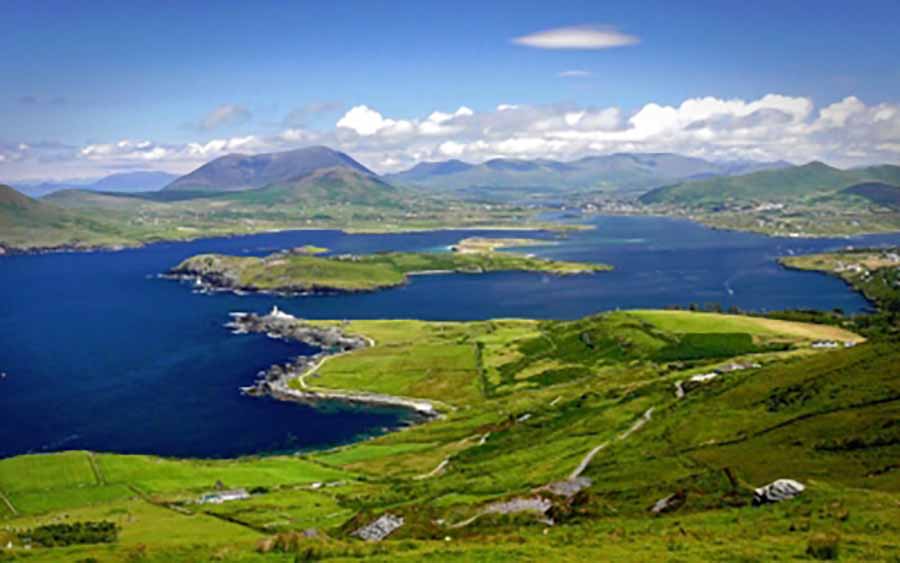
The surface is exceedingly diversified and picturesque. A succession of mountain chains traverses it from east to west, the principal being the Macgillicuddy’s Reeks, which attain in Carrantuohill an elevation of 3,414 feet above sea-level, the highest summit in Ireland; the Dunkerron mountains, rising to about 2,500 feet; Slievemish, about 2,000 feet; and various other ranges from 1,000 to 2,000 feet. The valleys and lower grounds are often fertile and beautiful, particularly the vale of Killarney, celebrated for its lakes and scenery. The principal lakes are the three lakes of Killarney, the Upper, Middle, and Lower, extending in a curved line about 6 miles, studded with islands (Ross, Innisfallen, &c.), and surrounded by magnificent mountains and woods. Other lakes are Lough Guittane, Lough Caragh, Lough Leane, and numerous smaller ones. The chief rivers are the Laune, which issues from the Lower Lake of Killarney and flows into Castlemaine Harbour; the Feale, which forms part of the northern boundary; the Blackwater, Maine, Inny, Currane, Flesk, Roughty, and various smaller streams which fall into the bays or the Shannon. The coast is deeply indented with magnificent bays and harbours, Dingle Bay, Tralee Bay, Kenmare Bay, Ballinskelligs Bay, and others, and presents bold headlands, stupendous cliffs, and romantic scenery, particularly at the Blaskets, Skelligs, and Valentia Island.
The soil varies greatly. In the valleys and fertile districts, it is a rich loam or clay, well adapted for tillage and pasture; on the hills, lighter and gravelly; and on the mountains, rocky, heathy, or boggy. Agriculture is in a progressive state in the more accessible parts. Oats, barley, wheat (in favoured spots), potatoes, and flax are cultivated; but pasture and dairy farming predominate. Large quantities of butter are produced and exported from Tralee, Killarney, and other markets. Cattle and sheep are reared extensively; and pigs are numerous. The fisheries on the coast and in the bays are productive, affording herrings, mackerel, cod, ling, haddock, and other fish; and the salmon fisheries in the rivers and estuaries are valuable. Kelp-burning was formerly carried on, but has declined. The linen manufacture exists to a small extent in Dingle and other places; coarse woollens are made; but manufactures are not prominent. Minerals include slate (quarried in various parts), limestone, freestone, and indications of coal and iron, but little worked.
The county is divided into the baronies of Corkaguiny, Dunkerron North, Dunkerron South, Glanerought, Iveragh, Iraghticonnor, Clanmaurice, Magunihy, and Trughenackmy. The principal towns are Tralee (the county town), Killarney, Cahirciveen, Dingle, Listowel, Kenmare, Milltown, Castleisland, and Tarbert. Tralee is a place of considerable trade, with good quays and markets; Killarney is famed for its lakes and tourist attractions; Cahirciveen and Dingle are market towns with some shipping.
The population, by the census of 1841, was 231,379; showing a slight decrease or stationary state since 1831 in some returns, but generally progressive in others according to districts. The number of houses was about 41,000. A large proportion of families were engaged in agriculture, with smaller numbers in trade, manufactures, and labour.
Education is advancing, particularly through national schools. There are diocesan schools and others in the principal towns.
Ecclesiastically, the county is in the dioceses of Ardfert (united to Aghadoe) and Limerick (small part), and Cashel for portions. The Established Church has parishes and churches; the Roman Catholics numerous chapels and a cathedral at Kerry; Presbyterians and others have places of worship in towns.
The Poor-Law unions are Tralee, Killarney, Cahirciveen, Dingle, Listowel, and parts of others. Workhouses are established.
The county returns two members to Parliament. Assizes are held at Tralee; petty sessions courts are distributed.
This county possesses great natural advantages in its magnificent scenery, which attracts visitors; its extensive coast and fisheries; its fertile valleys for pasture and tillage; and its water power for mills. Improvements in roads, drainage, and liming are progressing, though the mountainous character and isolation of parts retard advance. The lakes of Killarney and the surrounding mountains form one of the chief attractions of Ireland.
Ireland in 1846
Antrim – Armagh – Carlow – Cavan – Clare – Cork – Derry – Donegal – Down – Dublin – Fermanagh – Galway – Kerry – Kildare – Kilkenny – Laois – Leitrim – Limerick – Longford – Louth – Mayo – Meath – Monaghan – Offaly – Roscommon – Sligo – Tipperary – Tyrone – Waterford – Westmeath – Wexford – Wicklow
County Kerry:
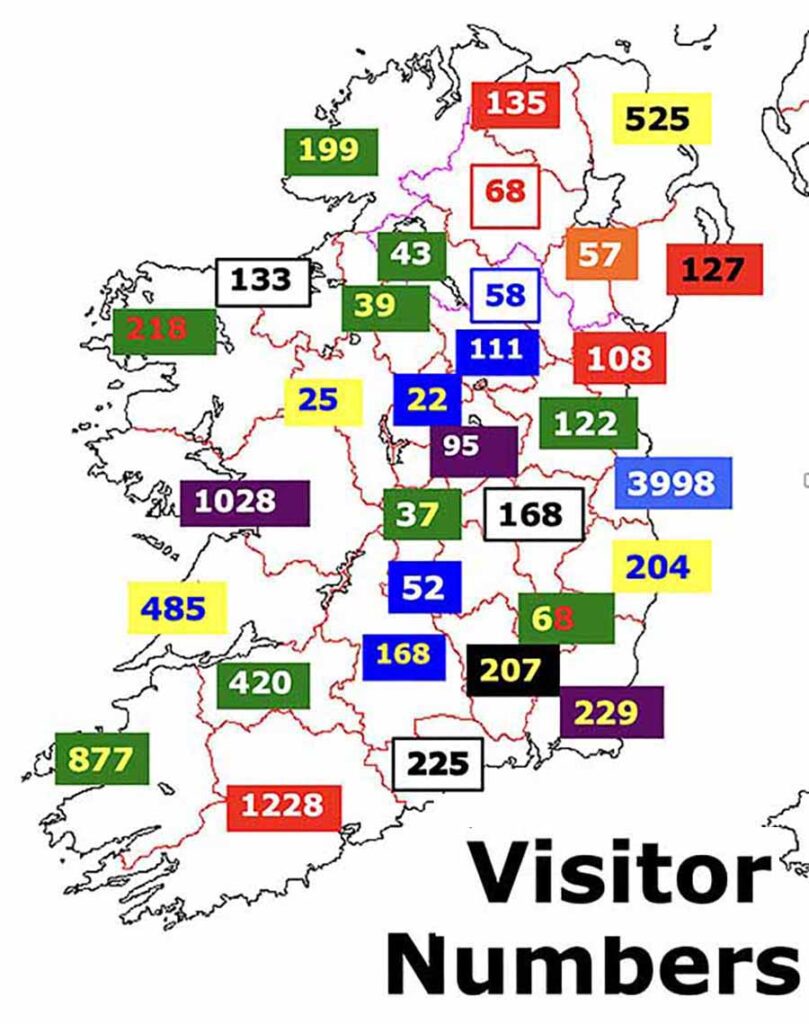
Ireland’s county Kerry is renowned for its dramatic landscapes, with the Ring of Kerry offering scenic drives past lakes and coastal cliffs. Killarney National Park features the serene Lakes of Killarney and historic Muckross House, while Dingle’s coastal trails and dolphin-watching opportunities add natural allure. Accessible by seasonal ferry, the Skellig Islands’ ancient monastic ruins make Kerry a compelling choice for outdoor adventure and history. Kerry is Ireland’s fifth largest county by size (4,701 square km) and 15th largest by population (156,458). Population peaked at 293,880 in 1841 and reached its lowest point, 112,785 in 1966. In terms of hospitality, Kerry is Ireland’s fourth most visited tourist county with around 877,000 international visitors per year.
Introduction – Adventure – Anthem – Archaeology – Attractions – Awards – Birdwatching – Camping – Castles – Churches – Contact list – Cycling – Dining – Equestrian – Festivals – Fishing – Folklore – Gardens – Golf – Graveyards – Happening – Haunted – Highest – Hiking – History – Holy Wells – Hotels – Hotels top 8 – Hunting & shooting – Instagrammable – Itineraries – Largest town – Luxury – MICE – Movies – Music – Name – New – Novelists – Off the beaten track – Poets – Pubs – Quotes – Random Facts – Restaurant Awards – Sacred Places – Saints – Songs – Spas – Sports – Sunsets – Sustainable – Things to do – Towns – Video – Villages – Walking – Wanderlist – Weddings – Wild swimming – Writers – 1837 – 1846 – 1852 – 1909 – 1955 – 1980 –