- Poulnabrone Dolmen: The Burren, near Carron, Co. Clare, V95 A0W8. This Neolithic portal tomb, dating to 4200-2900 BC, is Ireland’s oldest dated megalithic monument, predating Newgrange. Excavations in 1986 revealed the remains of 22 individuals, indicating ritual burials. Its iconic capstone and stark Burren setting make it one of Ireland’s most photographed sites. Managed by the Office of Public Works (OPW), it’s freely accessible with nearby parking.
- Caherconnell Stone Fort: Caherconnell, The Burren, Co. Clare, V95 YK76. A well-preserved medieval ringfort, occupied from the 10th to 12th centuries, likely by a high-status family. Ongoing excavations by an international archaeology school have uncovered artefacts like jewellery and tools, revealing daily life. The visitor centre offers tours, demonstrations, and a sheepdog display, making it a key Burren heritage site. Managed privately, it’s a major educational hub.
- Cahercommaun Stone Fort: Near Kilnaboy, The Burren, Co. Clare, V95 H9K2. This triple-walled stone fort, dating to the 6th-10th centuries, sits dramatically on a limestone cliff. Excavated in the 1930s by Harvard archaeologists, it revealed 12 stone buildings and souterrains, with evidence of sheep and cattle farming. Likely a defensive or communal site, it’s accessible via public trails, offering insight into early medieval life.
- Dysert O’Dea Castle and Archaeological Centre: Corofin, Co. Clare, V95 T17K. Built in 1480 by the O’Dea clan, this tower house stands on a former monastic site from the 8th century. The area features over 25 monuments, including a Romanesque church with a carved doorway, a round tower stump, and a high cross. The castle houses the Clare Archaeological Centre, with exhibits and a 4-km trail. Managed privately, it’s a key site for exploring medieval and early Christian Clare.
- Knappogue Castle: Quin, Co. Clare, V95 A2DX. A 15th-century tower house built in 1467 by Sean Mac-Con MacNamara, expanded in later centuries. Occupied by Cromwellian forces during the 1641 Rebellion, it was restored in the 20th century. The castle reflects Gaelic and later Anglo-Norman influences, offering guided tours and medieval banquets. Privately managed, it’s accessible to visitors.
- Quin Abbey: Quin, Co. Clare, V95 VY06. A 13th-century Franciscan friary founded by the O’Brien clan, with significant 15th-16th century limestone sculptures. Built near an earlier Norman castle, it served as a religious centre until its dissolution in the 1540s. Its well-preserved cloister and tower are highlights. Managed by the OPW, it’s freely accessible, showcasing Clare’s medieval ecclesiastical heritage.
- Ennis Friary: Abbey Street, Ennis, Co. Clare, V95 N7K8. Founded in 1242 by the O’Brien kings of Thomond, this Franciscan friary features intricate 14th-15th century carvings, including a Passion scene. It served as a religious and educational hub until the 17th century. Managed by the OPW, it offers guided tours, highlighting Clare’s Franciscan legacy in an urban setting.
- Leamaneh Castle: Near Kilfenora, Co. Clare, V95 YX78. A 15th-century tower house expanded into a fortified mansion in the 17th century by Conor O’Brien and Máire Rua. Associated with legends of Máire’s ruthlessness, it reflects Gaelic and early modern architecture. Now a ruin, it’s accessible via roadside viewing on private land, offering a glimpse into Clare’s turbulent history.
- Kilfenora Cathedral and High Crosses: Kilfenora, Co. Clare, V95 RF28. A 12th-century cathedral, once the seat of a small diocese, with seven early medieval high crosses (9th-12th centuries), including the ornate Doorty Cross. Known as the “City of the Crosses,” it was a religious centre tied to St. Fachtnan. The site, partially in use as a church, is managed by the OPW, with crosses displayed in a glass-roofed transept for protection.
- Mooghaun Hillfort: Near Newmarket-on-Fergus, Co. Clare, V95 X2F8. A Late Bronze Age hillfort (c. 1000-500 BC), one of Ireland’s largest, with three concentric ramparts. Excavations revealed evidence of a high-status settlement, possibly linked to the nearby Mooghaun Hoard, a significant gold find. Accessible via public paths, it offers views of the Shannon Estuary and insight into prehistoric social hierarchies.
Archaeological sites
Antrim – Armagh – Carlow – Cavan – Clare – Cork – Derry – Donegal – Down – Dublin – Fermanagh – Galway – Kerry – Kildare – Kilkenny – Laois – Leitrim – Limerick – Longford – Louth – Mayo – Meath – Monaghan – Offaly – Roscommon – Sligo – Tipperary – Tyrone – Waterford – Westmeath – Wexford – Wicklow
County Clare:
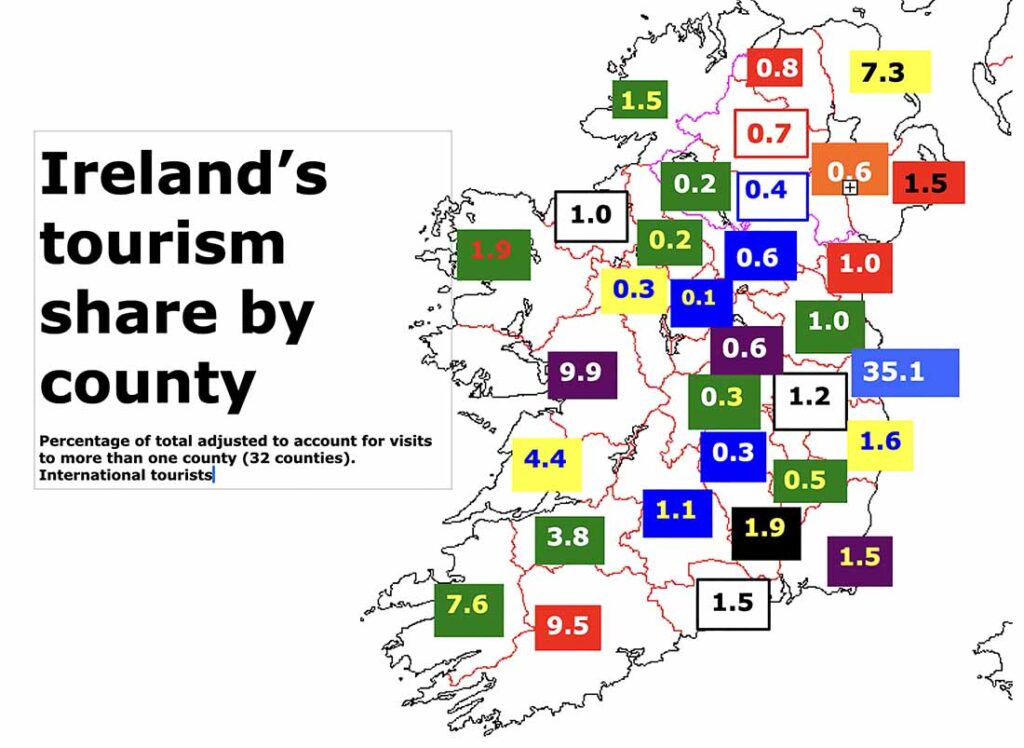
Ireland’s county Clare is renowned for its dramatic cliffs and traditional heritage, with the Cliffs of Moher offering breathtaking views over the Atlantic. The Burren’s unique limestone landscape provides hiking and rare flora, while Bunratty Castle offers medieval history with its restored interiors. Check out the traditional music scene in Doolin and the county’s coastal beaches. Clare is Ireland’s eighth largest county by size (3,188 square km) and 19th largest by population (127,938). Population peaked at 286,394 in 1841 and reached its lowest point, 73,597 in 1966. In terms of hospitality, Clare is Ireland’s sixth most visited tourist county with around 485,000 international visitors per year.
Introduction – Adventure – Anthem – Archaeology – Attractions – Awards – Birdwatching – Camping – Castles – Churches – Contact list – Cycling – Dining – Equestrian – Festivals – Fishing – Folklore – Gardens – Golf – Graveyards – Happening – Haunted – Highest – Hiking – History – Holy Wells – Hotels – Hotels top 8 – Hunting & shooting – Instagrammable – Itineraries – Largest town – Luxury – MICE – Movies – Music – New – Name – Novelists – Off the beaten track – Poets – Pubs – Quotes – Random Facts – Restaurant Awards – Sacred Places – Saints –Songs – Spas – Sports – Sunsets – Sustainable – Things to do – Towns – Video – Villages – Walking – Wanderlist – Weddings – Wild swimming – Writers – 1837– 1846 – 1852 – 1909 – 1955 – 1980 –