- Blarney Stone: Kissing the Blarney Stone at Blarney Castle is believed to grant the gift of eloquence, requiring visitors to lean backwards over a high drop.
- Titanic’s Last Stop: Cobh, named Queenstown under the colonial regime, was the final port of call for the Titanic in 1912 before its ill-fated voyage.
- Kinsale’s Giant Footprint: A rock formation near Kinsale, known as the Giant’s Footprint, is linked to folklore about a giant leaping across the sea.
- Cork’s Butter Museum: The Butter Museum in Cork city celebrates the county’s historic butter trade, once the largest butter market in the world.
- Ballycotton’s Ghost Ship: In 1917, a German U-boat sank a ship off Ballycotton, and locals report sightings of a ghostly vessel on foggy nights.
- Youghal’s Clock Gate: Youghal’s Clock Gate Tower was used as a prison where rebels were hanged from its windows during the 1798 Rebellion.
- Mizen Head’s Marconi Station: Mizen Head, Ireland’s southernmost point, housed an early Marconi radio station that received signals from the Titanic.
- Bantry’s French Armada: In 1796, a French fleet of 43 ships attempted to land at Bantry Bay to support Irish rebels but was scattered by storms.
- Garnish Island’s Italian Gardens: Garnish Island near Glengarriff features Italian-style gardens created in 1910, accessible only by boat.
- Clonakilty’s Model Village: Clonakilty has a detailed miniature replica of West Cork’s towns, built to scale using local materials.
Random facts
Antrim – Armagh – Carlow – Cavan – Clare – Cork – Derry – Donegal – Down – Dublin – Fermanagh – Galway – Kerry – Kildare – Kilkenny – Laois – Leitrim – Limerick – Longford – Louth – Mayo – Meath – Monaghan – Offaly – Roscommon – Sligo – Tipperary – Tyrone – Waterford – Westmeath – Wexford – Wicklow
County Cork:
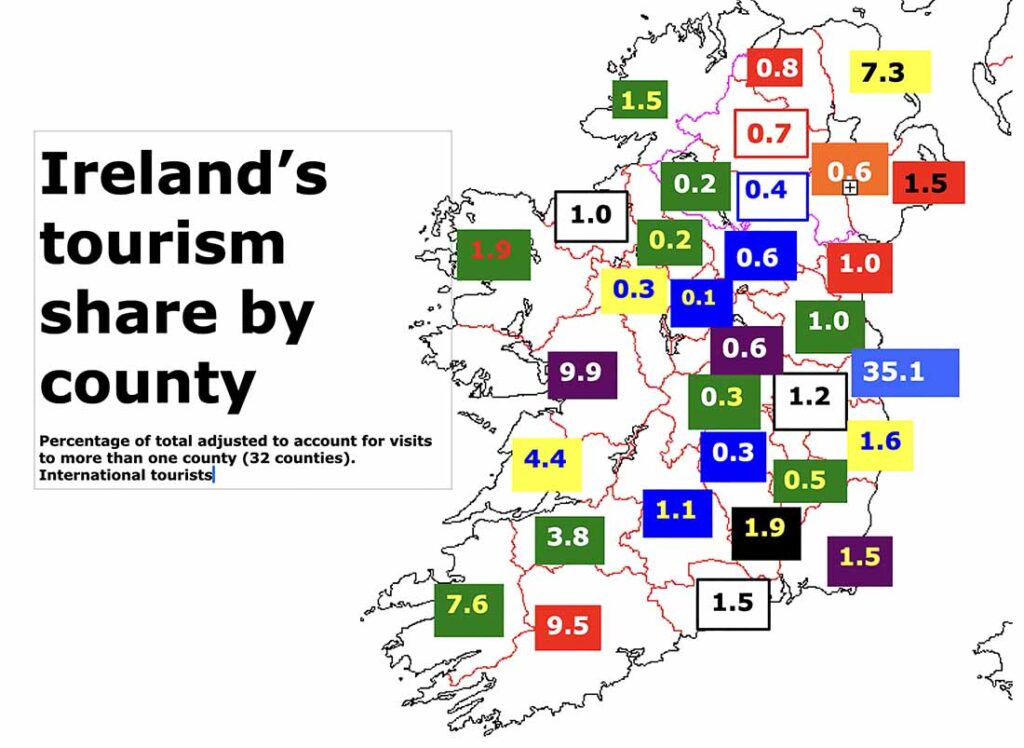
Ireland’s county Cork blends historic sites with scenic beauty, with Cork City’s English Market and St Fin Barre’s Cathedral offering cultural and architectural depth. Blarney Castle, home to the famous Blarney Stone, provides historic allure, while the coastal town of Kinsale offers sailing and seafood. Other attractions include the Beara Peninsula’s rugged trails. Cork is Ireland’s largest county by size (7,460 sq km) and third largest by population (584,156). Population peaked at 854,118 in 1841 (when Cork was Ireland’s most populous county) and reached its lowest point, 330,443 in 1961. In terms of hospitality, Cork is Ireland’s second most visited tourist county with around 1,228,000 international visitors per year.
Introduction – Adventure – Anthem – Archaeology – Attractions – Awards – Birdwatching – Camping – Castles – Churches – Contact list – Cycling – Dining – Equestrian – Festivals – Fishing – Folklore – Gardens – Golf – Graveyards – Happening – Haunted – Highest – Hiking – History – Holy Wells – Hotels – Hotels top 8 – Hunting & shooting – Instagrammable – Itineraries – Largest town – Luxury – MICE – Movies – Music – New – Name – Novelists – Off the beaten track – Poets – Pubs – Quotes – Random Facts – Restaurant Awards – Sacred Places – Saints – Songs – Spas – Sports – Sunsets – Sustainable – Things to do – Towns – Video – Villages – Walking – Wanderlist – Weddings – Wild swimming – Writers – 1837– 1846 – 1852 – 1909 – 1955 – 1980 –