Start your walking tour through the historic streets of Derry at the striking Peace Bridge, a sinuous pedestrian span opened in 2011 that arcs gracefully over the River Foyle, linking the east and west banks as a potent symbol of unity. Cross from the Cityside to the Waterside, pausing to admire views of the river and the distant spire of St Eugene’s Cathedral rising behind the neo-classical Guildhall, whose restored façade and stained-glass windows speak of civic pride rebuilt after fire and conflict.
Descending to the west bank, proceed along the Foyle Embankment towards the city centre, where the famous Derry Girls mural adorns a gable end near Badger’s Bar. This colourful tribute to the beloved television series captures the cheeky spirit of local youth and has become an essential selfie spot for fans tracing the show’s locations.
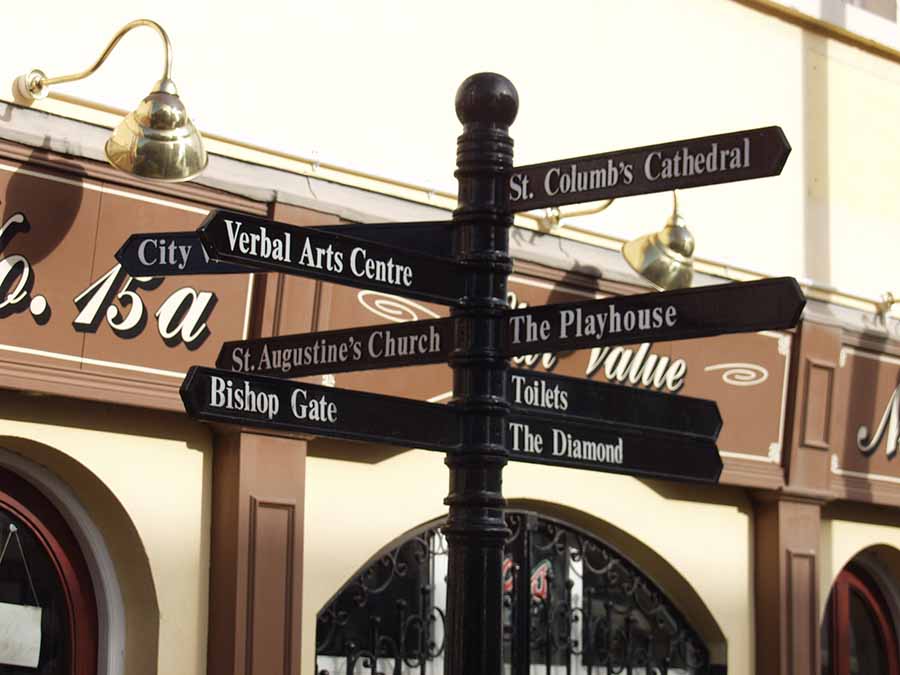
From here, head uphill via Butcher Street and Magazine Street to ascend the City Walls at one of the access points, such as near Ferryquay Gate. These remarkable 17th-century defences, constructed between 1613 and 1618 during the Plantation of Ulster, form a circuit of about one mile atop broad ramparts that reach up to eight metres high and nine metres thick in places. Stroll the elevated walkway in a clockwise direction, passing bastions like Double Bastion and Royal Bastion, where historic cannons still point outwards. The path offers panoramic prospects over the compact streets within the walls, the Bogside neighbourhood below, and the sweeping curve of the Foyle. The four original gates—Bishop’s Gate, Butcher Gate, Ferryquay Gate, and Shipquay Gate—punctuate the route, each carrying echoes of sieges and commerce from centuries past.
A short descent from the walls near Butcher Gate leads into the Bogside, where the People’s Gallery of murals tells a powerful story of civil rights, resistance, and the events of Bloody Sunday in 1972. These vivid outdoor artworks, created by the Bogside Artists, provide a poignant outdoor gallery that contrasts sharply with the Georgian elegance above. Nearby, the Museum of Free Derry offers deeper insight into that turbulent era, its exhibits a sobering yet essential complement to the visual narrative on the streets.
To complete the loop, return uphill towards the walls or wander back via Shipquay Street into the bustling heart around The Diamond, where independent shops, cafés, and the occasional live music spill from pubs. The entire circuit, manageable in about an hour and a half at a comfortable pace, weaves together Derry’s monastic origins, Plantation heritage, troubled modern history, and contemporary hope. No grand theatrics here, but a profoundly moving sense of a place that has walked through division to emerge welcoming and reflective.
Largest town walking tour
Antrim – Armagh – Carlow – Cavan – Clare – Cork – Derry – Donegal – Down – Dublin – Fermanagh – Galway – Kerry – Kildare – Kilkenny – Laois – Leitrim – Limerick – Longford – Louth – Mayo – Meath – Monaghan – Offaly – Roscommon – Sligo – Tipperary – Tyrone – Waterford – Westmeath – Wexford – Wicklow
Population of towns in county Derry
| Derry | 85,080 |
| Coleraine | 24,483 |
| Limavady | 11,810 |
| Magherafelt | 9,250 |
| Portstewart | 7,854 |
| Maghera | 4,235 |
| Eglington | 3,571 |
| Dungiven | 3,346 |
| Newbuildings | 2,837 |
Towns
Antrim – Armagh – Carlow – Cavan – Clare – Cork – Derry – Donegal – Down – Dublin – Fermanagh – Galway – Kerry – Kildare – Kilkenny – Laois – Leitrim – Limerick – Longford – Louth – Mayo – Meath – Monaghan – Offaly – Roscommon – Sligo – Tipperary – Tyrone – Waterford – Westmeath – Wexford – Wicklow
Villages
Antrim – Armagh – Carlow – Cavan – Clare – Cork – Derry – Donegal – Down – Dublin – Fermanagh – Galway – Kerry – Kildare – Kilkenny – Laois – Leitrim – Limerick – Longford – Louth – Mayo – Meath – Monaghan – Offaly – Roscommon – Sligo – Tipperary – Tyrone – Waterford – Westmeath – Wexford – Wicklow
County Derry:
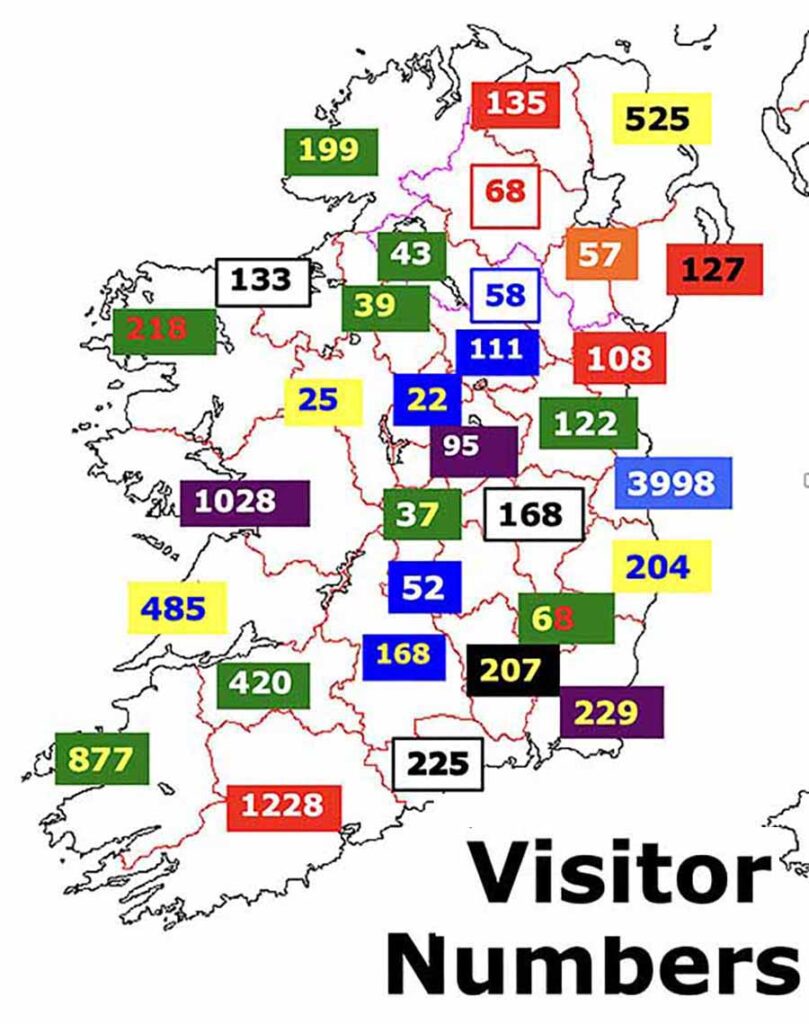
Ireland’s county Derry offers a rich historical tapestry, with the city’s 17th-century walls providing a walkable journey through its past. The Guildhall and Tower Museum explore Derry’s maritime and political history, while the Peace Bridge offers scenic views over the River Foyle. Derry is Ireland’s 15th largest county by size (2,067 square km) and sixth largest by population (252,231). Population previously peaked at 222,174 in 1841 and reached its lowest point, 139,693 in 1926. In terms of hospitality, Derry is Ireland’s 16th most visited tourist county with around 135,000 international visitors per year.
Introduction – Adventure – Anthem – Archaeology – Attractions – Awards – Birdwatching – Camping – Castles – Churches – Contact list – Cycling – Dining – Equestrian – Festivals – Fishing – Folklore – Gardens – Golf – Graveyards – Happening – Haunted – Highest – Hiking – History – Holy Wells – Hotels – Hotels top 8 – Hunting & shooting – Instagrammable – Itineraries – Largest town – Luxury – MICE – Movies – Music – New – Name – Novelists – Off the beaten track – Poets – Pubs – Quotes – Random Facts – Restaurant Awards– Sacred Places – Saints – Songs – Spas – Sports – Sunsets – Sustainable – Things to do – Towns – Video – Villages – Walking – Wanderlist – Weddings – Wild swimming – Writers – 1837 – 1846 – 1852 – 1909 – 1955 – 1980 –