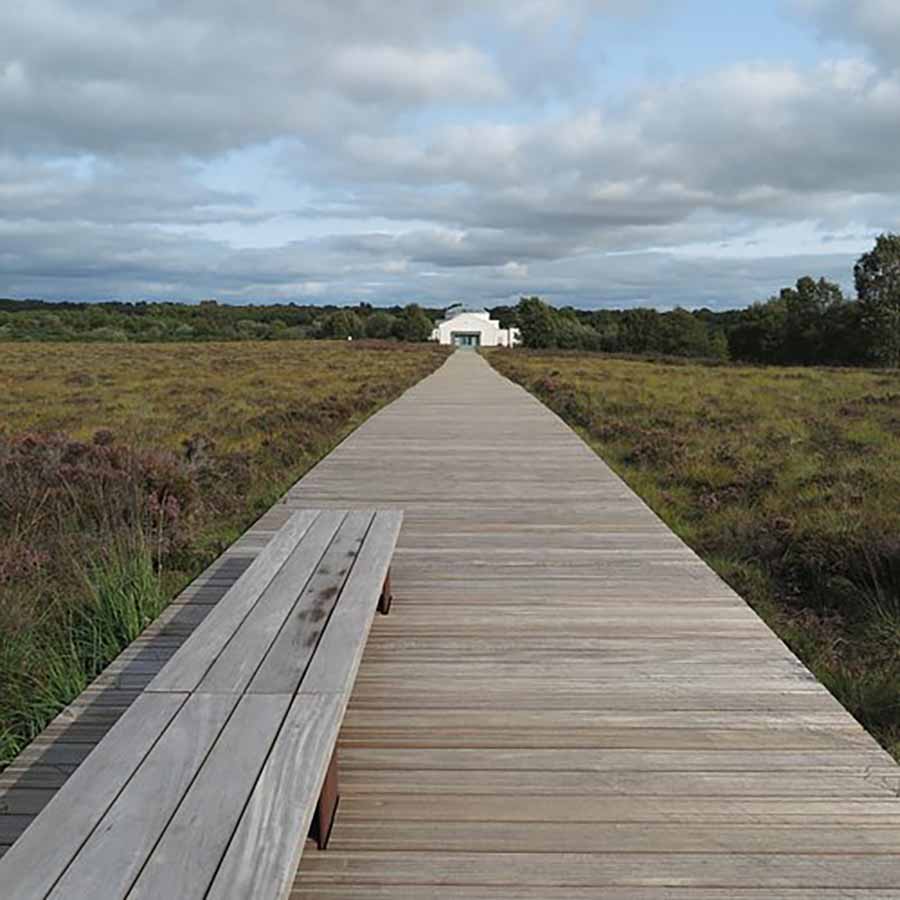
- Corlea Trackway Visitor Centre: Corlea, Keenagh, County Longford, approximately 15 km south of Longford Town (Coordinates: 53.659°N, 7.842°W).. The Corlea Trackway, dating to 148 BC, is an Iron Age wooden road discovered in a bog, representing one of the largest and best-preserved prehistoric trackways in Europe. Constructed from oak planks and runners, it was likely built to facilitate movement across the boggy landscape, possibly for ceremonial or trade purposes. Excavations in the 1980s and 1990s uncovered 18th- and 19th-century trackways nearby, indicating long-term use of the route. The site is associated with local folklore and the O’Farrell clan, who dominated the region in medieval times. The visitor centre, opened in 1994, displays a preserved section of the trackway and offers insights into Iron Age life and bog conservation. Managed by the Office of Public Works (OPW) via Heritage Ireland, the visitor centre is open seasonally (typically April–September) with guided tours. Admission is free, but check www.heritageireland.ie for opening hours and tour availability.
- Granard Motte and Bailey: Granard, County Longford, approximately 20 km northeast of Longford Town (Coordinates: 53.774°N, 7.497°W).. The Granard Motte and Bailey is one of Ireland’s finest examples of a Norman earthwork fortification, constructed in the late 12th or early 13th century (c. 1190–1200). Standing 34 metres high, it is the highest motte in Ireland. Built by the Normans, likely under Richard Tuite, it served as a defensive and administrative centre in the medieval lordship of Meath. The site includes a flat-topped earthen mound (motte) and an enclosed courtyard (bailey). Its strategic location reflects Norman efforts to control the region, which was previously under O’Farrell Gaelic lordship. The motte is linked to local folklore, including tales of a hidden tunnel. The site is publicly accessible with no formal entry fee. Visitors can explore the motte and surrounding area, but there are no on-site facilities. Check www.discoverireland.ie or local tourism sites for access details.
- Inchcleraun (Quaker’s Island) Monastic Site: Inchcleraun Island, Lough Ree, near Lanesborough, County Longford (Coordinates: 53.683°N, 7.933°W).. Inchcleraun, also known as Quaker’s Island, is home to a significant early medieval monastic complex founded in the 6th century, traditionally linked to St. Diarmuid, a disciple of St. Ciarán of Clonmacnoise. The site includes the remains of several churches, a clochan (stone cell), a bullaun stone, and early Christian grave slabs, dating from the 8th to 12th centuries. The monastery was a key religious centre in the region, reflecting the spread of Christianity in early medieval Ireland. Its island setting provided isolation and protection. Archaeological surveys indicate continuous use until the 13th century, with later decline due to Viking and Norman pressures. Access is by boat from Lanesborough or nearby points on Lough Ree. The site is remote, with no formal visitor facilities, but it is open to the public. Visitors should arrange private boat hire and check www.archaeology.ie for monument details.
- Saints’ Island Monastic Site: Saints’ Island, Lough Ree, near Newtowncashel, County Longford (Coordinates: 53.616°N, 7.916°W).. Saints’ Island hosts another early medieval monastic site, established in the 6th or 7th century, associated with the spread of Christianity in the Irish midlands. The site includes the ruins of an Augustinian priory (founded c. 12th century) built on earlier monastic foundations, with remnants of a church, cloister, and associated structures. Artefacts from the site, including early Christian grave markers, suggest activity from the 7th to 13th centuries. The island’s isolation on Lough Ree made it a spiritual retreat, similar to Inchcleraun, and it was linked to the O’Farrell clan’s patronage. Its decline followed the Dissolution of the Monasteries in the 16th century. Accessible by boat from Newtowncashel or Lanesborough. No formal visitor facilities exist, but the site is open to the public. Check www.archaeology.ie for monument details and arrange boat access locally.
- Abbeyshrule Cistercian Abbey: Abbeyshrule, County Longford, approximately 15 km southwest of Longford Town (Coordinates: 53.582°N, 7.692°W).. Founded in 1150–1200 by the O’Farrell family, the Cistercian Abbey of Abbeyshrule (Monastery of St. Mary) is a well-preserved medieval monastic site. The abbey includes the remains of a church, chapter house, and cloister, with architectural features from the 12th to 15th centuries. It served as a religious and economic hub under Cistercian management, reflecting the order’s influence in medieval Ireland. The abbey was suppressed during the Dissolution of the Monasteries (16th century) but remains a significant example of Cistercian architecture. Archaeological surveys have identified associated features like fishponds and mills. Managed by the OPW, the site is accessible to the public with free entry. Limited on-site facilities; check www.heritageireland.ie for seasonal access information.
- Clonbrin Bronze Age Shield Find Site: Clonbrin, near Abbeylara, County Longford, approximately 20 km northeast of Longford Town (Coordinates: 53.783°N, 7.583°W).. Clonbrin is notable for the discovery of a rare Bronze Age leather shield in 1908, found in a bog and dated to c. 1200–1000 BC. The shield, one of only a few surviving leather examples from Europe, is now housed in the National Museum of Ireland. While the find spot itself is not a structured monument, it highlights the region’s Bronze Age activity, likely linked to ritual deposition in bogs. The surrounding area contains other archaeological features, such as ring forts, indicating long-term settlement. The shield’s discovery underscores County Longford’s role in prehistoric trade and ritual practices. The find spot is in a bog with no formal visitor access, but the shield can be viewed at the National Museum of Ireland in Dublin.
Archaeological sites
Antrim – Armagh – Carlow – Cavan – Clare – Cork – Derry – Donegal – Down – Dublin – Fermanagh – Galway – Kerry – Kildare – Kilkenny – Laois – Leitrim – Limerick – Longford – Louth – Mayo – Meath – Monaghan – Offaly – Roscommon – Sligo – Tipperary – Tyrone – Waterford – Westmeath – Wexford – Wicklow
County Longford:
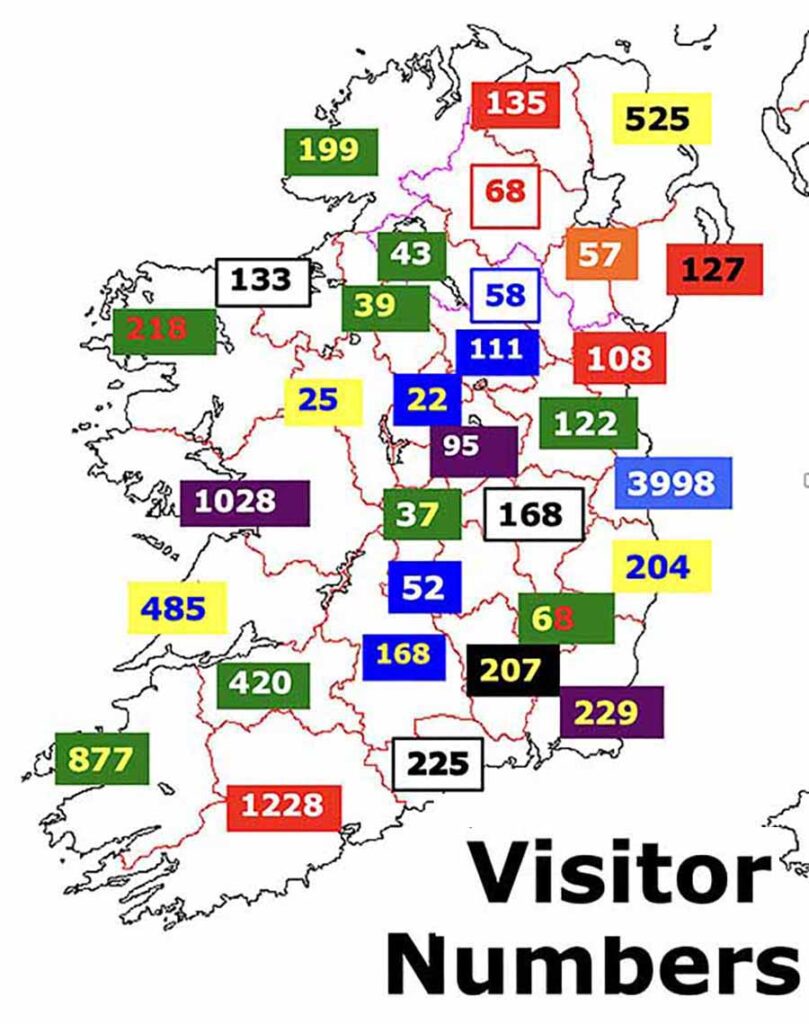
Ireland’s county Longford offers a peaceful blend of history and countryside, with the Corlea Trackway Visitor Centre showcasing an ancient Iron Age road. The county’s St Mel’s Cathedral in Longford town provides architectural beauty, while the River Inny offers opportunities for kayaking and fishing. Other attractions include the rolling farmlands and historic Ardagh village. Longford is Ireland’s fourth smallest county by size and second smallest by population (46,751). Population peaked at 115,491 in 1841 and reached its lowest point, 28,250 in 1971. In terms of hospitality, Longford is Ireland’s 32nd most visited and Ireland’s least visited tourist county with around 22,000 international visitors per year.
Introduction – Adventure – Anthem – Archaeology – Attractions – Awards – Birdwatching – Camping – Castles – Churches – Contact list – Cycling – Dining – Equestrian – Festivals – Fishing – Folklore – Gardens – Golf – Graveyards – Happening – Haunted – Highest – Hiking – History – Holy Wells – Hotels – Hotels top 8 – Hunting & shooting – Instagrammable – Itineraries – Largest town – Luxury – MICE – Movies – Music – Name – New – Novelists – Off the beaten track – Poets – Pubs – Quotes – Random Facts – Restaurant Awards – Sacred Places – Saints – Songs – Spas – Sports – Sunsets – Sustainable – Things to do – Towns – Video – Villages – Walking – Wanderlist – Weddings – Wild swimming – Writers – 1837 – 1846 – 1852 – 1909 – 1955 – 1980 –