- Oliver Goldsmith (c. 1728-1774) Born in Pallas, near Abbeyshrule, Goldsmith was a novelist, poet, and playwright whose works include The Vicar of Wakefield (1766), a classic novel, and the pastoral poem The Deserted Village (1770), which critiques rural depopulation. His plays, like She Stoops to Conquer (1773), remain influential. His Longford upbringing shaped his nostalgic depictions of rural Ireland.
- Maria Edgeworth (1768-1849) Born in Black Bourton, Oxfordshire, but raised in Edgeworthstown, Longford, Edgeworth was a novelist whose Castle Rackrent (1800) is considered a pioneering historical novel. Her works, like Belinda (1801) and Orlandino (1848), explored Irish society and education, outselling Jane Austen in her time. She influenced Sir Walter Scott and contributed to Longford’s literary legacy.
- Pádraic Colum (1881-1972) Born in Longford Workhouse, where his father was master, Colum was a poet, playwright, and folklorist central to the Irish Literary Revival. His works, like The Land (1905) and Wild Earth (1907), celebrated Irish rural life, while his children’s books retold myths. He later lived in the U.S., contributing to Irish-American literature.
- John Keegan Casey (1846-1870) Born in Mount Dalton, near Mullingar, Casey, known as “Leo,” was a poet and nationalist whose ballads, like The Rising of the Moon (1866), became anthems of Irish rebellion. His A Wreath of Shamrocks (1866) reflected Longford’s Fenian spirit. His work is celebrated by the John Keegan Casey Society in Gurteen, Longford.
- Vona Groarke (1964-) Born in Edgeworthstown, Groarke is a poet whose collections, like Shale (1994) and Flight (2002), explore personal and communal themes, often referencing Longford’s landscapes. Her work, praised for its lyricism, draws on Goldsmith’s The Deserted Village for contemporary resonance. She teaches at the University of Manchester.
- Frances Browne (1816-1879) Born in Stranorlar, Donegal, but with Longford connections through her family’s residence in Longford town, Browne was a blind poet and novelist known as the “Blind Poetess of Ulster.” Her Granny’s Wonderful Chair (1856) is a beloved children’s book, and her poetry reflected rural Irish life, including Longford’s influence.
- Jane Barlow (1856-1917) Born in Clontarf, Dublin, but with significant Longford ties through her family’s residence in Edgeworthstown, Barlow was a poet and novelist. Her Irish Idylls (1892) and Bog-land Studies (1892) depicted rural Irish life, drawing on Longford’s pastoral settings. She was a friend of the Edgeworth family.
- Kathy Rodgers (1970-) Born in Longford town, Rodgers is an emerging poet and short story writer featured in the Heartland anthology (2002), edited by Paul Perry. Her work, rooted in Longford’s storytelling tradition, explores local identity and community, contributing to the county’s modern literary scene.
- Thomas Davis (1814-1845) Born in Mallow, Cork, but with Longford connections through his mother’s family in Ballinalee, Davis was a poet and journalist who co-founded the Nation newspaper. His patriotic poems, like A Nation Once Again (1844), inspired Irish nationalism, reflecting Longford’s revolutionary spirit.
- Breda Sullivan (1950-) Born in Longford, Sullivan is a poet and short story writer whose work has gained national recognition. Featured in Longford’s Heartland anthology, her poetry and prose explore themes of rural life and personal experience, continuing the county’s literary tradition.
Writers
Antrim – Armagh – Carlow – Cavan – Clare – Cork – Derry – Donegal – Down – Dublin – Fermanagh – Galway – Kerry – Kildare – Kilkenny – Laois – Leitrim – Limerick – Longford – Louth – Mayo – Meath – Monaghan – Offaly – Roscommon – Sligo – Tipperary – Tyrone – Waterford – Westmeath – Wexford – Wicklow
County Longford:
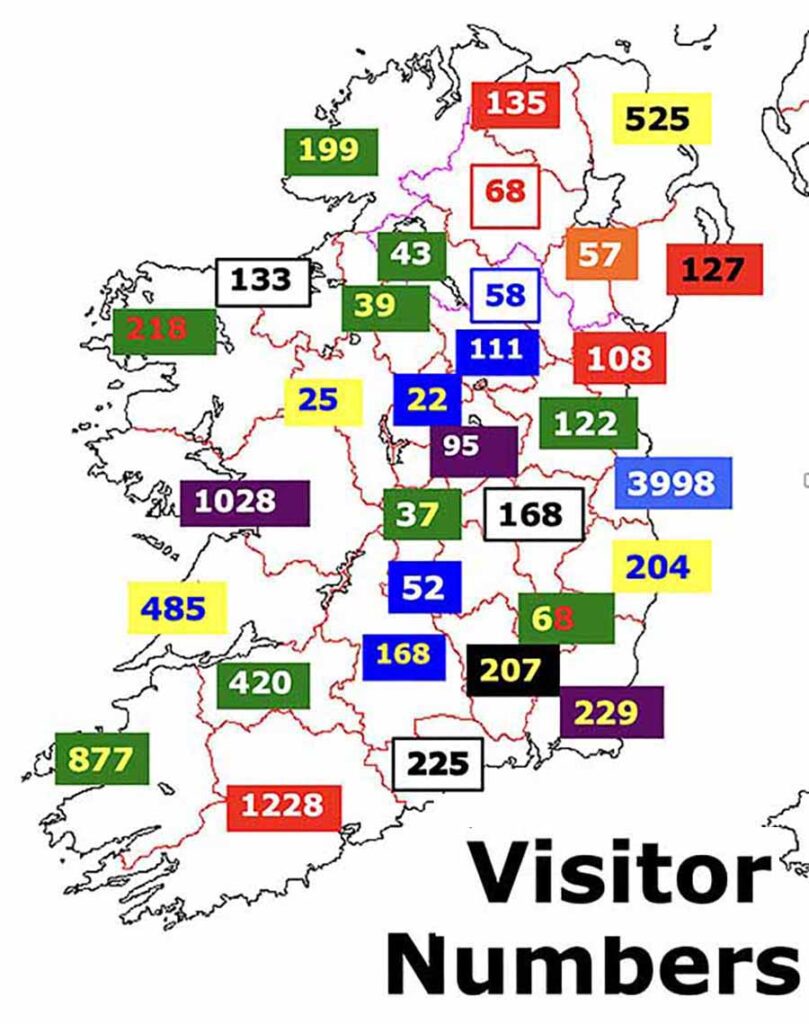
Ireland’s county Longford offers a peaceful blend of history and countryside, with the Corlea Trackway Visitor Centre showcasing an ancient Iron Age road. The county’s St Mel’s Cathedral in Longford town provides architectural beauty, while the River Inny offers opportunities for kayaking and fishing. Other attractions include the rolling farmlands and historic Ardagh village. Longford is Ireland’s fourth smallest county by size and second smallest by population (46,751). Population peaked at 115,491 in 1841 and reached its lowest point, 28,250 in 1971. In terms of hospitality, Longford is Ireland’s 32nd most visited and Ireland’s least visited tourist county with around 22,000 international visitors per year.
Introduction – Adventure – Anthem – Archaeology – Attractions – Awards – Birdwatching – Camping – Castles – Churches – Contact list – Cycling – Dining – Equestrian – Festivals – Fishing – Folklore – Gardens – Golf – Graveyards – Happening – Haunted – Highest – Hiking – History – Holy Wells – Hotels – Hotels top 8 – Hunting & shooting – Instagrammable – Itineraries – Largest town – Luxury – MICE – Movies – Music – Name – New – Novelists – Off the beaten track – Poets – Pubs – Quotes – Random Facts – Restaurant Awards – Sacred Places – Saints – Songs – Spas – Sports – Sunsets – Sustainable – Things to do – Towns – Video – Villages – Walking – Wanderlist – Weddings – Wild swimming – Writers – 1837 – 1846 – 1852 – 1909 – 1955 – 1980 –