Pre-1000 The Gaelic Nation
County Longford, originally part of the kingdom of Conmaicne, was a region shaped by Gaelic regional structures. By 85 AD, the High King of Ireland formed the province of Meath, incorporating Longford, Meath, Westmeath, and parts of Dublin. The area later became known as Teffia (Teathbha), ruled by the Conmaicne Rein, a branch of the Conmaicne dynasty. In the 9th century, a prince named Annaly gave his name to the territory, establishing it as Annaly, which broadly corresponds to modern County Longford. The O’Farrell (Ó Fearghail) clan, descending from a warrior named Fearghal (‘valiant’), emerged as the dominant Gaelic family, establishing a stronghold at Longfort Ui Ferghail (meaning ‘fortress of the O’Farrells’) on the River Camlin, the site of modern Longford town. This period was marked by small-scale Gaelic kingships, with Longford as a strategic frontier between Meath and Connacht. Archaeological evidence, such as ringforts, suggests a society based on cattle rearing and local trade, with Christianity influencing the region through early monastic sites like those on Saints’ Island and Inchcleraun (Quakers’ Island).
1000–1100: Gaelic Dominance and Early Christian Influence
During this period, Longford remained under the control of the O’Farrells, who consolidated their power in Annaly. The region was a Gaelic stronghold, with the O’Farrells maintaining relative autonomy despite the growing influence of the High Kings of Ireland. The Battle of Clontarf (1014) saw a warrior from Annaly earn the title ‘Fearghal’ for valour, reinforcing the clan’s prominence. Monastic settlements, such as the Cistercian Abbey at Abbeylara, began to take root, reflecting the spread of Christianity and its integration into Gaelic society. Longford’s strategic location near the River Shannon made it a key point for trade and communication. The Annals of Ulster and Annals of the Four Masters note regional conflicts but provide limited detail on Longford, indicating it was a relatively stable Gaelic territory.
1100–1200: Norman Arrival and O’Farrell Resilience
The Norman invasion of Ireland (1169) marked a significant shift, though Longford was less immediately affected than eastern counties. The O’Farrells, ruling Annaly, maintained their dominance, navigating the new Norman presence through diplomacy and resistance. The Normans established some influence in nearby Meath, but Longford’s bogs and low-lying terrain deterred large-scale incursion. The O’Farrells’ fortified settlements, such as the longphort at Longford town, served as defensive strongholds. Ecclesiastical developments continued, with monasteries like Abbeyshrule gaining prominence, as noted in historical surveys of Longford’s religious sites. The period saw the O’Farrells balancing Gaelic traditions with the encroaching Anglo-Norman feudal system, maintaining their status as lords of Annaly.
1200–1300: Gaelic-Norman Coexistence
Longford remained under O’Farrell control, with the dynasty adapting to Norman administrative structures while retaining Gaelic customs. The county’s landscape, dominated by bogs and lakelands, limited Norman settlement, preserving Annaly’s Gaelic character. The O’Farrells paid tribute to Norman lords when necessary but avoided significant land loss. Ecclesiastical sites, such as the Dominican Monastery in Longford town (though formally founded later), tend to have had early roots in this period, reflecting the Church’s growing influence. The Annals of Connacht (available via CELT) mention conflicts involving neighbouring Gaelic clans, suggesting Longford’s O’Farrells were involved in regional power struggles. The county’s strategic position as a gateway to Connacht ensured its importance, though it remained a peripheral region in Norman-dominated Ireland.
1300–1400: O’Farrell Ascendancy and Monastic Growth
The O’Farrells strengthened their hold on Annaly, benefiting from the decline of Norman power in the midlands. By 1400, a Dominican priory was established in Longford town, indicating the region’s integration into Ireland’s ecclesiastical network. This priory, later the site of St. John’s Church of Ireland, marked Longford’s growing religious significance. The O’Farrells maintained their fortified longphort, and their rule was unchallenged locally. The county’s economy relied on agriculture, with oats and cattle prominent, as noted in later historical accounts. The Black Death (1348–1350)impacted Longford. The Annals of Tigernach reference broader Gaelic resurgence, which bolstered the O’Farrells’ autonomy. Longford’s isolation from major Norman strongholds allowed it to remain a Gaelic enclave.
1400–1500: Late Medieval Stability
Longford continued as a Gaelic stronghold under the O’Farrells, who were recognised as Lords of Annaly by the English crown. The county’s strategic importance grew due to its position between English-controlled Meath and Gaelic Connacht. The Dominican priory in Longford town flourished, serving as a cultural and religious centre. Castles, such as Longford Castle and Barry Castle, were maintained by the O’Farrells, reflecting their wealth and power. The period saw minimal English interference, with the O’Farrells leveraging their frontier status to maintain independence. Folklore from this era, such as tales of the ‘Sleeping Beauty’ of Gowna, suggests a rich oral tradition, as documented in later sources.
1500–1600: Tudor Conquest and O’Farrell Decline
The Tudor reconquest of Ireland brought significant change to Longford. In 1569, Sir Henry Sidney declared Longford a county, formalising its boundaries and naming it after Longford town. The O’Farrells, still Lords of Annaly, faced increasing pressure from English authorities. Faghan O’Farrell surrendered to Queen Elizabeth I in 1587, receiving a regrant of lands, but English influence grew. The plantation system, expanded under Elizabeth I, began to encroach, though Longford saw limited settlement compared to Ulster. The Nine Years’ War (1593–1603) involved regional Gaelic lords, and the O’Farrells played a minor role. Annals of the Four Masters note their continued local dominance until the late 16th century.
1600–1700: Cromwellian Upheaval and Plantation
The early 17th century saw the plantation of Longford (1618), with English and Scottish settlers, including the Lanes, Newcommens, and Edgeworths, granted lands confiscated from the O’Farrells. The 1641 Rebellion saw the O’Farrells briefly reclaim influence, but Cromwell’s conquest (1649–1653) devastated their power. Their lands were further confiscated, and new landlords, such as the Forbes and Bonds, were installed. By 1657, many O’Farrells were exiled, with some, like Lisagh and Connell Farrell, fighting in Spanish Flanders, as noted in History Ireland. The county’s Gaelic identity weakened, with English landlords dominating. The establishment of Castle Forbes and other estates marked this shift. The Confederate Wars documents detail the O’Farrells’ resistance.
1700–1800: Anglo-Irish Ascendancy
Longford’s landscape was reshaped by Anglo-Irish landlords, such as the Edgeworths and Pakenhams, who built estates like Edgeworthstown. The county produced oats, potatoes, and butter, with market towns like Ballymahon and Granard growing. The 1798 Rebellion saw a French expedition defeated at Ballinamuck, a pivotal event in Longford’s history, entries on local figures. Robert Lovell Edgeworth, an MP, opposed the Act of Union (1800), reflecting Anglo-Irish reformist sentiments. The Dominican priory site became St. John’s Church of Ireland (1710), symbolising Colonial/protestan dominance. The Royal Canal’s construction began in 1790, enhancing connectivity, though it bypassed Longford town until a spur was added in 1831.
1800–1900: Famine, Reform, and Revival
The Great Famine (1845–1852) severely impacted Longford, with its population dropping significantly due to starvation and emigration. The Royal Canal spur (1831) improved trade, but economic hardship persisted. St. Mel’s Cathedral (1840s) and St. John’s Church became central to Longford town’s identity. Land reform movements gained traction, with families like the Edgeworths losing influence as tenant rights were championed. The Gaelic Revival sparked interest in Longford’s folklore, such as tales of Saints’ Island, documented in later sources. The county’s role in the Irish Revolution was minor, but local agitation grew.
1900–2025: Modern Longford
The early 20th century saw Longford active in the War of Independence (1919–1921), particularly in ambushes, as noted in History Ireland. The population stabilised, reaching 46,634 by 2022. Longford town grew as an administrative and tourist hub, with St. Mel’s Cathedral and the River Shannon as key attractions. Modern developments include improved infrastructure, like the N4 and N5 roads, and a focus on tourism, with festivals and heritage sites like Castle Forbes promoted. The county’s rural charm and historical sites, such as Abbeyshrule Abbey, continue to attract visitors. Longford is one of 24 Irish counties that still has a smaller population than it did in 1841.
History
Antrim – Armagh – Carlow – Cavan – Clare – Cork – Derry – Donegal – Down – Dublin – Fermanagh – Galway – Kerry – Kildare – Kilkenny – Laois – Leitrim – Limerick – Longford – Louth – Mayo – Meath – Monaghan – Offaly – Roscommon – Sligo – Tipperary – Tyrone – Waterford – Westmeath – Wexford – Wicklow
County Longford:
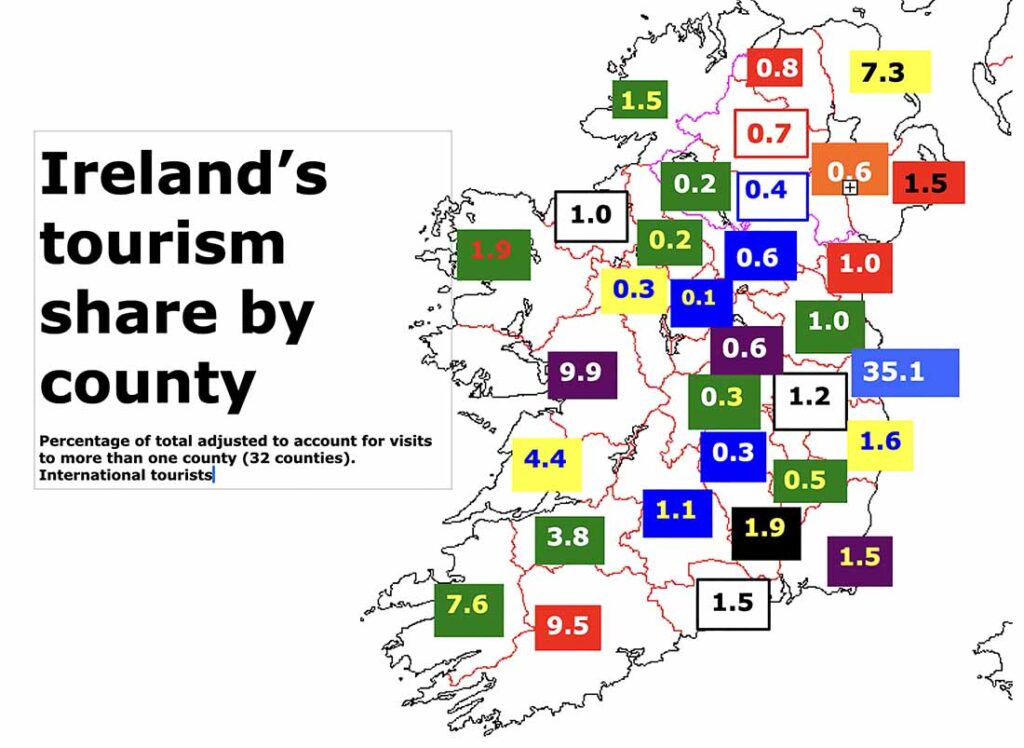
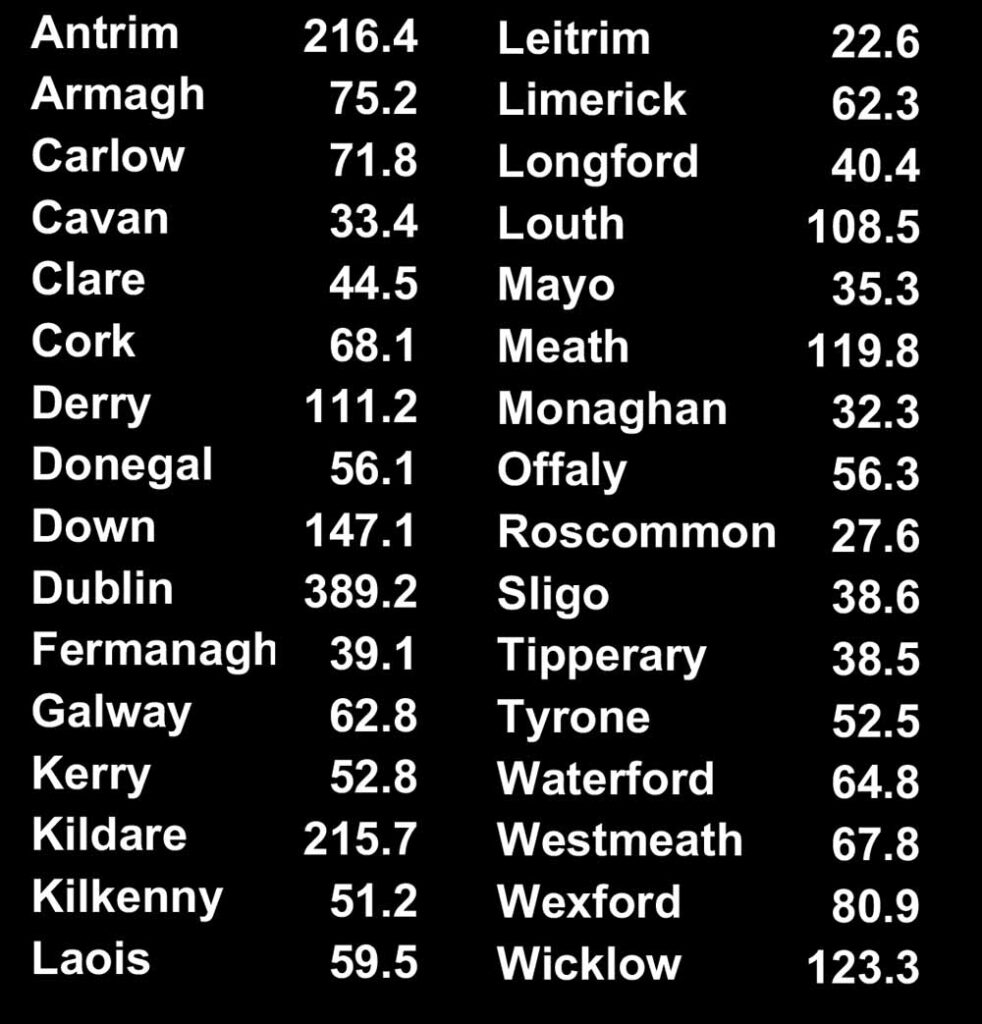
Ireland’s county Longford offers a peaceful blend of history and countryside, with the Corlea Trackway Visitor Centre showcasing an ancient Iron Age road. The county’s St Mel’s Cathedral in Longford town provides architectural beauty, while the River Inny offers opportunities for kayaking and fishing. Other attractions include the rolling farmlands and historic Ardagh village. Longford is Ireland’s fourth smallest county by size and second smallest by population (46,751). Population peaked at 115,491 in 1841 and reached its lowest point, 28,250 in 1971. In terms of hospitality, Longford is Ireland’s 32nd most visited and Ireland’s least visited tourist county with around 22,000 international visitors per year.
Introduction – Adventure – Anthem – Archaeology – Attractions – Awards – Birdwatching – Camping – Castles – Churches – Contact list – Cycling – Dining – Equestrian – Festivals – Fishing – Folklore – Gardens – Golf – Graveyards – Happening – Haunted – Highest – Hiking – History – Holy Wells – Hotels – Hotels top 8 – Hunting & shooting – Instagrammable – Itineraries – Largest town – Luxury – MICE – Movies – Music – Name – New – Novelists – Off the beaten track – Poets – Pubs – Quotes – Random Facts – Restaurant Awards – Sacred Places – Saints – Songs – Spas – Sports – Sunsets – Sustainable – Things to do – Towns – Video – Villages – Walking – Wanderlist – Weddings – Wild swimming – Writers – 1837 – 1846 – 1852 – 1909 – 1955 – 1980 –