- The Rose of Ardee: A romantic ballad praising a woman from Ardee, a historic town in Louth, celebrating her beauty and the town’s charm. It captures local pride and the romantic allure of rural Louth. Traditional, no specific author documented; noted in Reddit discussions as a key Louth song.
- The Wee County: A modern tribute to County Louth, nicknamed “The Wee County” due to its small size. The song celebrates Louth’s community spirit, landscapes, and local pride, referencing its towns and heritage, attributed to contemporary Louth musicians; cited in a 2012 Reddit thread as a perfect Louth anthem.
- Farewell to Carlingford: A nostalgic song about Carlingford, a coastal town in Louth known for its medieval heritage and scenic beauty. It reflects on leaving the town, with themes of emigration and longing for home. Written by Tommy Makem, a renowned folk singer from Armagh, but closely associated with Louth’s Carlingford through his performances.
- Return to Louth: A contemporary folk song about returning to County Louth, highlighting its landscapes, history, and emotional pull. The chorus explicitly mentions “Louth,” tying it to the county’s identity. Written by Fiona Gregory, a Louth-based musician, as noted in a tourist video referenced on Reddit.
- The Rattlin’ Bog: A humorous, cumulative folk song about a bog near Collon Monastery in County Louth. It describes a fantastical bog with escalating elements (e.g., tree, branch, bird), celebrating local folklore and community sing-alongs. Traditional, no known author; occasionally documented as Louth-specific despite its ubiquitousness.
- Drogheda Town: A ballad celebrating Drogheda, Louth’s largest town, with references to its historic walls, the River Boyne, and its vibrant community. It evokes local pride and the town’s historical significance. Traditional, no specific author; part of Louth’s folk repertoire.
- The Maid of Dundalk: A love song about a woman from Dundalk, Louth’s main commercial hub, blending romance with descriptions of the town’s streets and coastal setting. It reflects local charm and personal connection. Traditional, no documented author. as a Dundalk favorite.
- The Battle of the Boyne: A historical ballad recounting the 1690 Battle of the Boyne near Drogheda, a pivotal event in Irish history. It focuses on the conflict’s local impact and Louth’s role in this turning point. Traditional, no known author; part of Louth’s historical song tradition.
- Louth’s Green Fields: A pastoral song celebrating Louth’s fertile plains and rural beauty, with references to its agricultural heritage and small villages like Louth and Termonfeckin. Traditional, no specific author.
- The Hills of Cooley: A song inspired by the Cooley Peninsula, Louth’s scenic coastal region, tied to the mythological Táin Bó Cúailnge. It celebrates the area’s rugged beauty and ancient heritage.
Songs
Antrim – Armagh – Carlow – Cavan – Clare – Cork – Derry – Donegal – Down – Dublin – Fermanagh – Galway – Kerry – Kildare – Kilkenny – Laois – Leitrim – Limerick – Longford – Louth – Mayo – Meath – Monaghan – Offaly – Roscommon – Sligo – Tipperary – Tyrone – Waterford – Westmeath – Wexford – Wicklow
County Anthem
Antrim – Armagh – Carlow – Cavan – Clare – Cork – Derry – Donegal – Down – Dublin – Fermanagh – Galway – Kerry – Kildare – Kilkenny – Laois – Leitrim – Limerick – Longford – Louth – Mayo – Meath – Monaghan – Offaly – Roscommon – Sligo – Tipperary – Tyrone – Waterford – Westmeath – Wexford – Wicklow
County Louth:
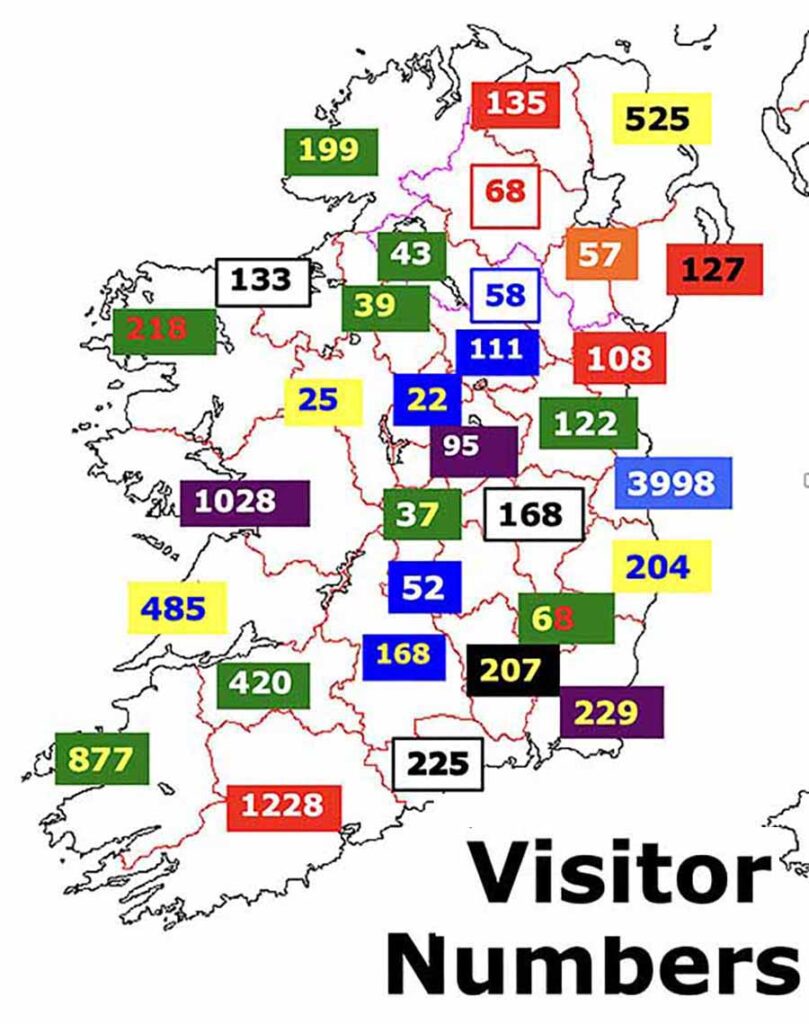
Ireland’s county Louth is a county of historic depth and coastal beauty, with Drogheda’s St Peter’s Church housing a historic shrine and the Boyne Valley offering ancient sites like Newgrange, a UNESCO-listed passage tomb just over the border in county Meath. Carlingford’s medieval streets and castle provide scenic walks, while Dundalk’s coastal paths add natural allure. Other attractions include the Cooley Peninsula’s hiking trails. Louth is Ireland’s smallest county by size (821 sq km) and 17th largest by population (139,703). Population peaked at 128,240 in 1841 and reached its lowest point, 63,665 in 1926. In terms of hospitality, Louth is Ireland’s 21st most visited tourist county with around 108,000 international visitors per year.
Introduction – Adventure – Anthem – Archaeology – Attractions – Awards – Birdwatching – Camping – Castles – Churches – Contact list – Cycling – Dining – Equestrian – Festivals – Fishing – Folklore – Gardens – Golf – Graveyards – Happening – Haunted – Highest – Hiking – History – Holy Wells – Hotels – Hotels top 8 – Hunting & shooting – Instagrammable – Itineraries – Largest town – Luxury – MICE – Movies – Music – Name – New – Novelists – Off the beaten track – Poets – Pubs – Quotes – Random Facts – Restaurant Awards – Sacred Places – Saints – Songs – Spas – Sports – Sunsets – Sustainable – Things to do – Towns – Video – Villages – Walking – Wanderlist – Weddings – Wild swimming – Writers – 1837 – 1846 – 1852 – 1909 – 1955 – 1980 –