A maritime county of Munster, the largest in Ireland, bounded on the north by the counties of Limerick and Tipperary, on the east by the county of Waterford, on the south by the Atlantic Ocean, and on the west by the county of Kerry. Its greatest length, from Dursey Island on the southwest to Youghal on the southeast, is about 110 English miles; and its greatest breadth, from Cape Clear on the south to the vicinity of Mitchelstown on the north, is about 60 miles. Its area is computed at 1,849,917 acres, or 2,890 square miles; of which about 1,200,000 acres are arable land. Its outline is very irregular, deeply indented by numerous bays and inlets; and its surface is diversified with lofty mountains, extensive plains, fertile valleys, and large tracts of bog. The principal elevations are the range of mountains which traverses the northern and western districts, including the Galtee mountains on the northern frontier, rising to 3,015 feet; the Derrynasaggart mountains in the northwest, attaining an altitude of 2,284 feet; the Sheehy mountains near Bantry, rising to about 2,000 feet; and several detached groups in the centre and south, none of which exceed 1,800 feet. The general aspect of the county is highly picturesque; the southern and southeastern districts are richly cultivated and well wooded; the western districts are wild and mountainous; and the northern districts, though hilly, are in many places fertile and beautiful.
The principal rivers are the Blackwater, the Lee, the Bandon, the Bride, the Araglin, the Funshion, the Dalua, and the Feagle. The Blackwater rises in the county of Kerry, enters Cork near Millstreet, flows eastward past Mallow and Fermoy, receives the Araglin and the Bride, and falls into the sea at Youghal. It is navigable for boats of considerable burden as far as Cappoquin in Waterford. The Lee rises in the Sheehy mountains near Gougane Barra, flows eastward past Inchigeelagh and Macroom, expands into Lough Mahon near Cork city, and discharges itself into Cork harbour. It is navigable for vessels of large burden to Cork. The Bandon rises near Dunmanway, flows eastward past Bandon, and falls into the sea at Kinsale. The Bride rises near Millstreet, and falls into the Blackwater near Tallow. The Araglin rises near Kilworth, and falls into the Blackwater near Fermoy. The Funshion rises in the county of Limerick, forms for some distance the boundary between Cork and Tipperary, and falls into the Blackwater near Fermoy. The Dalua rises near Newmarket, and falls into the Blackwater near Kanturk. The Feagle rises in the Boggeragh mountains, and falls into the Lee near Inniscarra. The county is intersected by no canal; but the navigation of the Blackwater and the Lee is of great importance to its trade.
The soils are exceedingly various. The northern districts consist chiefly of strong clay and limestone soils, well adapted to tillage; the central districts are a mixture of clay, loam, and gravel; the southern districts exhibit a rich loam and sandy soils, admirably suited to pasturage; and the western districts are in general moorish and boggy. Limestone is abundant in the north and northeast; freestone, granite, and slate occur in various parts; copper mines exist near Skull and Allihies; and manganese and iron ore are found in small quantities. The agriculture is in a very advanced state in the eastern and southern districts; the farms are in general of moderate size, and well cultivated; and the system of green-cropping, stall-feeding, and irrigation is extensively practised. The principal crops are oats, wheat, barley, potatoes, turnips, and flax; and large quantities of excellent butter, pork, and beef are produced for exportation. The linen manufacture has greatly declined; but frieze, drugget, and coarse woollens are still made to some extent. The fisheries on the southern coast are very productive; and considerable quantities of herrings, mackerel, and pilchards are cured for exportation.
The population in 1841 was 773,635; of whom 380,082 were males, and 393,553 females; 513,462 were returned as living in rural districts, and 260,173 in towns and villages. The principal towns are Cork, the county town, Youghal, Kinsale, Bandon, Mallow, Fermoy, Macroom, Bantry, Skibbereen, Clonakilty, Middleton, Charleville, and Mitchelstown. The county contains 112 parishes, and parts of 12 others; and is divided into the baronies of Barrymore, Condons and Clangibbon, Courceys, Duhallow, Ibane and Barryroe, Imokilly East, Imokilly West, Kerrycurrihy, Kinalea, Kinalmeaky, Kinnatalloon, Muskerry East, Muskerry West, Orrery and Kilmore.
Ireland in 1846
Antrim – Armagh – Carlow – Cavan – Clare – Cork – Derry – Donegal – Down – Dublin – Fermanagh – Galway – Kerry – Kildare – Kilkenny – Laois – Leitrim – Limerick – Longford – Louth – Mayo – Meath – Monaghan – Offaly – Roscommon – Sligo – Tipperary – Tyrone – Waterford – Westmeath – Wexford – Wicklow
County Cork:
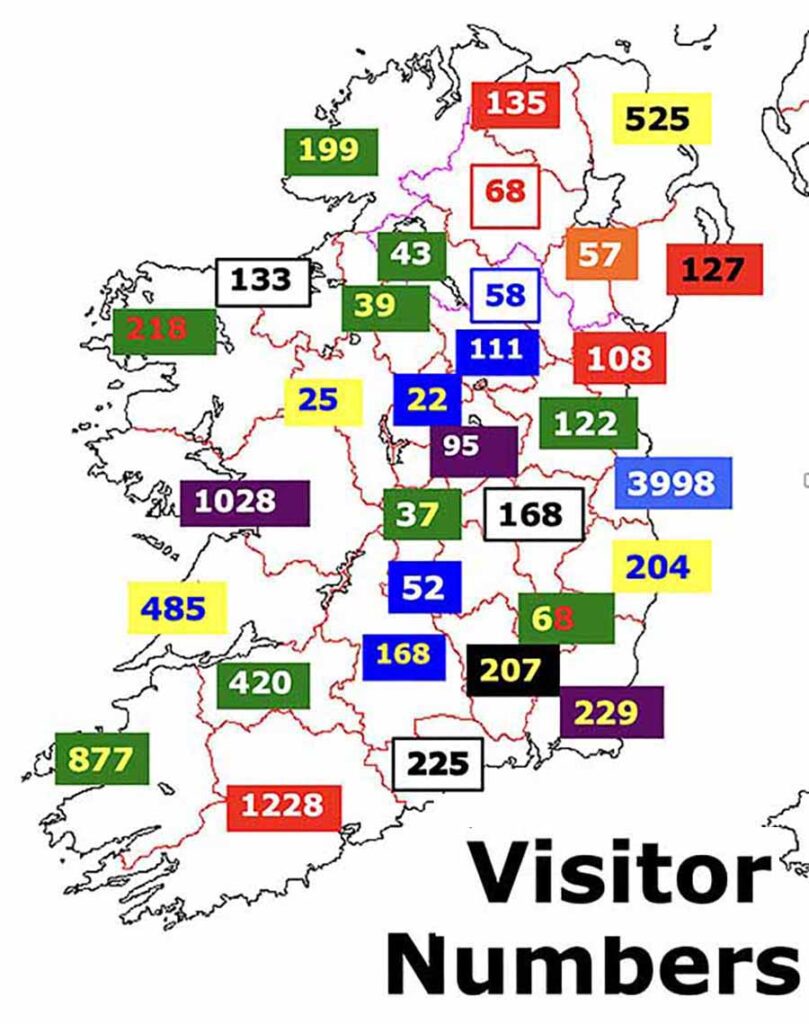
Ireland’s county Cork blends historic sites with scenic beauty, with Cork City’s English Market and St Fin Barre’s Cathedral offering cultural and architectural depth. Blarney Castle, home to the famous Blarney Stone, provides historic allure, while the coastal town of Kinsale offers sailing and seafood. Other attractions include the Beara Peninsula’s rugged trails. Cork is Ireland’s largest county by size (7,460 sq km) and third largest by population (584,156). Population peaked at 854,118 in 1841 (when Cork was Ireland’s most populous county) and reached its lowest point, 330,443 in 1961. In terms of hospitality, Cork is Ireland’s second most visited tourist county with around 1,228,000 international visitors per year.
Introduction – Adventure – Anthem – Archaeology – Attractions – Awards – Birdwatching – Camping – Castles – Churches – Contact list – Cycling – Dining – Equestrian – Festivals – Fishing – Folklore – Gardens – Golf – Graveyards – Happening – Haunted – Highest – Hiking – History – Holy Wells – Hotels – Hotels top 8 – Hunting & shooting – Instagrammable – Itineraries – Largest town – Luxury – MICE – Movies – Music – New – Name – Novelists – Off the beaten track – Poets – Pubs – Quotes – Random Facts – Restaurant Awards – Sacred Places – Saints – Songs – Spas – Sports – Sunsets – Sustainable – Things to do – Towns – Video – Villages – Walking – Wanderlist – Weddings – Wild swimming – Writers – 1837– 1846 – 1852 – 1909 – 1955 – 1980 –