- William Trevor (1928-2016) Born in Mitchelstown, County Cork, Trevor was a novelist, short-story writer, and playwright. His works, such as The Old Boys and The Collected Stories, explore human relationships and Irish society with subtle irony. Often set in Cork towns like Skibbereen and Youghal, his writing influenced younger Irish authors and earned him multiple awards, including the Whitbread Prize.
- Frank O’Connor (1903-1966) Born Michael O’Donovan in Cork city, O’Connor was a short-story writer, novelist, and critic. His collections, like Guests of the Nation, capture Irish life with humor and empathy, often reflecting Cork’s urban and rural settings. A key figure in Irish literature, he also served as a director of the Abbey Theatre.
- Seán Ó Faoláin (1900-1991) Born in Cork city, Ó Faoláin was a short-story writer, novelist, and critic. His works, including Midsummer Night Madness and Bird Alone, explore Irish nationalism and identity, often set in Cork. Elected Saoi of Aosdána in 1986, he was a leading voice in 20th-century Irish literature.
- Elizabeth Bowen (1899-1973) Born in Dublin but raised at Bowen’s Court, Farahy, County Cork, Bowen was a novelist and short-story writer. Her novels, such as The Last September and The Death of the Heart, depict Anglo-Irish life and wartime themes, with Cork’s landscapes influencing her settings. She is considered a major 20th-century writer.
- Patrick Augustine Sheehan (1852-1913) Born in Mallow, County Cork, Sheehan was a Catholic priest and novelist. His works, including My New Curate and Glenanaar, portray rural Irish life and clergy experiences, often set in Cork. His novels were popular for their moral and social insights, reflecting Cork’s cultural fabric.
- Thomas Crofton Croker (1798-1854) Born in Cork city, Croker was a folklorist and antiquarian. His Fairy Legends and Traditions of the South of Ireland popularized Irish folklore, preserving Cork’s oral traditions. His work influenced the Celtic Revival and remains a key source for Irish cultural studies.
- William Wall (1955-present) Born in Cork city, Wall is a novelist, poet, and short-story writer. His novels, like This Is the Country, and poetry collections, such as Ghost Estate, explore contemporary Irish life with a focus on Cork’s social and political landscape. He has won the Patrick Kavanagh Poetry Award.
- Arthur Murphy (1727-1805) Born in Cloonyquin, County Roscommon, but raised in Cork, Murphy was a playwright, actor, and translator. His comedies, such as The Way of the World, and translations of Tacitus were well-regarded in 18th-century London. His Cork upbringing shaped his early literary career.
- Edward Vaughan Kenealy (1819-1880) Born in Cork city, Kenealy was a barrister, poet, and writer. His works, including poems and legal writings, often reflected his controversial career, notably his defense in the Tichborne case. His literary output contributed to Cork’s reputation as a hub of intellectual activity.
- James Roche (1770-1853) Born in Cork city, Roche was a journalist and historian. His articles in Fraser’s Magazine and other works on Irish history and genealogy highlighted Cork’s cultural and historical significance, contributing to the city’s literary character in the 19th century.
Writers
Antrim – Armagh – Carlow – Cavan – Clare – Cork – Derry – Donegal – Down – Dublin – Fermanagh – Galway – Kerry – Kildare – Kilkenny – Laois – Leitrim – Limerick – Longford – Louth – Mayo – Meath – Monaghan – Offaly – Roscommon – Sligo – Tipperary – Tyrone – Waterford – Westmeath – Wexford – Wicklow
County Cork:
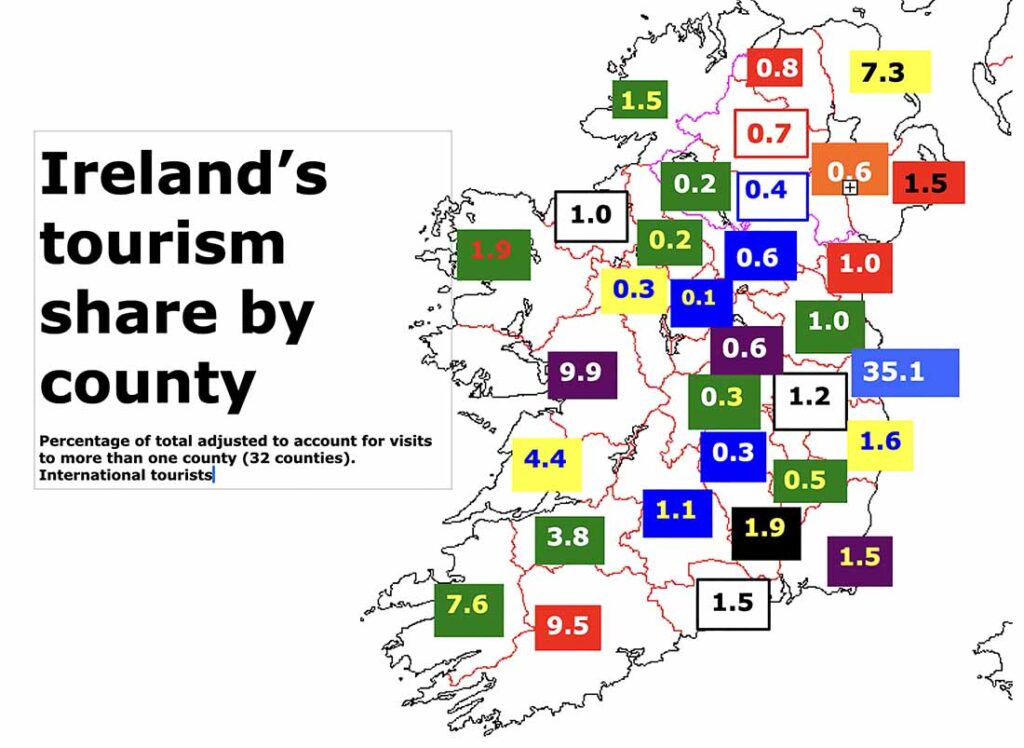
Ireland’s county Cork blends historic sites with scenic beauty, with Cork City’s English Market and St Fin Barre’s Cathedral offering cultural and architectural depth. Blarney Castle, home to the famous Blarney Stone, provides historic allure, while the coastal town of Kinsale offers sailing and seafood. Other attractions include the Beara Peninsula’s rugged trails. Cork is Ireland’s largest county by size (7,460 sq km) and third largest by population (584,156). Population peaked at 854,118 in 1841 (when Cork was Ireland’s most populous county) and reached its lowest point, 330,443 in 1961. In terms of hospitality, Cork is Ireland’s second most visited tourist county with around 1,228,000 international visitors per year.
Introduction – Adventure – Anthem – Archaeology – Attractions – Awards – Birdwatching – Camping – Castles – Churches – Contact list – Cycling – Dining – Equestrian – Festivals – Fishing – Folklore – Gardens – Golf – Graveyards – Happening – Haunted – Highest – Hiking – History – Holy Wells – Hotels – Hotels top 8 – Hunting & shooting – Instagrammable – Itineraries – Largest town – Luxury – MICE – Movies – Music – New – Name – Novelists – Off the beaten track – Poets – Pubs – Quotes – Random Facts – Restaurant Awards – Sacred Places – Saints – Songs – Spas – Sports – Sunsets – Sustainable – Things to do – Towns – Video – Villages – Walking – Wanderlist – Weddings – Wild swimming – Writers – 1837– 1846 – 1852 – 1909 – 1955 – 1980 –