- St Finbarr’s cemetery, Cork city, Jack Lynch (John Mary Lynch, 1917–1999), Legendary sportsman (All-Ireland hurling/football winner with Cork), Fianna Fáil politician, and Taoiseach (prime minister) of Ireland (1966–1973, 1977–1979); key figure in modern Irish politics and the Troubles era.
- Saint Oliver’s Cemetery, Ballincollig, Rory Gallagher (Musician): Buried in
- Saint Finbarr’s Cemetery, Cork City, Terence MacSwiney (Lord Mayor of Cork/Hunger Striker): Buried in the Republican Plot.
- Saint Finbarr’s Cemetery, Cork City, Tomás MacCurtain (Lord Mayor of Cork): Buried in the Republican Plot.
- Saint Finbarr’s Cemetery, Cork City, Jack Lynch (Taoiseach).
- Saint Joseph’s Cemetery, Tory Top Road, Cork, Edward Mulhare (Actor, Knight Rider): Buried in
- Seamus Murphy (Sculptor): Buried in Saint Finbarr’s Cemetery, Cork City,
- Old Church Cemetery, Cobh, Jack Doyle (Boxer/Actor):
- Saint Joseph’s Cemetery, Daniel Corkery (Writer/Politician)
- Matehy cemetery, Blarney, Denny Lane (1814–1895), Poet, Young Irelander nationalist, songwriter (famous for “Carrigdhoun”), and cultural figure in 19th-century Cork; involved in repeal and literary movements.
- Fanlobbus Parish Church (Church of Ireland) in Dunmanway, Richard Cox, the lawyer, historian, and Lord Chancellor of Ireland.
- St Finbarr’s cemetery, William Kirby Sullivan (c.1820/21–1890), Chemist, Young Irelander, educationalist, and president of Queen’s College Cork (now UCC); contributed to science and Irish resistance, buried in with a Celtic cross memorial funded by public subscription.
- Douglas cemetery, Richard Caulfield (1823–1887), antiquarian, historian, and archivist of Cork; compiled important records of Cork’s history and genealogy.
- Kilnamartra cemetery, Art Ó Laoghaire (c.1740s–1773), Gaelic nobleman and soldier whose death in a duel/ambush inspired the famous lament Caoineadh Airt Uí Laoghaire by his wife Eibhlín Dubh Ní Chonaill; iconic in Irish literature and folklore.
- Cobh, Charles Wolfe (1791–1823), Clergyman and poet, best remembered for his elegy “The Burial of John Moore after Corunna,” a celebrated 19th-century poem. Buried in the local parish graveyard.
List of Graveyards in Cork
Abbey Graveyard (Bantry), Abbeystrowry Graveyard (Skibbereen), Aghabullogue (St. Olan’s Churchyard), Aghada (St. Colman’s Churchyard), Aghadown Graveyard, Aglish Graveyard, Ardnageehy Graveyard, Ballinadee (St. Matthew’s Churchyard), Ballincollig (St. Mary’s Churchyard), Ballindangan Graveyard, Ballineen (St. Mary’s RC Churchyard), Ballinora Graveyard, Ballintemple (St. Joseph’s Churchyard), Ballyclogh Graveyard, Ballycurrany Graveyard, Ballydehob (St. Matthias’ Churchyard), Ballyfeard Graveyard, Ballyhea (St. Mary’s Churchyard), Ballyhooly (St. Nathaniel’s Churchyard), Ballymacoda (St. Peter’s Churchyard), Ballymartle Graveyard, Ballymodan (St. Peter’s Churchyard, Bandon), Ballymoney Graveyard, Ballynoe Graveyard, Ballyvourney (St. Gobnait’s Churchyard), Bandon (Kilbrogan Graveyard), Bandon (St. Patrick’s Churchyard), Bantry (Abbey Graveyard), Berehaven (St. Michael’s Churchyard), Blarney (Immaculate Conception Churchyard), Brigown Graveyard (Mitchelstown), Buttevant (St. Mary’s Churchyard), Caherlag Graveyard (Glanmire), Carrigaline (St. Mary’s Churchyard), Carrigrohanebeg Cemetery (Ballincollig), Carrigtwohill (St. David’s Churchyard), Castlehaven Graveyard, Castlemagner Graveyard, Castletownroche (St. Mary’s Churchyard), Charleville (Holy Cross Cemetery), Clogheen Graveyard (Kinsale), Clonakilty (Kilgarriffe Churchyard), Clonmult Graveyard (Midleton), Cloyne (St. Colman’s Cathedral Graveyard), Cobh (Old Church Cemetery), Cobh (St. Colman’s RC Cemetery), Cork City (Curraghkippane, St. Mary’s Old Section), Cork City (St. Finbarr’s Cemetery), Cork City (St. Joseph’s Cemetery), Crosshaven (St. Brigid’s Churchyard), Curraghkippane Cemetery (Cork City), Desertserges Graveyard, Doneraile (St. Mary’s Churchyard), Douglas (St. Columba’s Churchyard), Douglas (St. Luke’s Churchyard), Dromtarriff Graveyard, Dunmanway (St. Patrick’s Churchyard), Durrus (St. James’ Churchyard), Fanlobbus Graveyard (Dunmanway), Fermoy (Christ Church Graveyard), Garryvoe Churchyard, Glanmire (St. Mary’s Churchyard), Glanworth Graveyard, Goleen (St. Mary’s Churchyard), Innishannon (Christ Church Graveyard), Kanturk (St. Peter’s Churchyard), Kilbarry Graveyard, Kilbonane Churchyard (Aherla), Kilbrin Graveyard, Kilbrogan Graveyard (Bandon), Kilcatherine Graveyard, Kilcredan Graveyard, Kilcrohane Graveyard, Kilcully Graveyard, Kilgarriffe Churchyard (Clonakilty), Kilkerranmore Graveyard, Killathy Graveyard, Killeagh Graveyard, Kilmacabea Graveyard, Kilmichael Graveyard, Kilmonoge Graveyard, Kilmurry (St. Andrew’s Churchyard), Kilnaglory Graveyard (Ballincollig), Kilnamartry Graveyard, Kilshannig Graveyard, Kinsale (St. Multose Churchyard), Kinsale (St. John’s Churchyard), Lisgoold Cemetery, Liscarroll Graveyard, Macroom (St. Colman’s Churchyard), Mallow (St. Mary’s Churchyard), Midleton (Holy Rosary Churchyard), Millstreet (St. Patrick’s Churchyard), Rathcormac (St. Michael’s Churchyard), Rathgoggan Graveyard (Charleville), Ross Carbery (St. Fachtna’s Cathedral Graveyard), Schull (St. Mary’s Churchyard), Shandrum Graveyard, Skibbereen (Abbeystrowry Famine Graveyard), Skibbereen (St. Patrick’s RC Cemetery), Templebreedy Graveyard (Crosshaven), Templemartin Graveyard, Timoleague (Church of the Ascension Graveyard), Tracton Graveyard, Tullilease Graveyard (Tullylease), Youghal (St. Mary’s Collegiate Churchyard), Youghal (North Abbey Graveyard)
Graveyards
Antrim – Armagh – Carlow – Cavan – Clare – Cork – Derry – Donegal – Down – Dublin – Fermanagh – Galway – Kerry – Kildare –Kilkenny – Laois – Leitrim – Limerick – Longford – Louth – Mayo – Meath – Monaghan – Offaly – Roscommon – Sligo – Tipperary – Tyrone – Waterford – Westmeath – Wexford – Wicklow
County Cork:
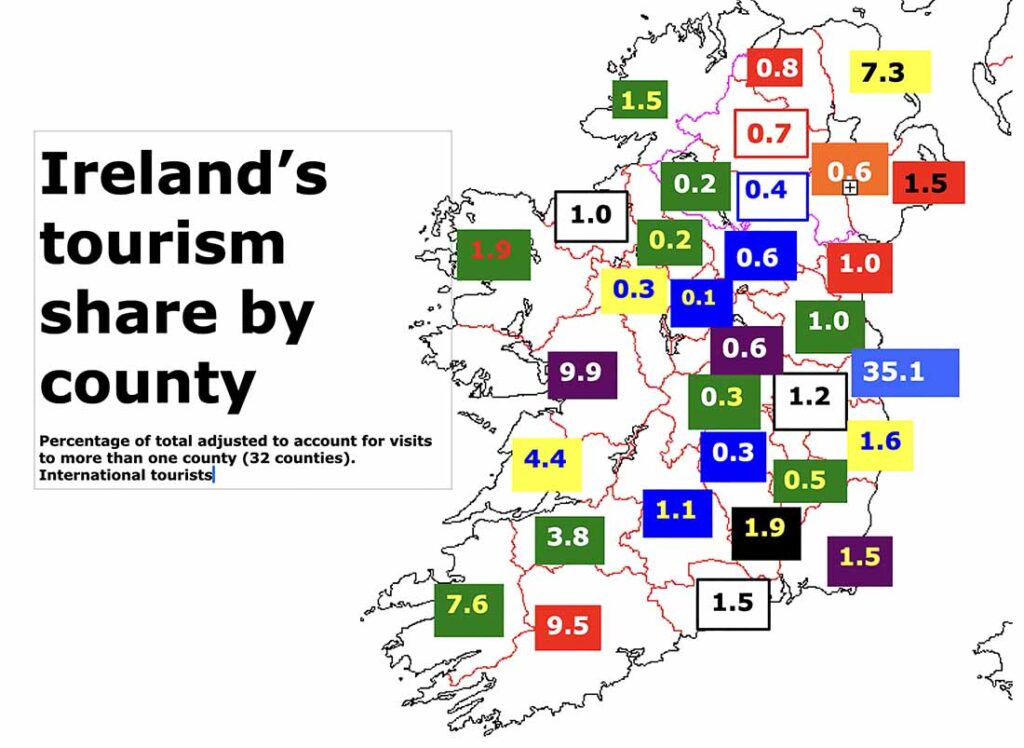
Ireland’s county Cork blends historic sites with scenic beauty, with Cork City’s English Market and St Fin Barre’s Cathedral offering cultural and architectural depth. Blarney Castle, home to the famous Blarney Stone, provides historic allure, while the coastal town of Kinsale offers sailing and seafood. Other attractions include the Beara Peninsula’s rugged trails. Cork is Ireland’s largest county by size (7,460 sq km) and third largest by population (584,156). Population peaked at 854,118 in 1841 (when Cork was Ireland’s most populous county) and reached its lowest point, 330,443 in 1961. In terms of hospitality, Cork is Ireland’s second most visited tourist county with around 1,228,000 international visitors per year.
Introduction – Adventure – Anthem – Archaeology – Attractions – Awards – Birdwatching – Camping – Castles – Churches – Contact list – Cycling – Dining – Equestrian – Festivals – Fishing – Folklore – Gardens – Golf – Graveyards – Happening – Haunted – Highest – Hiking – History – Holy Wells – Hotels – Hotels top 8 – Hunting & shooting – Instagrammable – Itineraries – Largest town – Luxury – MICE – Movies – Music – New – Name – Novelists – Off the beaten track – Poets – Pubs – Quotes – Random Facts – Restaurant Awards – Sacred Places – Saints – Songs – Spas – Sports – Sunsets – Sustainable – Things to do – Towns – Video – Villages – Walking – Wanderlist – Weddings – Wild swimming – Writers – 1837– 1846 – 1852 – 1909 – 1955 – 1980 –