County Cork, Ireland’s largest county, is home to approximately 358 holy wells, as recorded in the Archaeological Inventory of County Cork, many of which are steeped in pre-Christian and early Christian traditions. These wells, often linked to local saints, the Blessed Virgin Mary, or specific healing properties, were historically central to community devotion, particularly on pattern days (feast days of patron saints). While some wells remain active pilgrimage sites, others are neglected or forgotten, with pattern days often diminished due to the Famine, Penal Laws, and church reforms.
- Saint Gobnait’s Well (Tobar Ghobnatan), Ballyvourney: Pattern day: February 11 (Saint Gobnait’s Day), with a major pilgrimage and Mass. Located in Ballyvourney, this well is dedicated to Saint Gobnait, a 6th-century saint associated with bees and deer. Pilgrims perform rounds, circumambulating the well and nearby stations (e.g., her grave, statue), reciting prayers. The well is famed for healing, especially sore eyes, with offerings like clooties and rosaries left on a sacred tree. It remains a vibrant pilgrimage site, reflecting Gobnait’s enduring local reverence. Ballyvourney, Co. Cork.
- Saint John’s Well (Tobar Eoin Óg), Carrigaline: Pattern day: June 23 (Saint John’s Eve), historically significant, with smaller gatherings today. Near Carrigaline, this well is dedicated to Saint John the Baptist. Known for curing headaches and eye ailments, it historically drew crowds for rounds, where pilgrims sipped water and left rags on trees. A 1835 sketch shows men, women, and animals crowding to drink the water. While less rowdy now, it remains a focal point for local devotion. Carrigaline, Co. Cork.
- Tobar Mhuire (Lady’s Well), Titeskin: Pattern day: August 15 (Feast of the Assumption), with Mass and pilgrimage. Dedicated to the Blessed Virgin Mary, this well in Titeskin is renowned for miraculous cures and an alleged apparition of Mary. Pilgrims perform rounds eight days before and after August 15, praying at stations, including a statue in a tree. Historically documented in the 19th century, it remains active, with offerings like candles and medals adorning the site. Titeskin, near Clonakilty, Co. Cork.
- Tubrid Well (Tobar Bo Finne), Millstreet: Pattern day: May 1 (Bealtaine), with local devotions. Near Millstreet, this well’s name (meaning “white well”) reflects its clear spring. Used for general healing, particularly rheumatism, pilgrims perform rounds and leave clooties or coins. The well is set in a scenic landscape, with a small shrine and sacred tree. Its Bealtaine connection suggests pre-Christian roots, and it remains a cherished local site. Millstreet, Co. Cork.
- Saint Fanahan’s Well (Tobar Naomh Fionnchú), Mitchelstown: Pattern day: November 25 (Saint Fanahan’s Day). Dedicated to Saint Fanahan, a 7th-century warrior-monk, this well near Mitchelstown is known for curing toothaches and wounds. Pilgrims perform rounds, reciting the Rosary, and leave offerings like rags on a nearby bush. The well’s association with a fierce local saint adds to its mystique, with a small stone enclosure preserving its sanctity. Mitchelstown, Co. Cork.
- Gougane Barra Well, Gougane Barra: Pattern day: September 25 (Saint Finbarr’s Day, Gougane Sunday), a major pilgrimage. Linked to Saint Finbarr, Cork’s patron saint, this well on an island in Gougane Barra’s lake is part of a historic monastic site. Pilgrims perform rounds, including stations at the oratory, and drink the water for healing, especially skin ailments. Historically, it drew thousands, with separate pattern days for travellers (Saint John’s Eve). It remains a dignified, well-attended event. Gougane Barra, Co. Cork.
- Saint Laitiarian’s Well, Cullen: Pattern day: July 25 (Saint Laitiarian’s Day), with smaller community gatherings. In Cullen, this well is dedicated to Saint Laitiarian, a local saint. Known for curing backaches, pilgrims perform rounds and apply water to afflicted areas, leaving clooties on a sacred tree. The well is housed in a simple stone structure, with offerings like rosaries reflecting ongoing devotion, though on a smaller scale today. Cullen, Co. Cork.
- Lady’s Well, Near Bantry: Pattern day: May 1 (Bealtaine), with local visits. Dedicated to the Blessed Virgin Mary, this well near Bantry is set in a coastal landscape. Used for general healing, pilgrims perform rounds and leave offerings like candles or cloths. Its Bealtaine association suggests pagan origins, and while less prominent now, it retains local significance with a small shrine. Near Bantry, Co. Cork.
- Skour Well (Tobar na Sceabhrach), Lough Hyne: Pattern day: April 30 (Walpurgis Night), with minor devotions. Near Lough Hyne, this well’s name (meaning “well of the scabby place”) reflects its use for curing skin diseases. Pilgrims perform rounds and apply water topically, leaving clooties. Set in a scenic marine reserve, the well’s pre-Christian roots are evident, though it’s now less visited. Lough Hyne, near Skibbereen, Co. Cork.
- Saint Bartholomew’s Well (Tobar Phartalain), Garryantaggart: Pattern day: August 24 (Saint Bartholomew’s Day). Dedicated to Saint Bartholomew, this well in Garryantaggart near Kanturk is known for curing sores and wounds. Pilgrims perform rounds, recite prayers, and leave offerings like coins or rags. A small well house and sacred tree mark the site, which retains quiet local reverence despite reduced patterns. Garryantaggart, near Kanturk, Co. Cork.
- Saint Colman’s Well, Near Cloyne: Pattern day: October 27 (Saint Colman’s Day), though patterns are rare today. Linked to Saint Colman of Cloyne, a 6th-century poet-saint, this well near Cloyne was used for healing, particularly stomach ailments. Pilgrims performed rounds and left clooties or medals. Set near Cloyne’s historic cathedral, the well is now less visited but retains historical significance. Near Cloyne, Co. Clare.
- Tobar na Súl, Near Drimoleague: Pattern day: Unknown, possibly tied to Lughnasa (August 1). Known as the “Eye Well,” this well near Drimoleague is famed for curing sore eyes, a common attribute in Cork (71 wells hold this cure). Though scummy and neglected today, pilgrims historically bathed eyes with its water and left rags on a hedgerow. Its simplicity reflects the enduring belief in water’s healing power. Near Drimoleague
Holy Wells
Antrim – Armagh – Carlow – Cavan – Clare – Cork – Derry – Donegal – Down – Dublin – Fermanagh – Galway – Kerry – Kildare – Kilkenny – Laois – Leitrim – Limerick – Longford – Louth – Mayo – Meath – Monaghan – Offaly – Roscommon – Sligo – Tipperary – Tyrone – Waterford – Westmeath – Wexford – Wicklow
Sacred Places
Antrim – Armagh – Carlow – Cavan – Clare – Cork – Derry – Donegal – Down – Dublin – Fermanagh – Galway – Kerry – Kildare – Kilkenny – Laois – Leitrim – Limerick – Longford – Louth – Mayo – Meath – Monaghan – Offaly – Roscommon – Sligo – Tipperary – Tyrone – Waterford – Westmeath – Wexford – Wicklow
County Cork:
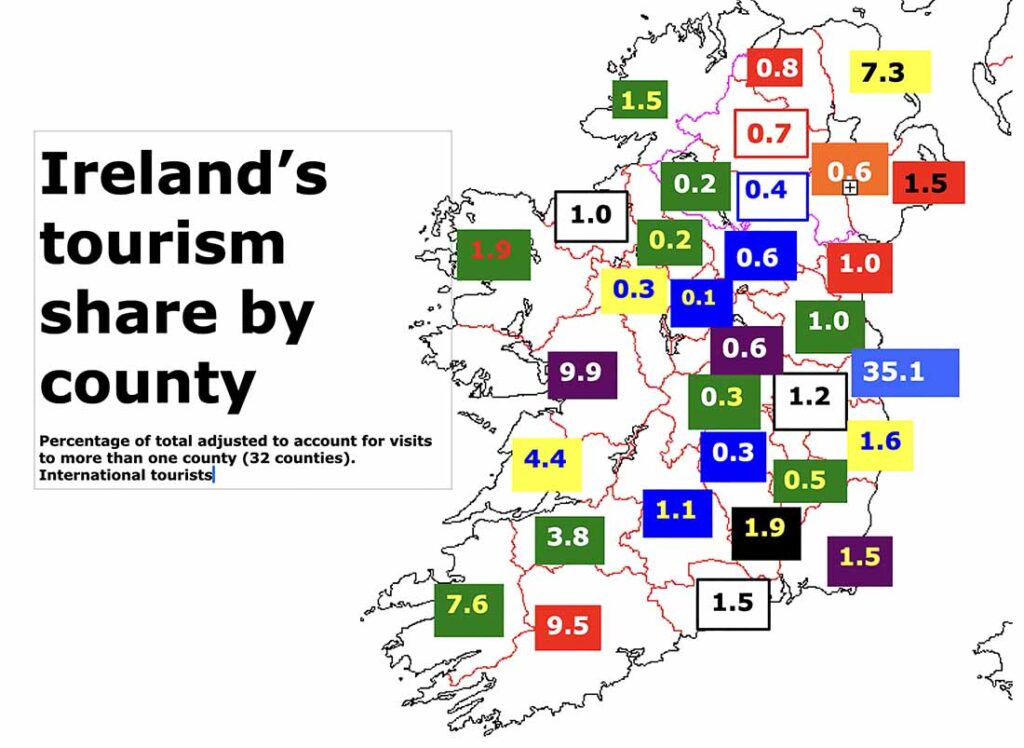
Ireland’s county Cork blends historic sites with scenic beauty, with Cork City’s English Market and St Fin Barre’s Cathedral offering cultural and architectural depth. Blarney Castle, home to the famous Blarney Stone, provides historic allure, while the coastal town of Kinsale offers sailing and seafood. Other attractions include the Beara Peninsula’s rugged trails. Cork is Ireland’s largest county by size (7,460 sq km) and third largest by population (584,156). Population peaked at 854,118 in 1841 (when Cork was Ireland’s most populous county) and reached its lowest point, 330,443 in 1961. In terms of hospitality, Cork is Ireland’s second most visited tourist county with around 1,228,000 international visitors per year.
Introduction – Adventure – Anthem – Archaeology – Attractions – Awards – Birdwatching – Camping – Castles – Churches – Contact list – Cycling – Dining – Equestrian – Festivals – Fishing – Folklore – Gardens – Golf – Graveyards – Happening – Haunted – Highest – Hiking – History – Holy Wells – Hotels – Hotels top 8 – Hunting & shooting – Instagrammable – Itineraries – Largest town – Luxury – MICE – Movies – Music – New – Name – Novelists – Off the beaten track – Poets – Pubs – Quotes – Random Facts – Restaurant Awards – Sacred Places – Saints – Songs – Spas – Sports – Sunsets – Sustainable – Things to do – Towns – Video – Villages – Walking – Wanderlist – Weddings – Wild swimming – Writers – 1837– 1846 – 1852 – 1909 – 1955 – 1980 –