A county of Ireland, in the province of Munster. It is an inland county, bounded on the north by the counties of Offaly and Galway, on the east by the Laois and Kilkenny, on the south by Waterford and Cork, and on the west by Limerick and Clare. Its greatest length, from north-east to south-west, is about 50 miles; its greatest breadth, from east to west, about 38 miles; and its computed area is 1,061,731 acres, or 1,659 square miles, of which about 13,523 acres are water. Some computations make the area 1,343,320 acres.
The surface is greatly diversified, consisting of mountains, hills, valleys, extensive plains, bogs, and lakes. The principal mountain ranges are the Galtee mountains in the south (Galtee-more, 3,015 feet), the Knockmealdown mountains on the south-east border (Knockmealdown, 2,609 feet), the Silvermines mountains in the north-west, the Keeper and Devil’s Bit mountains in the north, and Slievenamuck and other hills in the south-east. The chief valleys are the Golden Vale (a rich limestone tract in the centre and south), the vale of Aherlow, and the valleys of the Suir and Shannon. The general character of the low grounds is flat or gently undulating, with rich alluvial soils in the valleys and limestone-based fertile land over much of the county; the higher grounds are often heathy or moorish, and the western districts contain considerable tracts of bog.
The county is well watered. The principal rivers are the Shannon, which forms the greater part of the western boundary and is navigable; the Suir, which rises in the Slieve Bloom mountains, flows through the eastern and southern districts, and forms part of the southern boundary; the Nenagh, flowing into Lough Derg; the Ara, the Blackwater (Munster Blackwater), the Anner, the Clodiagh, and numerous smaller streams. The chief lakes are Lough Derg (about 24,000 acres, shared with the Shannon navigation), and various smaller loughs such as Lough Graney, Lough Curra, Lough Muskerry, and others scattered over the surface, with a total water area of about 13,523 acres.
The soil is generally fertile, especially in the limestone districts, which predominate in the east and centre, producing excellent crops and supporting rich pasture. The agriculture is in an advanced state; the principal crops are oats, barley, wheat, potatoes, and turnips; flax is grown to some extent; and dairy husbandry is extensively carried on, large quantities of butter being exported. Farms are of various sizes, but subdivision has prevailed in some districts. Limestone is abundant and largely used for building and as manure; coal exists in the Slieve Ardagh district (anthracite, worked to some extent); iron ore, marble, and building stone are found.
Manufactures are not extensive, but include some linen and woollen weaving, brewing, distilling, and flour-milling. Trade is chiefly in agricultural produce, butter, cattle, and provisions.
The population, by the census of 1841, was 435,558, showing an increase upon 1831 (when it was 402,835). The inhabited houses in 1841 were 66,384. The families chiefly employed in agriculture numbered about 47,000; in manufactures and trade, about 8,000; in other pursuits, the remainder. Literacy statistics show a considerable proportion able to read and write, especially in the eastern and southern districts, though illiteracy remained high in some rural areas.
The county is divided into the North Riding and South Riding (for administrative purposes), and into baronies including Upper and Lower Ormond, Ikerrin, Eliogarty, Kilnamanagh Upper and Lower, Clanwilliam, Middlethird, Iffa and Offa East and West, Slievardagh, and others. It contains numerous civil parishes. It is included in the dioceses of Cashel, Emly, Killaloe, and Limerick. The poor-law unions are Clonmel, Nenagh, Cashel, Tipperary, Carrick-on-Suir, and others.
The county returns four members to parliament (two for each riding); Clonmel, a borough, returns one member.
The chief towns are Clonmel (the assize town and principal place, population in 1841 about 10,000), Cashel (ancient ecclesiastical centre), Nenagh, Thurles, Tipperary (the nominal county town), Cahir, Carrick-on-Suir, Roscrea, and smaller market towns like Fethard, Templemore, and Killenaule.
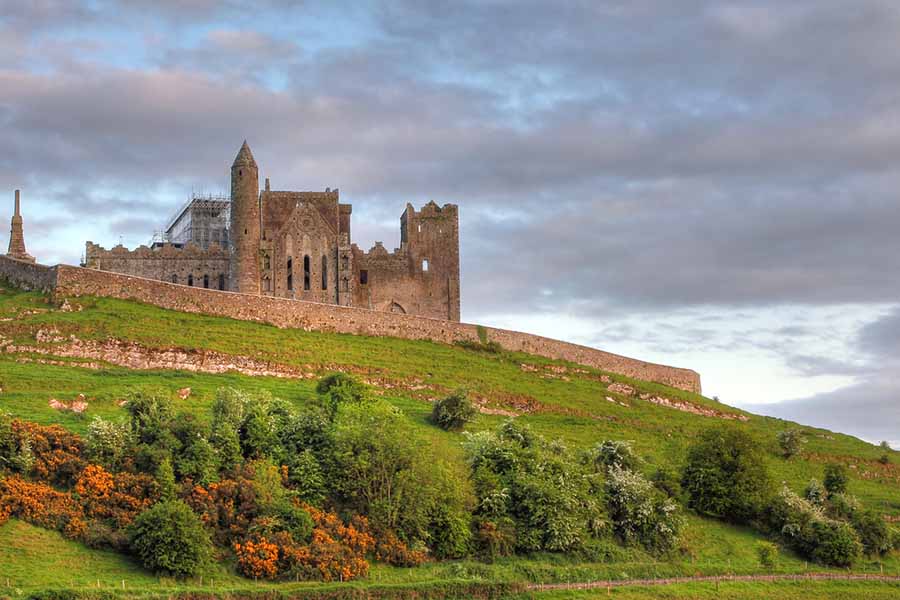
The antiquities are numerous and important, including the Rock of Cashel with its cathedral ruins, round tower, and high crosses; Holycross Abbey; Cahir Castle; Hore Abbey; numerous monastic ruins, raths, and ancient forts; and remains of Norman and Elizabethan castles.
Ireland in 1846
Antrim – Armagh – Carlow – Cavan – Clare – Cork – Derry – Donegal – Down – Dublin – Fermanagh – Galway – Kerry – Kildare – Kilkenny – Laois – Leitrim – Limerick – Longford – Louth – Mayo – Meath – Monaghan – Offaly – Roscommon – Sligo – Tipperary – Tyrone – Waterford – Westmeath – Wexford – Wicklow
County Tipperary:
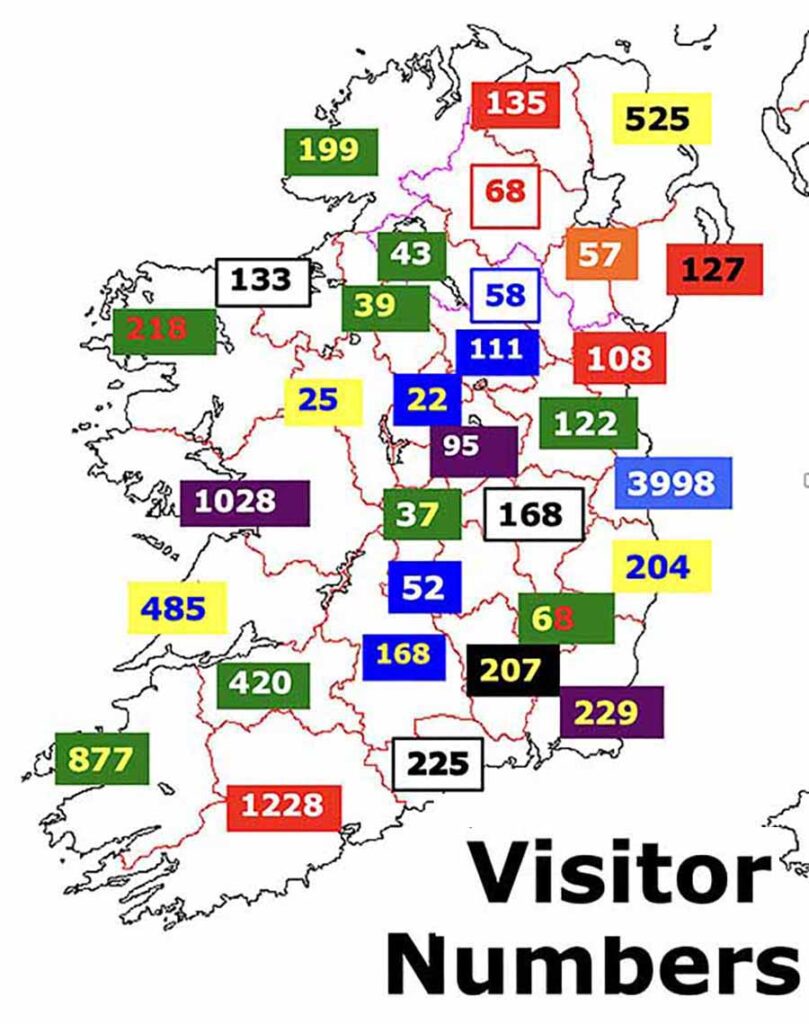
Ireland’s county Tipperary offers a mix of historic landmarks and lush countryside, with the Rock of Cashel’s medieval fortress and cathedral providing a stunning hilltop vista. Cahir Castle, one of Ireland’s best-preserved castles, offers historical insights, while the Glen of Aherlow’s walking trails showcase scenic valleys. Other attractions include the historic town of Clonmel and its markets. Tipperary is Ireland’s sixth largest county by size (4,254 square km) and 12th largest by population (167,895). Population peaked at 435,553 in 1841 and reached its lowest point, 122,812 in 1966. In terms of hospitality, Tipperary is Ireland’s 14th most visited tourist county with around 168,000 international visitors per year.
Introduction – Adventure] – Anthem – Archaeology – Attractions – Awards – Birdwatching – Camping – Castles – Churches – Contact list – Cycling – Dining – Equestrian – Festivals – Fishing – Folklore – Gardens – Golf – Graveyards – Happening – Haunted – Highest – Hiking – History – Holy Wells – Hotels – Hotels top 8 – Hunting & shooting – Instagrammable – Itineraries – Largest town – Luxury – MICE – Movies – Music – Name – New – Novelists – Off the beaten track – Poets – Pubs – Quotes – Random Facts – Restaurant Awards – Sacred Places – Saints – Songs – Spas – Sports – Sunsets – Sustainable – Things to do – Towns – Video – Villages – Walking – Wanderlist – Weddings – Wild swimming – Writers – 1837 – 1846– 1852 – 1909 – 1955 – 1980 –