- Rock of Cashel: Cashel, County Tipperary, approximately 20 km northeast of Tipperary Town (Coordinates: 52.520°N, 7.889°W).. The Rock of Cashel, a limestone outcrop rising 60 metres, is one of Ireland’s most iconic archaeological sites, serving as the seat of the Kings of Munster from the 4th century. By the 12th century, it became an ecclesiastical centre with structures including Cormac’s Chapel (c. 1127–1134, a Romanesque masterpiece), a 13th-century Gothic cathedral, a round tower (c. 1100), and high crosses. Donated to the Church in 1101 by King Muirchertach Ua Briain, it was a hub of religious and political power until its decline in the 18th century. Archaeological finds, including medieval artefacts, highlight its significance. The site is linked to St. Patrick, who reportedly baptised King Aengus here in the 5th century. Managed by Heritage Ireland, open year-round with a visitor centre, guided tours, and audio-visual displays. Admission fees apply; check www.heritageireland.ie for hours and tickets.
- Cahir Castle: Cahir, County Tipperary, approximately 15 km south of Cashel (Coordinates: 52.374°N, 7.927°W).. Built from the 12th century by the O’Brien clan and rebuilt in the 13th–15th centuries by the Butler family, Cahir Castle is one of Ireland’s best-preserved medieval fortresses. Located on an island in the River Suir, it features a massive keep, curtain walls, and a portcullis, reflecting Anglo-Norman military architecture. The castle was a key stronghold during the Desmond Rebellions and Cromwellian sieges, surrendering in 1650. Archaeological surveys have uncovered medieval artefacts, and the castle’s intact state reflects its continuous use into the 19th century. It also served as a filming location for films like Excalibur. Managed by Heritage Ireland, open year-round (seasonal hours apply) with guided tours and a visitor centre. Admission fees apply; check www.heritageireland.ie for details.
- Holycross Abbey: Holycross, near Thurles, County Tipperary, approximately 6 km south of Thurles (Coordinates: 52.639°N, 7.867°W).. Founded in 1180 by King Donal Mór O’Brien for the Cistercian order, Holycross Abbey became a major pilgrimage site due to its relic of the True Cross, attracting devotees across Ireland. The abbey features a 12th-century church with a Gothic nave, cloister, and ornate tombs, notably those of the Butler family. Suppressed in 1536 during the Dissolution, it was restored in the 20th century and remains an active parish. Archaeological excavations have revealed medieval artefacts, including tiles and reliquaries, underscoring its religious and economic importance. Open year-round as an active church with free entry for visitors; donations appreciated. Guided tours may be available; check www.holycrossabbey.ie or www.heritageireland.ie for details.
- Roscrea Castle and Damer House: Roscrea, County Tipperary, approximately 35 km northeast of Thurles (Coordinates: 52.955°N, 7.798°W).. Roscrea Castle, built in the early 13th century (c. 1213) by the Anglo-Normans, is a motte-and-bailey fortress with a later stone gatehouse and curtain walls, granted to the Butler family in 1315. Nearby, Damer House (c. 18th century) sits within the castle grounds, built on the site with earlier archaeological features. The castle served as a defensive outpost in Ely O’Carroll territory, reflecting Norman consolidation. Archaeological surveys have uncovered medieval structures, while the adjacent St. Cronan’s monastic site (6th century) includes a round tower and high cross. The complex illustrates Tipperary’s transition from Gaelic to Norman rule. Managed by Heritage Ireland, open seasonally (April–September) with guided tours of the castle and Damer House. Admission fees apply; check www.heritageireland.ie for hours.
- Loughmoe Castle: Loughmoe, near Thurles, County Tipperary, approximately 10 km east of Thurles (Coordinates: 52.678°N, 7.753°W).. Built in the 15th century by the Purcell family, Loughmoe Castle is a well-preserved tower house with later 17th-century additions, reflecting Gaelic and Anglo-Norman architectural fusion. The castle was a stronghold of the Purcells, vassals of the Butlers, and played a role in regional conflicts, including the Cromwellian wars. Archaeological evidence includes medieval artefacts and defensive features like a bawn wall. The site’s picturesque ruin highlights Tipperary’s medieval lordships. Located on private land but visible from public roads; access may be granted with landowner permission. No formal facilities; check www.archaeology.ie or www.tipperary.com for guidance.
- Devil’s Bit (Bearnán Éile): Near Templemore, County Tipperary, approximately 15 km northeast of Thurles (Coordinates: 52.788°N, 7.873°W).. The Devil’s Bit, a prominent hill, is a multi-period site with prehistoric and early Christian significance. It features a Bronze Age cairn (c. 2000–1000 BC), an early Christian hermitage, and a rock formation linked to folklore claiming the devil bit the mountain, creating the gap. Archaeological surveys indicate ritual use, with finds like bullaun stones and cross-inscribed slabs. The hill was associated with the Éile tribe and later Christian ascetics, reflecting Tipperary’s sacred landscapes. Publicly accessible with free entry via hiking trails. No formal facilities; check www.discoverireland.ie or www.tipperary.com for trail information.
Archaeological sites
Antrim – Armagh – Carlow – Cavan – Clare – Cork – Derry – Donegal – Down – Dublin – Fermanagh – Galway – Kerry – Kildare – Kilkenny – Laois – Leitrim – Limerick – Longford – Louth – Mayo – Meath – Monaghan – Offaly – Roscommon – Sligo – Tipperary – Tyrone – Waterford – Westmeath – Wexford – Wicklow
County Tipperary:
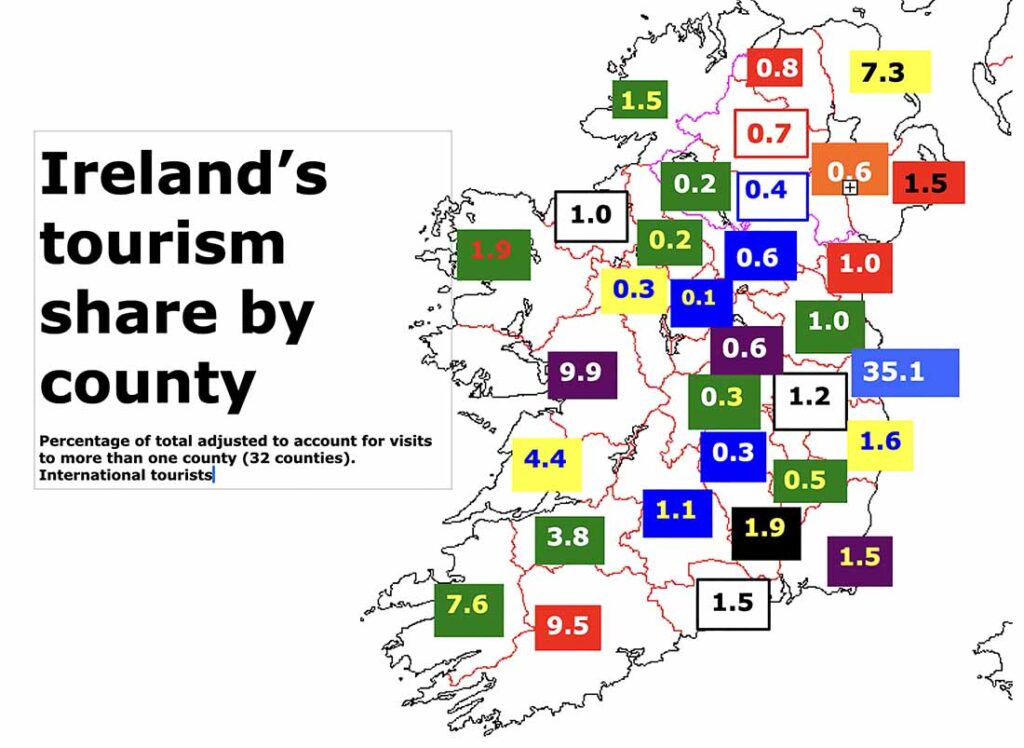
Ireland’s county Tipperary offers a mix of historic landmarks and lush countryside, with the Rock of Cashel’s medieval fortress and cathedral providing a stunning hilltop vista. Cahir Castle, one of Ireland’s best-preserved castles, offers historical insights, while the Glen of Aherlow’s walking trails showcase scenic valleys. Other attractions include the historic town of Clonmel and its markets. Tipperary is Ireland’s sixth largest county by size (4,254 square km) and 12th largest by population (167,895). Population peaked at 435,553 in 1841 and reached its lowest point, 122,812 in 1966. In terms of hospitality, Tipperary is Ireland’s 14th most visited tourist county with around 168,000 international visitors per year.
Introduction – Adventure] – Anthem – Archaeology – Attractions – Awards – Birdwatching – Camping – Castles – Churches – Contact list – Cycling – Dining – Equestrian – Festivals – Fishing – Folklore – Gardens – Golf – Graveyards – Happening – Haunted – Highest – Hiking – History – Holy Wells – Hotels – Hotels top 8 – Hunting & shooting – Instagrammable – Itineraries – Largest town – Luxury – MICE – Movies – Music – Name – New – Novelists – Off the beaten track – Poets – Pubs – Quotes – Random Facts – Restaurant Awards – Sacred Places – Saints – Songs – Spas – Sports – Sunsets – Sustainable – Things to do – Towns – Video – Villages – Walking – Wanderlist – Weddings – Wild swimming – Writers – 1837 – 1846– 1852 – 1909 – 1955 – 1980 –