A maritime county in the province of Leinster. It is bounded, on the north, by the county of Meath ; on the east, by the Irish Sea ; on the south, by the counties of Wicklow and Kildare ; and on the west, by the counties of Kildare and Meath.
Its greatest length, from north to south, is about 30 miles ; its greatest breadth, from east to west, about 22 miles ; and its area is computed at 699 square miles, or 447,360 acres,, of which 11,000 acres are under water.The surface, for the most part, is level, or but gently undulating ; yet, toward the south-west, it rises into hills of considerable height,, the loftiest summit, Kippure, attaining an elevation of 1,100 feet above sea-level. The principal rivers are the Liffey, which traverses the county from west to east, and falls into Dublin Bay ; the Dodder, which rises in the Wicklow mountains, and joins the Liffey within the city of Dublin ; the Tolka, which flows through the northern parts ; and the Poddle, a small stream which falls into the Liffey at the city.
The coast is generally low and sandy, but is indented with several creeks and bays,, the chief of which is Dublin Bay, a spacious and beautiful expanse, forming one of the finest roadsteads in the empire.The soil is, in general, fertile ; and the agriculture is in a highly advanced state. Wheat, barley, oats, potatoes, and turnips, are extensively cultivated ; and large quantities of butter, beef, mutton, and pork, are sent to the Dublin market. The dairy system is particularly attended to in the vicinity of the metropolis ; and market-gardening is carried on to a great extent in the neighbourhood of Dublin.
The chief minerals are granite and limestone, which are quarried in various parts ; and coal and iron are found, but not worked to any considerable extent. The fisheries on the coast, particularly in Dublin Bay, afford employment to a number of persons ; the principal fish taken being herrings, mackerel, cod, and haddock.The county is divided into the baronies of Castleknock, Coolock, Dublin (including the suburbs of the city), Fingal (or Balrothery East and West), Nethercross, Rathdown, and Uppercross.
The principal towns are Dublin (the metropolis), Dun Laoghaire, Malahide, Swords, Lucan, Rathcoole, and Tallaght. The chief seats are the Phoenix Park (containing the Vice-regal Lodge), the residences of numerous noblemen and gentlemen in the vicinity of Dublin, and various demesnes in the southern and western districts.
The county is intersected by excellent roads, radiating from Dublin in all directions ; and it possesses the great advantage of railway communication with most parts of the kingdom. The Great Southern and Western Railway, the Midland Great Western, and other lines, pass through or terminate in it.
The population, by the census of 1841, was 414,908 ; showing an increase since 1831 of about 7 per cent. The number of houses was 68,978. Of the families, 36,978 were engaged in agriculture, 22,000 in manufactures and trade, and the remainder in other pursuits. The proportion of persons dependent on property and professions, labour direction, manual labour, &c, corresponds generally with that of other counties in the vicinity of a large metropolis.Education is in a more advanced state than in most other parts of Ireland. Trinity College, the University of Dublin, the Royal Dublin Society, and numerous excellent schools, are situated in or near the city ; and national and other schools are widely diffused over the county.
Ecclesiastically, the county is in the diocese of Dublin. The Established Church has numerous parishes and churches ; the Roman Catholics have a large cathedral and many chapels ; and Presbyterians, Methodists, and other Dissenters have places of worship, chiefly in Dublin and its suburbs.The Poor-Law unions are those of Dublin (North and South), Balrothery, Celbridge, Dunshaughlin (part), Naas (part), Rathdown, and others. The workhouses are large and well-conducted.The county returns two members to Parliament for the county proper, and the city of Dublin returns two members. The assizes are held in Dublin ; and the county is well supplied with petty sessions courts.
This county possesses peculiar advantages from its vicinity to the metropolis,, the great mart of Irish commerce and manufactures. The linen, cotton, woollen, brewing, distilling, and other trades of Dublin, afford employment to great numbers ; and the facilities of transport by canal, river, road, and railway, give it a high degree of commercial importance.
Ireland in 1846
Antrim – Armagh – Carlow – Cavan – Clare – Cork – Derry – Donegal – Down – Dublin – Fermanagh – Galway – Kerry – Kildare – Kilkenny – Laois – Leitrim – Limerick – Longford – Louth – Mayo – Meath – Monaghan – Offaly – Roscommon – Sligo – Tipperary – Tyrone – Waterford – Westmeath – Wexford – Wicklow
County Dublin:
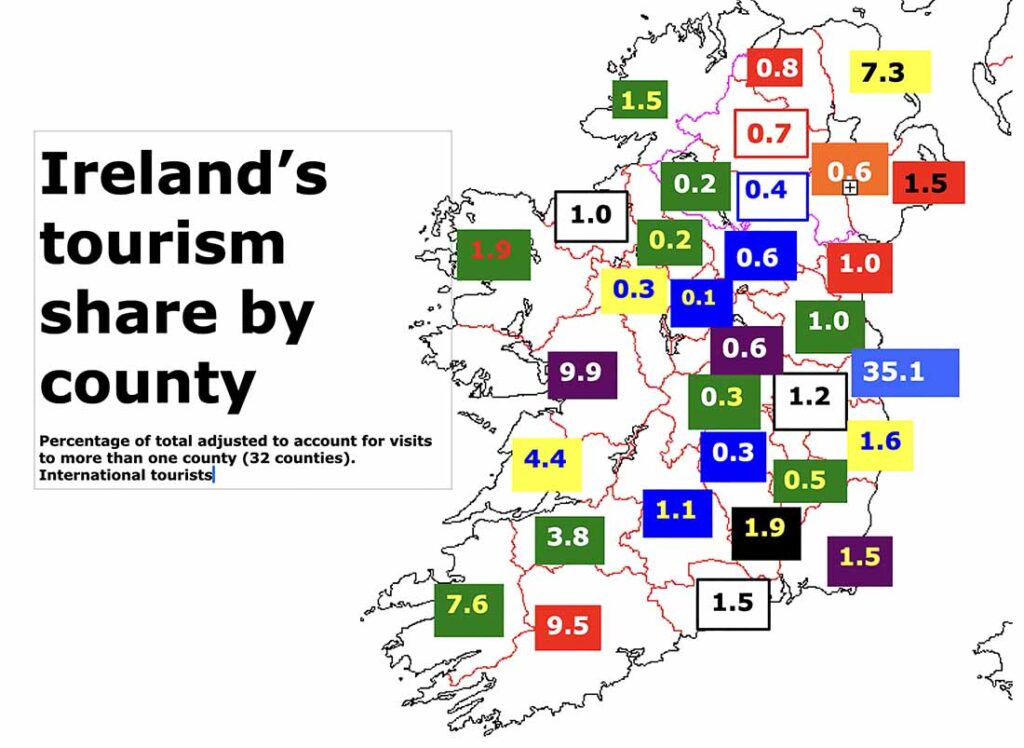
Ireland’s county Dublin combines cultural heritage with urban appeal, with Trinity College’s Book of Kells and Dublin Castle offering historical depth. The Guinness Storehouse provides a journey through Ireland’s iconic stout, while Phoenix Park’s vast green spaces are ideal for cycling. The River Liffey’s scenic walks and Kilmainham Gaol’s historical tours make Dublin a versatile destination for culture and history. Dublin is Ireland’s third smallest county by size (922 square km) and largest by population (1,458,154). Dublin is also Ireland’s most visited tourist county by a margin, with around four million international visitors per year. In terms of hospitality,
Introduction – Adventure – Anthem – Archaeology – Attractions – Awards – Birdwatching – Camping – Castles – Churches – Contact list – Cycling – Dining – Equestrian – Festivals – Fishing – Folklore – Gardens – Golf – Graveyards – Happening – Haunted – Highest – Hiking – History – Holy Wells – Hotels – Hotels top 8 – Hunting & shooting – Instagrammable – Itineraries – Largest town – Luxury – MICE – Movies – Music – New – Name – Novelists – Off the beaten track – Poets – Pubs – Quotes – Random Facts – Restaurant Awards – Sacred Places – Saints – Songs – Spas – Sports – Sunsets – Sustainable – Things to do – Towns – Video – Villages – Walking – Wanderlist – Weddings – Wild swimming – Writers – 1837 – 1846 – 1852 – 1909 – 1955 – 1980 –