- Jonathan Swift: Born in Dublin City, County Dublin (Hoey’s Court); lived in Dublin (St. Patrick’s Cathedral) 1667–1745) Best known for his satirical novel Gulliver’s Travels (1726), Swift was a towering figure in English literature. As Dean of St. Patrick’s Cathedral, his works, including A Tale of a Tub (1704), critiqued society and politics with sharp wit. His Dublin upbringing and residence shaped his engagement with Irish issues, notably in A Modest Proposal (1729).
- Maria Edgeworth: Lived in Edgeworthstown, County Longford; born in Black Bourton, Oxfordshire, but spent significant time in Dublin City, County Dublin 1768–1849) A pioneer of the realist novel, Edgeworth wrote Castle Rackrent (1800), considered one of the first historical and regional novels in English. Her time in Dublin, where she socialised with literary and intellectual circles, influenced her novels like The Absentee (1812), which addressed Anglo-Irish landlordism. Her work bridged English and Irish literary traditions.
- Bram Stoker: Born in Clontarf, County Dublin; lived in Dublin City (Marino Crescent) 1847–1912) Best known for Dracula (1897), a foundational Gothic novel, Stoker also wrote The Snake’s Pass (1890), set in Ireland. Educated at Trinity College Dublin, he worked as a civil servant at Dublin Castle and theatre critic before moving to London. His Dublin roots influenced his fascination with folklore and the supernatural.
- James Joyce: Born in Rathgar, County Dublin; lived in Dublin City (various addresses, including North Richmond Street) (1882–1941) A literary giant, Joyce revolutionised the novel with Ulysses (1922), A Portrait of the Artist as a Young Man (1916), and Finnegans Wake (1939). His works, deeply rooted in Dublin’s streets and culture, capture the city’s social and psychological landscape. Exiled in Europe, he remained devoted to Dublin in his writing, earning global acclaim.
- Elizabeth Bowen: Born in Dublin City, County Dublin (Herbert Place); lived in Bowen’s Court, County Cork 1899–1973) An Anglo-Irish novelist, Bowen wrote The Last September (1929) and The Heat of the Day (1949), exploring identity, war, and loss. Her Dublin childhood influenced her depictions of Anglo-Irish society, though she spent much of her life in England. Her lyrical prose and psychological depth earned her critical acclaim.
- Roddy Doyle: Born and lived in Kilbarrack, County Dublin 1958–living) A Booker Prize winner for Paddy Clarke Ha Ha Ha (1993), Doyle is known for The Commitments (1987), The Snapper (1990), and The Van (1991), collectively the Barrytown Trilogy. His novels capture working-class Dublin life with humour and authenticity. A former teacher, he remains a leading voice in contemporary Irish fiction.
- Maeve Binchy: Born in Dalkey, County Dublin; lived in Dublin City 1939–2012) A beloved novelist, Binchy wrote Circle of Friends (1990), Tara Road (1998), and Light a Penny Candle (1982), focusing on Irish family and community life. Her warm, accessible style made her a global bestseller. Her Dalkey upbringing and Dublin settings are central to her storytelling.
- Sebastian Barry (1955–): Born in Dublin, Co. Dublin. Shortlisted for the Booker Prize in 2005 for A Long Long Way, in 2008 for The Secret Scripture, and longlisted in 2023 for Old God’s Time, a novel about a retired policeman confronting trauma. Barry, also a playwright, is known for his lyrical explorations of Irish history and identity.
- Anne Enright (1962–): Born in Dublin, Co. Dublin. Won the Booker Prize in 2007 for The Gathering, a novel about family grief and memory, and was longlisted in 2015 for The Green Road. Enright’s incisive prose explores Irish family dynamics and societal shifts. Her Dublin birth is noted in dib.ie and The Booker Prizes website.
- Audrey Magee: Born in Dublin, Co. Dublin; lives in Bray, Co. Wicklow. Longlisted for the Booker Prize in 2022 for The Colony, a lyrical novel about an Irish island community in 1979. Magee, a former journalist, explores themes of colonialism and identity.
- Paul Murray (1975–): Born in Dublin, Co. Dublin. Shortlisted for the Booker Prize in 2023 for The Bee Sting, a tragicomic family saga set in the Irish midlands post-2008 financial crash, and longlisted in 2010 for Skippy Dies.
- Naoise Dolan (1992–): Born in Dublin. Known for her sharp, witty prose, Dolan’s debut novel Exciting Times (2020) explores a love triangle in Hong Kong, drawing comparisons to Sally Rooney for its focus on millennial relationships. Her second novel, The Happy Couple (2023), continues her incisive social commentary. Her Dublin background informs her characters’ Irish identities.
- Christine Dwyer Hickey (1958–): Born in Dublin. A novelist renowned for capturing Dublin’s vernacular and historical shifts, Hickey’s works include Tatty (2004), a Dublin One City One Book selection, The Cold Eye of Heaven (2011), and Our London Lives (2024), a life-affirming novel about love and identity. Her Dublin settings are central to her storytelling.
- Claire Kilroy (1973–): Born in Dublin. A novelist and critic, Kilroy’s works include All Summer (2003), Tenderwire (2006), All Names Have Been Changed (2009), and The Devil I Know (2012), a satirical take on the Celtic Tiger. Her recent novel Soldier Sailor (2023) was longlisted for the Women’s Prize for Fiction, exploring motherhood’s challenges. Her Dublin settings are integral to her work.
- Catherine Prasifka (1996–): Born in Dublin. A debut novelist, Prasifka’s None of This Is Serious (2022) explores millennial life and societal pressures through a speculative lens, with a mysterious crack appearing in the sky. Sister-in-law to Sally Rooney, her work draws on Dublin’s contemporary culture and her background in fantasy literature.
- Sally Rooney (1991–): Born in Castlebar, Co. Mayo. A globally acclaimed novelist, Rooney’s works include Conversations with Friends (2017), Normal People (2018), longlisted for the 2018 Booker Prize, and Beautiful World, Where Are You (2021). Her latest, Intermezzo (2024), continues her focus on relationships and class. Her Mayo and Dublin influences shape her minimalist style.
Novelists
Antrim – Armagh – Carlow – Cavan – Clare – Cork – Derry – Donegal – Down – Dublin – Fermanagh – Galway – Kerry – Kildare – Kilkenny – Laois – Leitrim – Limerick – Longford – Louth – Mayo – Meath – Monaghan – Offaly – Roscommon – Sligo – Tipperary – Tyrone – Waterford – Westmeath – Wexford – Wicklow
Poets
Antrim – Armagh – Carlow – Cavan – Clare – Cork – Derry – Donegal – Down – Dublin – Fermanagh – Galway – Kerry – Kildare – Kilkenny – Laois – Leitrim – Limerick – Longford – Louth – Mayo – Meath – Monaghan – Offaly – Roscommon – Sligo – Tipperary – Tyrone – Waterford – Westmeath – Wexford – Wicklow
Writers
Antrim – Armagh – Carlow – Cavan – Clare – Cork – Derry – Donegal – Down – Dublin – Fermanagh – Galway – Kerry – Kildare – Kilkenny – Laois – Leitrim – Limerick – Longford – Louth – Mayo – Meath – Monaghan – Offaly – Roscommon – Sligo – Tipperary – Tyrone – Waterford – Westmeath – Wexford – Wicklow
County Dublin:
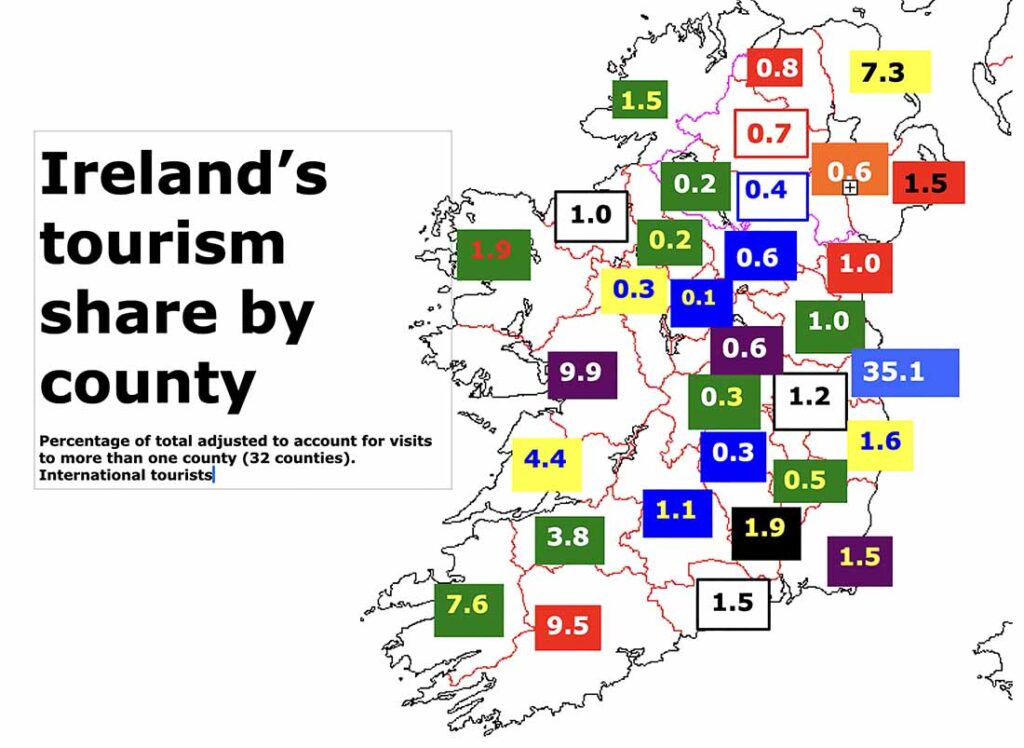
Ireland’s county Dublin combines cultural heritage with urban appeal, with Trinity College’s Book of Kells and Dublin Castle offering historical depth. The Guinness Storehouse provides a journey through Ireland’s iconic stout, while Phoenix Park’s vast green spaces are ideal for cycling. The River Liffey’s scenic walks and Kilmainham Gaol’s historical tours make Dublin a versatile destination for culture and history. Dublin is Ireland’s third smallest county by size (922 square km) and largest by population (1,458,154). Dublin is also Ireland’s most visited tourist county by a margin, with around four million international visitors per year. In terms of hospitality,
Introduction – Adventure – Anthem – Archaeology – Attractions – Awards – Birdwatching – Camping – Castles – Churches – Contact list – Cycling – Dining – Equestrian – Festivals – Fishing – Folklore – Gardens – Golf – Graveyards – Happening – Haunted – Highest – Hiking – History – Holy Wells – Hotels – Hotels top 8 – Hunting & shooting – Instagrammable – Itineraries – Largest town – Luxury – MICE – Movies – Music – New – Name – Novelists – Off the beaten track – Poets – Pubs – Quotes – Random Facts – Restaurant Awards – Sacred Places – Saints – Songs – Spas – Sports – Sunsets – Sustainable – Things to do – Towns – Video – Villages – Walking – Wanderlist – Weddings – Wild swimming – Writers – 1837 – 1846 – 1852 – 1909 – 1955 – 1980 –