- Jonathan Swift (1667-1745) Born in Dublin, Swift was a satirist, poet, and cleric, best known for Gulliver’s Travels (1726), a biting satire of human nature and society. As Dean of St. Patrick’s Cathedral, he wrote influential pamphlets like A Modest Proposal (1729), critiquing British policy in Ireland. His sharp wit made him a towering figure in English literature.
- Oscar Wilde (1854-1900) Born in Dublin, Wilde was a playwright, poet, and novelist renowned for The Picture of Dorian Gray (1890) and plays like The Importance of Being Earnest (1895). Known for his wit and flamboyant style, he was a leading figure in Victorian literature until his imprisonment for homosexuality. His Dublin upbringing shaped his early literary career.
- William Butler Yeats (1865-1939) Born in Sandymount, Dublin, Yeats was a poet and dramatist, central to the Irish Literary Revival. His works, including The Tower (1928) and The Winding Stair (1933), earned him the Nobel Prize for Literature in 1923. He co-founded the Abbey Theatre and drew heavily on Irish mythology and politics.
- James Joyce (1882-1941) Born in Rathgar, Dublin, Joyce was a novelist and short story writer whose modernist works, Ulysses (1922), Dubliners (1914), and Finnegans Wake (1939), revolutionized literature. His stream-of-consciousness style and focus on Dublin life made him a global literary icon.
- George Bernard Shaw (1856-1950) Born in Dublin, Shaw was a playwright and critic known for works like Pygmalion (1913) and Man and Superman (1903). A Nobel Prize winner (1925), he was a socialist and co-founder of the London School of Economics. His plays combined sharp social commentary with humor.
- Samuel Beckett (1906-1989) Born in Foxrock, Dublin, Beckett was a playwright, novelist, and poet, celebrated for Waiting for Godot (1953), a landmark in absurdist theater. His minimalist style and existential themes earned him the Nobel Prize in 1969. His Dublin education at Trinity College shaped his early work.
- Seán O’Casey (1880-1964) Born in Dublin, O’Casey was a playwright whose works, including The Plough and the Stars (1926) and Juno and the Paycock (1924), depicted working-class Dublin life during Ireland’s revolutionary period. His socialist views and realistic dialogue made him a major figure in Irish drama.
- Brendan Behan (1923-1964) Born in Dublin, Behan was a playwright, novelist, and poet known for The Quare Fellow (1954) and The Hostage (1958), which blended humor with social critique. His memoir Borstal Boy (1958) reflects his IRA involvement and imprisonment. His colorful Dublin persona added to his fame.
- Maeve Binchy (1939-2012) Born in Dalkey, Dublin, Binchy was a novelist and journalist whose works, like Circle of Friends (1990) and Tara Road (1998), explored Irish life with warmth and empathy. A bestselling author, her stories often centered on relationships and small-town Ireland, resonating globally.
- Roddy Doyle (1958-) Born in Dublin, Doyle is a novelist, playwright, and screenwriter known for The Commitments (1987), part of the Barrytown Trilogy, and Paddy Clarke Ha Ha Ha (1993), which won the Booker Prize. His works capture Dublin’s working-class culture with humor and authenticity.
Writers
Antrim – Armagh – Carlow – Cavan – Clare – Cork – Derry – Donegal – Down – Dublin – Fermanagh – Galway – Kerry – Kildare – Kilkenny – Laois – Leitrim – Limerick – Longford – Louth – Mayo – Meath – Monaghan – Offaly – Roscommon – Sligo – Tipperary – Tyrone – Waterford – Westmeath – Wexford – Wicklow
County Dublin:
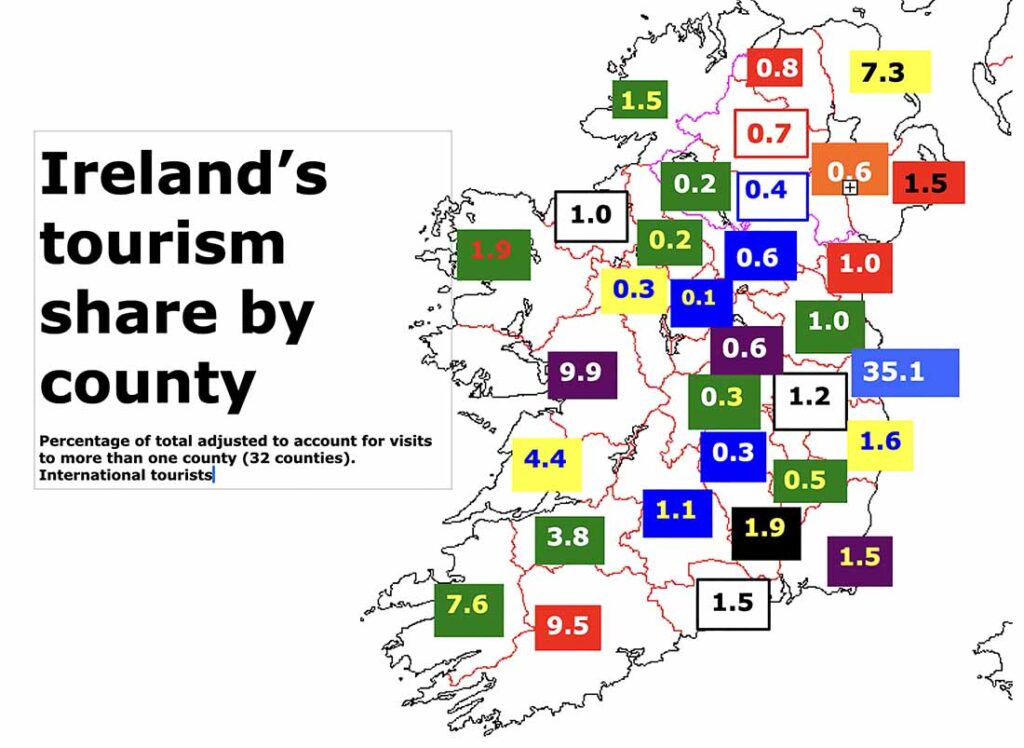
Ireland’s county Dublin combines cultural heritage with urban appeal, with Trinity College’s Book of Kells and Dublin Castle offering historical depth. The Guinness Storehouse provides a journey through Ireland’s iconic stout, while Phoenix Park’s vast green spaces are ideal for cycling. The River Liffey’s scenic walks and Kilmainham Gaol’s historical tours make Dublin a versatile destination for culture and history. Dublin is Ireland’s third smallest county by size (922 square km) and largest by population (1,458,154). Dublin is also Ireland’s most visited tourist county by a margin, with around four million international visitors per year. In terms of hospitality,
Introduction – Adventure – Anthem – Archaeology – Attractions – Awards – Birdwatching – Camping – Castles – Churches – Contact list – Cycling – Dining – Equestrian – Festivals – Fishing – Folklore – Gardens – Golf – Graveyards – Happening – Haunted – Highest – Hiking – History – Holy Wells – Hotels – Hotels top 8 – Hunting & shooting – Instagrammable – Itineraries – Largest town – Luxury – MICE – Movies – Music – New – Name – Novelists – Off the beaten track – Poets – Pubs – Quotes – Random Facts – Restaurant Awards – Sacred Places – Saints – Songs – Spas – Sports – Sunsets – Sustainable – Things to do – Towns – Video – Villages – Walking – Wanderlist – Weddings – Wild swimming – Writers – 1837 – 1846 – 1852 – 1909 – 1955 – 1980 –