- Guinness Storehouse: Located at St. James’s Gate in Dublin City, this iconic attraction explores the history of Guinness, Ireland’s famous stout. Visitors can expect a self-guided tour through seven floors of interactive exhibits on brewing, advertising, and the brand’s legacy, culminating in a pint at the Gravity Bar with 360-degree city views. Tasting sessions and a gift shop enhance the experience.
- Trinity College and the Book of Kells: Ireland’s oldest university, founded in 1592, houses the 9th-century Book of Kells, a stunning illuminated manuscript. Visitors can expect to see the Book of Kells exhibition, showcasing its intricate artistry, and explore the Long Room, a historic library with 200,000 books. Guided campus tours offer insights into Trinity’s academic heritage and architecture.
- Dublin Castle: A historic complex in Dublin City, dating back to the 13th century, once the seat of British rule. Visitors can expect guided tours of the State Apartments, medieval undercroft, and Chapel Royal, with exhibits on Ireland’s history. The gardens and nearby Dubh Linn Garden provide a peaceful retreat. Temporary exhibitions and events add cultural depth.
- Kilmainham Gaol: A former prison in Dublin City, pivotal in Ireland’s fight for independence. Visitors can expect guided tours through its stark cells and execution yard, learning about its role in the 1916 Easter Rising. The museum displays artifacts and stories of political prisoners. Booking in advance is essential due to high demand.
- Phoenix Park: One of Europe’s largest urban parks, spanning 707 hectares in Dublin City. Visitors can expect vast green spaces, cycling and walking trails, and sightings of the resident deer herd. Highlights include Áras an Uachtaráin (the President’s residence), Dublin Zoo, and the Wellington Monument. The park hosts events and is ideal for picnics.
- St. Patrick’s Cathedral: Ireland’s largest cathedral, founded in 1191, linked to St. Patrick, Ireland’s patron saint. Visitors can expect to explore its Gothic architecture, intricate stained glass, and Jonathan Swift’s tomb (the author of Gulliver’s Travels). Guided tours, choral evensong, and a gift shop offer a rich historical and cultural experience.
- Temple Bar: Dublin City’s cultural quarter, known for its vibrant nightlife and cobbled streets. Visitors can expect lively pubs with traditional Irish music, art galleries, and the Irish Film Institute. The area hosts markets, like the Temple Bar Food Market on Saturdays, and is perfect for soaking up Dublin’s bohemian atmosphere, though it can be touristy.
- National Museum of Ireland – Archaeology: Located in Dublin City, this museum showcases Ireland’s ancient past. Visitors can expect free entry to exhibits featuring the Ardagh Chalice, Tara Brooch, and preserved “bog bodies.” The collection spans prehistoric gold, Viking artifacts, and medieval treasures, with interactive displays offering insights into Ireland’s history.
- Howth Village and Cliffs: A picturesque fishing village on Dublin’s coast, known for its harbor and cliff walks. Visitors can expect fresh seafood at local restaurants, a scenic 6km cliff loop trail with views of Dublin Bay, and visits to Howth Castle or the Maritime Museum. The Sunday market offers local crafts and food, and seals are often spotted in the harbor.
- Malahide Castle and Gardens: A 12th-century castle in Malahide, north of Dublin City, set on 260 acres. Visitors can expect guided tours of the castle’s medieval and Georgian interiors, including tales of its resident ghost. The gardens feature a butterfly house, walled garden, and woodland trails. The nearby village offers charming shops and cafés.
Attractions
Antrim – Armagh – Carlow – Cavan – Clare – Cork – Derry – Donegal – Down – Dublin – Fermanagh – Galway – Kerry – Kildare – Kilkenny – Laois – Leitrim – Limerick – Longford – Louth\ – Mayo – Meath – Monaghan – Offaly – Roscommon – Sligo – Tipperary – Tyrone – Waterford – Westmeath – Wexford – Wicklow
County Dublin:
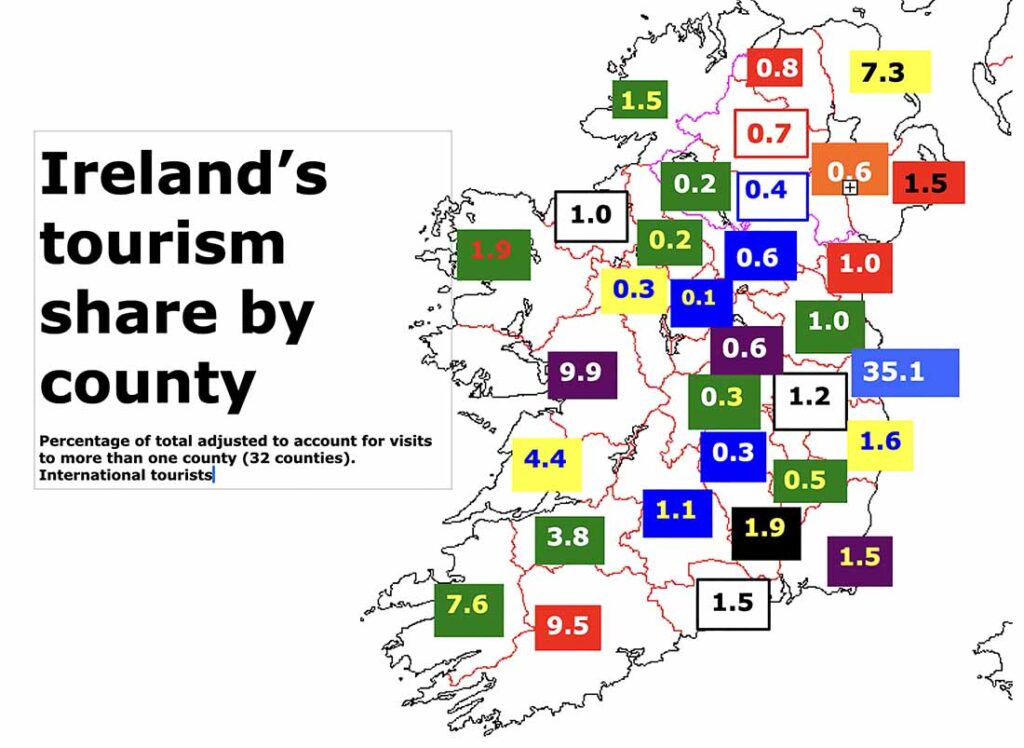
Ireland’s county Dublin combines cultural heritage with urban appeal, with Trinity College’s Book of Kells and Dublin Castle offering historical depth. The Guinness Storehouse provides a journey through Ireland’s iconic stout, while Phoenix Park’s vast green spaces are ideal for cycling. The River Liffey’s scenic walks and Kilmainham Gaol’s historical tours make Dublin a versatile destination for culture and history. Dublin is Ireland’s third smallest county by size (922 square km) and largest by population (1,458,154). Dublin is also Ireland’s most visited tourist county by a margin, with around four million international visitors per year. In terms of hospitality,
Introduction – Adventure – Anthem – Archaeology – Attractions – Awards – Birdwatching – Camping – Castles – Churches – Contact list – Cycling – Dining – Equestrian – Festivals – Fishing – Folklore – Gardens – Golf – Graveyards – Happening – Haunted – Highest – Hiking – History – Holy Wells – Hotels – Hotels top 8 – Hunting & shooting – Instagrammable – Itineraries – Largest town – Luxury – MICE – Movies – Music – New – Name – Novelists – Off the beaten track – Poets – Pubs – Quotes – Random Facts – Restaurant Awards – Sacred Places – Saints – Songs – Spas – Sports – Sunsets – Sustainable – Things to do – Towns – Video – Villages – Walking – Wanderlist – Weddings – Wild swimming – Writers – 1837 – 1846 – 1852 – 1909 – 1955 – 1980 –