Deansgrange Cemetery
- Dermot Morgan (1952–1998): An acclaimed Irish actor and comedian, best known for starring as the irascible Father Ted Crilly in the hit Channel 4 sitcom Father Ted (1995–1998). He tragically died of a heart attack shortly after filming the final episode; his ashes are interred in an understated plot at Deansgrange.
- Sinéad O’Connor (1966–2023): A groundbreaking Irish singer-songwriter, activist, and one of the most influential voices in music. Famous for her powerful 1990 hit “Nothing Compares 2 U,” her shaved head, outspoken views on religion, politics, and abuse, and albums like The Lion and the Cobra. She converted to Islam later in life and is buried in a simple grave in the cemetery’s “Garden” section.
- Seán Lemass (1899–1971): A key Irish politician and Taoiseach (prime minister) from 1959 to 1966. A 1916 Easter Rising veteran and long-time Fianna Fáil figure, he modernized Ireland’s economy through industrialization, free trade, and the first applications for EEC membership, earning credit as the architect of modern economic Ireland.
- John A. Costello (1891–1976): An Irish Fine Gael politician who served as Taoiseach twice (1948–1951 and 1954–1957). He led the first inter-party government, declared Ireland a republic in 1949 (ending Commonwealth ties), and oversaw key social and economic policies during post-war reconstruction.
- John McCormack (1884–1945): A world-renowned Irish tenor and one of the most celebrated classical and popular singers of the early 20th century. Known for his pure voice in opera, lieder, ballads, and Irish songs, he was honored as a Papal Count; his grave features a distinctive papal cross.
- Brian O’Nolan (1911–1966): Better known by his pen names Flann O’Brien (novels) and Myles na gCopaleen (Irish-language journalism), he was a brilliant Irish satirist, novelist, and columnist. Masterpieces include At Swim-Two-Birds (a postmodern classic) and The Third Policeman; his work blends absurdity, philosophy, and Irish folklore.
- Frank O’Connor (1903–1966): A major Irish short-story writer, memoirist, and translator (real name Michael O’Donovan). Renowned for poignant, humane stories of Irish life like “Guests of the Nation” and “My Oedipus Complex,” he was a key figure in 20th-century Irish literature and a translator of early Irish poetry.
- Garret FitzGerald (1926–2011): An intellectual Fine Gael politician and Taoiseach (1981–1982 and 1982–1987). Known as “Garret the Good,” he pursued Anglo-Irish relations (e.g., the 1985 Anglo-Irish Agreement), liberal social reforms, and economic stabilization during turbulent times.
- Albert Reynolds (1932–2014): A Fianna Fáil politician and Taoiseach (1992–1994) who played a crucial role in the peace process. His government helped initiate the IRA ceasefire and laid groundwork for the Good Friday Agreement; he was known for his direct, business-like style.
- John Boyd Dunlop (1840–1921): A Scottish-born veterinary surgeon and inventor who developed the first practical pneumatic (inflatable) tyre in 1888 in Belfast for his son’s tricycle. This innovation revolutionized cycling and later motoring; the Dunlop tyre company bears his name.
- Ernest Walton (1903–1995): An Irish physicist and Nobel Prize laureate (Physics, 1951, shared with John Cockcroft). He became the first person to artificially split the atom (1932) using particle acceleration at Cambridge, a landmark in nuclear physics; he later taught at Trinity College Dublin.
- Barry Fitzgerald (1888–1961): An Oscar-winning Irish actor (real name William Joseph Shields). Famous for roles in Hollywood classics like Going My Way (1944, winning Best Supporting Actor) and The Quiet Man (1952), he was a stage veteran with the Abbey Theatre before emigrating to film success in America.
Glasnevin Cemetery
- Michael Collins (1890–1922): A pivotal Irish revolutionary leader, intelligence mastermind during the War of Independence, chief negotiator of the 1921 Anglo-Irish Treaty, and commander-in-chief of the Irish Free State Army. Assassinated during the Irish Civil War, he is one of the cemetery’s most visited graves.
- Daniel O’Connell (1775–1847): Known as “The Liberator,” he was a dominant 19th-century Irish political leader who successfully campaigned for Catholic Emancipation (1829) and pushed for Repeal of the Act of Union. He founded Glasnevin Cemetery as a non-denominational burial ground; his grand tomb features a distinctive round tower.
- Charles Stewart Parnell (1846–1891): A towering Irish nationalist politician and leader of the Irish Parliamentary Party, he championed Home Rule for Ireland in the late 19th century through parliamentary means. His career ended amid personal scandal, but he remains a symbol of Irish nationalism.
- Éamon de Valera (1882–1975): A long-serving Irish political giant, he was a 1916 Easter Rising survivor, anti-Treaty leader in the Civil War, founder of Fianna Fáil, Taoiseach (prime minister) multiple times, and President of Ireland (1959–1973). He shaped modern Ireland’s constitution and neutrality policy.
- Countess Constance Markievicz (1868–1927): A revolutionary nationalist, socialist, suffragette, and Irish republican. She was the first woman elected to the Westminster House of Commons (1918, as a Sinn Féin abstentionist) and served as Minister for Labour in the revolutionary Dáil. She fought in the 1916 Rising and was a key figure in Cumann na mBan.
- Luke Kelly (1940–1984): A legendary Irish folk singer and founding member of The Dubliners, renowned for his powerful voice and performances of classics like “Raglan Road,” “The Town I Loved So Well,” and “Scorn Not His Simplicity.” He became an icon of Irish traditional and protest music.
- Brendan Behan (1923–1964): A celebrated Irish poet, novelist, short-story writer, and playwright known for his vivid, humorous, and often autobiographical works in English and Irish. Famous titles include Borstal Boy, The Quare Fellow, and The Hostage; his life was marked by republican activism, alcoholism, and larger-than-life personality.
- Maud Gonne (1866–1953): An Irish revolutionary nationalist, actress, suffragette, and fervent campaigner for Irish independence and against English colonial rule. Immortalized as the muse and unrequited love of poet W.B. Yeats, she was also mother to Seán MacBride (Nobel Peace Prize winner, also buried in her grave plot).
- Kevin Barry (1902–1920): An 18-year-old medical student and Irish Republican Army member executed by the English for his role in an ambush during the War of Independence. His death sparked outrage and made him a martyr; the ballad “Kevin Barry” commemorates him.
- Christy Brown (1932–1981): An Irish author, poet, and painter who overcame severe cerebral palsy to create acclaimed works using his left foot (the only limb he could control). Best known for his autobiography My Left Foot, later adapted into an Oscar-winning film.
- Cathal Brugha (1874–1922): A key anti-Treaty republican leader, Minister for Defence during the War of Independence, and prominent figure in the Easter Rising and Sinn Féin. Fatally wounded in fighting during the Irish Civil War, he is buried in the Republican Plot.
- Thomas Mathew Ray (1801–1881): An organizer for Daniel O’Connell’s Repeal Association, he played a crucial role in mass mobilization efforts for Catholic Emancipation and the campaign to repeal the Act of Union, helping orchestrate large-scale peaceful rallies like the “monster meetings.”
- Anne Devlin (c. 1780–1851): A heroine of the 1798 United Irishmen Rebellion and loyal aide to Robert Emmet during his 1803 rising. Imprisoned and tortured for refusing to inform on rebels, she became known as “the faithful servant.” Initially buried in a pauper’s grave, her remains were later reinterred more prominently in Glasnevin by historian Dr. Richard Madden.
- James (‘Skin-the-Goat’) Fitzharris (c. 1833–1910): A member of the Invincibles (a Fenian splinter group) who drove the getaway car in the 1882 Phoenix Park assassinations of English colonial officials Frederick Cavendish and Thomas Burke. Later a cab driver in Dublin, he became a folkloric figure; his nickname derives from an earlier incident.
Mount Jerome Cemetery,
- GJack Butler Yeats (1871–1957): A celebrated Irish painter (brother of poet W.B. Yeats), widely regarded as one of the most important 20th-century Irish artists. His expressive, colorful works often depicted Irish life, landscapes, and themes of nationalism and everyday scenes.
- William Wilde (1815–1876): An eminent Irish surgeon specializing in ophthalmology and otology (ear and eye), author of medical and antiquarian works, and a noted scholar of Irish archaeology and folklore. He was also the father of playwright Oscar Wilde.
- Thomas Davis (1814–1845): An influential Irish writer, poet, nationalist, and politician. A founder of the Young Ireland movement and co-founder/editor of The Nation newspaper, he promoted cultural revival and patriotic ideals through works like the song “A Nation Once Again.”
- Joseph Sheridan Le Fanu (1814–1873): A prominent Irish Gothic novelist and short-story writer, often considered a master of Victorian horror and mystery. His works include Uncle Silas and In a Glass Darkly, influencing later horror fiction.
- George Petrie (1790–1866): An Irish painter, antiquarian, archaeologist, musician, and collector of traditional Irish music and folklore. He played a key role in preserving Gaelic culture, archaeology, and heritage through his topographical artworks, essays (e.g., on round towers), and contributions to institutions like the Royal Irish Academy.
- John Millington Synge (1871–1909): A leading Irish playwright and key figure in the Irish Literary Revival. Best known for works like The Playboy of the Western World (which caused riots at its premiere) and Riders to the Sea, he drew inspiration from rural Irish life, especially the Aran Islands, and co-founded the Abbey Theatre with W.B. Yeats and Lady Gregory.
- William Rowan Hamilton (1805–1865): A brilliant Irish mathematician, physicist, and astronomer. Famous for inventing quaternions (a key development in algebra and 3D rotations used in modern computing and physics), he made major contributions to optics, classical mechanics, and dynamics.
- George William Russell (“AE”) (1867–1935): An Irish writer, poet, painter, mystic, editor, and nationalist (using the pseudonym Æ). Involved in the Irish Literary Revival, Theosophy, and rural reform, he was a visionary figure blending mysticism, art, and social activism.
- Arthur Guinness (II) (1768–1855): The second Arthur Guinness, eldest surviving son of the brewery founder Arthur Guinness (of Guinness stout fame). He expanded and managed the family brewing business, along with interests in banking, politics, and milling.
- William Carleton (1794–1869): An Irish novelist and short-story writer known for realistic (and sometimes controversial) depictions of rural Irish peasant life, poverty, and the Famine era. His major work is Traits and Stories of the Irish Peasantry.
- Edward Bunting (1773–1843): An Irish musician, organist, and pioneering collector of traditional Irish music. He transcribed ancient harp tunes at the 1792 Belfast Harp Festival and published influential collections like A General Collection of the Ancient Irish Music, preserving Ireland’s musical heritage.
- Maeve Binchy (1940–2012): A beloved Irish novelist and journalist, famous for warm, character-driven bestsellers like Circle of Friends and Tara Road (cremated).
- David Kelly (1929–2012): A prolific Irish actor known for roles in films like Into the West, Charlie and the Chocolate Factory, and TV series such as Strumpet City (cremated).
- Sarah Purser (1848–1943): An accomplished Irish portrait painter, stained-glass artist, and entrepreneur. She was the first woman elected as a full member of the Royal Hibernian Academy and helped establish Ireland’s stained-glass tradition
Saint Andrew’s churchyard,
- John Thomas Ball (1815–1898): A distinguished Irish judge, legal scholar, and politician who served as Lord Chancellor of Ireland (1875–1880). A prominent figure in the 19th-century Irish judiciary and Conservative politics, he authored important legal works and rose to high office under English administration in Ireland. (
Saint Fintan’s Cemetery, Sutton,
- Phil Lynott (1949–1986): The charismatic Irish singer, songwriter, and bassist who fronted the rock band Thin Lizzy. Famous for hits like “Whiskey in the Jar,” “The Boys Are Back in Town,” and “Jailbreak,” he blended hard rock with Irish folk influences and became a cultural icon. He died young from drug-related heart failure and pneumonia; his grave in St. Fintan’s Cemetery (Plot in St. Polan’s section) is a place of pilgrimage for fans.
- Charles J. Haughey (1925–2006): A dominant and controversial Irish politician who served as Taoiseach (prime minister) three times (1979–1981, 1982, 1987–1992) for Fianna Fáil. He shaped modern Ireland through economic policies and EU relations but was embroiled in scandals (e.g., arms trial, financial impropriety). His grave in St. Fintan’s Cemetery overlooks the sea, fulfilling his wish for a coastal resting place.
Saint George’s Church, Drumcondra,
- Marmaduke Coghill (1673–1739): An Irish politician, scholar, poet, and public figure who served as Chancellor of the Exchequer in Ireland. A key intellectual of his era, he co-founded the Dublin Society (forerunner to the Royal Dublin Society/RDS) in 1731 to promote arts, sciences, and agriculture. He is buried in a memorial tomb within Drumcondra Church, which his sister Mary rebuilt in 1743 as a tribute to him after his death.
- Francis Johnston (1760–1829): One of Ireland’s foremost neoclassical architects, responsible for iconic Dublin buildings including the General Post Office (GPO), the Chapel Royal at Dublin Castle, and contributions to various estates (e.g., in County Louth related to the Townley Balfour family). He designed many Georgian landmarks. He is buried in a simple grave of his own design in the burial ground of St. George’s Church (now on Whitworth Road, Drumcondra), interred there after his death on March 14, 1829.
Saint Mary’s Church, Howth,
- Eugene O’Curry (1794–1862): A pioneering Irish Gaelic scholar, antiquarian, and manuscript expert. He transcribed and cataloged ancient Irish texts, lectured on Irish history and literature (published as Lectures on the Manuscript Materials of Ancient Irish History), and collaborated with scholars like George Petrie. One of the foremost figures in 19th-century Celtic studies, he is associated with burial at Saint Mary’s Church in Howth.
Saint Patrick’s Cathedral:
- Jonathan Swift (1667–1745): The renowned Anglo-Irish satirist, essayist, poet, and clergyman, best known for Gulliver’s Travels and works like A Modest Proposal. Dean of St. Patrick’s Cathedral from 1713 until his death, he was a fierce critic of English rule in Ireland and a champion of Irish interests. He is buried in the cathedral nave, beside his companion Esther Johnson (“Stella”), with his self-penned epitaph in Latin.
Wolfe Tone square,
- Francis Hutcheson (1694–1746): A Scottish-born philosopher of the Irish Enlightenment, often called the “father of the Scottish Enlightenment.” His moral sense theory and ideas on natural rights, benevolence, and aesthetics influenced thinkers like David Hume, Adam Smith, and the American Founding Fathers (e.g., Thomas Jefferson). He died in Dublin during a visit and was originally buried in the churchyard of St. Mary’s (now deconsecrated and part of Wolfe Tone Square, with a commemorative plaque marking the site, the former graveyard of St. Mary’s Church, Mary Street)
List of Graveyards in Dublin
Arbour Hill Cemetery, Balgriffin Cemetery, Ballinteer (St. John’s Churchyard), Ballybough Jewish Cemetery, Ballymadun Churchyard, Ballyman Graveyard, Balrothery Churchyard (Balbriggan), Blackrock (St. Andrew’s Churchyard), Bohernabreena Cemetery, Bully’s Acre (Kilmainham), Cabra (St. Joseph’s Carmelite Monastery Graveyard), Carrickbrennan Churchyard (Monkstown), Castleknock (St. Brigid’s Churchyard), Chapelizod (St. Laurence’s Churchyard), Cloghran Churchyard (Swords), Clondalkin (Mount St. Joseph’s Monastery Graveyard), Clondalkin (St. John’s Churchyard), Clonmethan Churchyard, Clontarf (St. John the Baptist Churchyard), Coolmine (St. Mochta’s Churchyard), Cruagh Cemetery, Dardistown Cemetery, Deansgrange Cemetery, Donabate (St. Patrick’s Churchyard), Donnybrook Cemetery, Drumcondra Church Graveyard, Esker Churchyard (Lucan), Finglas (St. Canice’s Churchyard), Garristown Churchyard, Glasnevin Cemetery, Goldenbridge Cemetery, Grange Abbey Graveyard (Baldoyle), Grangegorman Military Cemetery, Howth (St. Mary’s Abbey Graveyard), Huguenot Cemetery (Merrion Row), Kenure Churchyard (Rush), Kilbarrack Cemetery, Kilbride Churchyard, Kilcreagh Graveyard (Donabate), Kilgobbin Churchyard, Kill of the Grange (St. Fintan’s Churchyard), Killeek Churchyard, Killester Cemetery, Killiney Old Churchyard, Kilmactalway Churchyard, Kilternan Churchyard, Lusk (St. Macculin’s Churchyard), Malahide (St. Andrew’s Churchyard), Mount Jerome Cemetery, Mount Venus Cemetery, Mulhuddart (St. Thomas’ Churchyard), Naul Churchyard, Newbridge Demesne Cemetery, Newcastle (St. Finian’s Churchyard), Old Connacht Burial Ground (Bray), Our Lady of Lourdes (Seán McDermott Street), Palmerstown Cemetery (Kennelsfort Road), Palmerstown Oldtown Graveyard, Portmarnock Churchyard, Raheny (St. Assam’s Churchyard), Rathcoole (St. Mary’s Churchyard), Rathfarnham (Loreto Abbey Graveyard), Rathmichael Old Churchyard, Redemptoristines Monastery Graveyard (Drumcondra), Rolestown (Killossery Churchyard), Royal Hospital Military Cemetery (Kilmainham), Rush (St. Maur’s Churchyard), Saggart (Main Street Churchyard), Santry (St. Pappan’s Churchyard), St. Andrew’s Churchyard (Dublin City), St. Ann’s Churchyard (Dawson Street), St. Audoen’s Churchyard (Dublin City), St. Brigid’s Churchyard (Castleknock), St. Catherine’s Churchyard (Dublin City), St. James’s Graveyard (Dublin City), St. Kevin’s Churchyard (Camden Row), St. Margaret’s Churchyard, St. Mark’s Churchyard (Dublin City), St. Mary’s Churchyard (Dublin City), St. Michan’s Churchyard (Dublin City), St. Patrick’s Cathedral Graveyard (Dublin City), St. Paul’s Churchyard (Dublin City), Swords (St. Columba’s Churchyard), Tallaght (St. Maelruain’s Churchyard), Taney Churchyard (Dundrum), Tully Churchyard
Graveyards
Antrim – Armagh – Carlow – Cavan – Clare – Cork – Derry – Donegal – Down – Dublin – Fermanagh – Galway – Kerry – Kildare –Kilkenny – Laois – Leitrim – Limerick – Longford – Louth – Mayo – Meath – Monaghan – Offaly – Roscommon – Sligo – Tipperary – Tyrone – Waterford – Westmeath – Wexford – Wicklow
County Dublin:
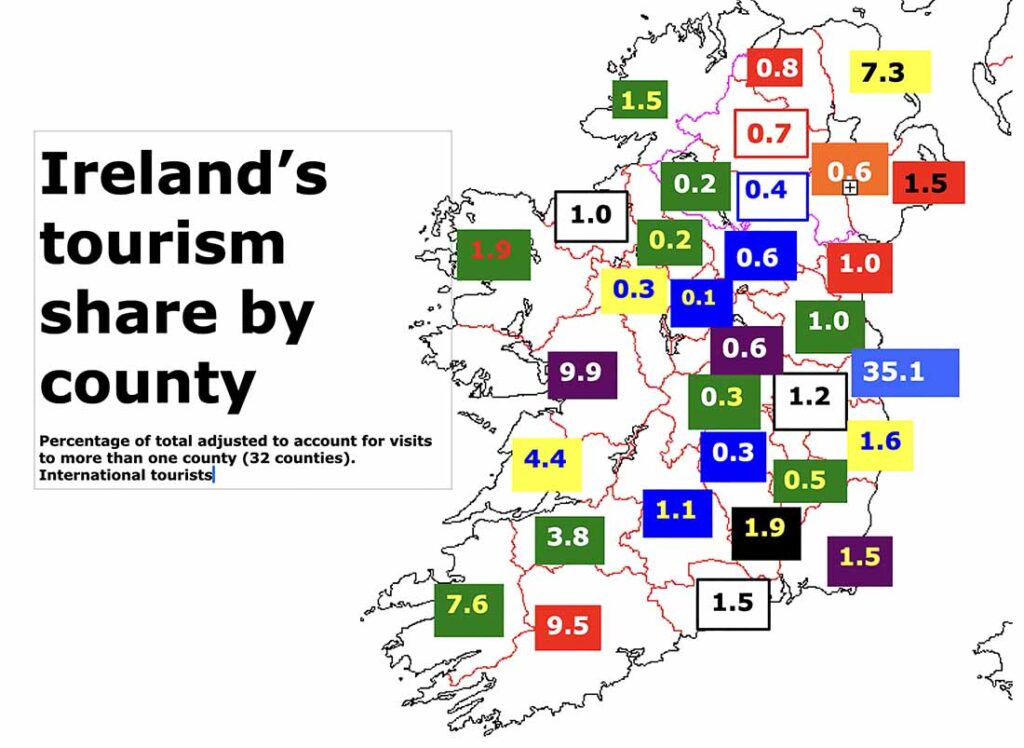
Ireland’s county Dublin combines cultural heritage with urban appeal, with Trinity College’s Book of Kells and Dublin Castle offering historical depth. The Guinness Storehouse provides a journey through Ireland’s iconic stout, while Phoenix Park’s vast green spaces are ideal for cycling. The River Liffey’s scenic walks and Kilmainham Gaol’s historical tours make Dublin a versatile destination for culture and history. Dublin is Ireland’s third smallest county by size (922 square km) and largest by population (1,458,154). Dublin is also Ireland’s most visited tourist county by a margin, with around four million international visitors per year. In terms of hospitality,
Introduction – Adventure – Anthem – Archaeology – Attractions – Awards – Birdwatching – Camping – Castles – Churches – Contact list – Cycling – Dining – Equestrian – Festivals – Fishing – Folklore – Gardens – Golf – Graveyards – Happening – Haunted – Highest – Hiking – History – Holy Wells – Hotels – Hotels top 8 – Hunting & shooting – Instagrammable – Itineraries – Largest town – Luxury – MICE – Movies – Music – New – Name – Novelists – Off the beaten track – Poets – Pubs – Quotes – Random Facts – Restaurant Awards – Sacred Places – Saints – Songs – Spas – Sports – Sunsets – Sustainable – Things to do – Towns – Video – Villages – Walking – Wanderlist – Weddings – Wild swimming – Writers – 1837 – 1846 – 1852 – 1909 – 1955 – 1980 –