- Bono (Paul David Hewson): Singer-songwriter, frontman of U2 (rock) from Glasnevin, Dublin, County Dublin. Born May 10, 1960. Lead singer of U2, known for hits like “With or Without You” and “Beautiful Day.” Bono is also a prominent activist, co-founding ONE and (RED). U2 has won 22 Grammy Awards.
- The Edge (David Howell Evans): Guitarist, songwriter, member of U2 (rock) from Malahide, County Dublin (born in London but raised in Dublin from age one). Born August 8, 1961. U2’s guitarist, known for his distinctive sound in songs like “Where the Streets Have No Name.” He co-wrote much of U2’s catalog and contributed to film scores like Spider-Man: Turn Off the Dark.
- Phil Lynott: Singer-songwriter, bassist, frontman of Thin Lizzy (rock) from West Bromwich, England; raised in Crumlin, Dublin, County Dublin. Born August 20, 1949 Died January 4, 1986. Known for hits like “The Boys Are Back in Town” and “Whiskey in the Jar,” Lynott was a pioneering rock star and Ireland’s first major Black musician. A statue of him stands on Harry Street, Dublin.
- Sinéad O’Connor: Singer-songwriter (pop, folk, alternative) from Glenageary, County Dublin. Born December 8, 1966 Died July 26, 2023. Famous for her cover of “Nothing Compares 2 U,” O’Connor was known for her powerful voice and outspoken activism. Her debut album, The Lion and the Cobra, earned critical acclaim.
- Luke Kelly: Singer, folk musician, member of The Dubliners from Dublin City, County Dublin (Sheriff Street area). Born November 17, 1940 Died January 30, 1984. A legendary folk singer, Kelly’s renditions of “Raglan Road” and “The Auld Triangle” are iconic. His work with The Dubliners helped revive Irish folk music globally.
- Christy Moore: Singer-songwriter, folk musician from Clondalkin, County Dublin (born in Newbridge, Kildare, but long associated with Dublin). Born May 7, 1945. A founding member of Planxty and Moving Hearts, Moore is known for songs like “Ride On” and “Black Is the Colour.” He is a cornerstone of Irish folk music.
- Damien Rice: Singer-songwriter (folk-pop) from Celbridge, County Kildare; raised in Rathfarnham, County Dublin. Born December 7, 1973. Known for his emotive albums O and 9, with hits like “The Blower’s Daughter,” Rice has influenced modern folk music. He won the Shortlist Music Prize in 2003.
- Hozier (Andrew Hozier-Byrne): Singer-songwriter (soul, blues, folk) from Bray, County Wicklow; raised in Delgany, Wicklow, but closely associated with Dublin (studied at Trinity College). Born March 17, 1990. Known for his global hit “Take Me to Church,” Hozier blends soul and folk. His albums, like Wasteland, Baby!, have topped charts in Ireland and the U.S.
- Ronnie Drew: Singer, folk musician, member of The Dubliners from Dún Laoghaire, County Dublin. Born September 16, 1934 Died August 16, 2008. With his gravelly voice, Drew was central to The Dubliners’ success, singing classics like “Dirty Old Town.” He also had a solo career and acted in films.
- Imelda May (Imelda Mary Higham): Singer-songwriter (rockabilly, jazz, pop) from The Liberties, Dublin, County Dublin. Born July 10, 1974. Known for albums like Love Tattoo and hits like “Johnny Got a Boom Boom,” May revitalized rockabilly. She later explored pop and poetry, earning multiple awards.
Musicians
Antrim – Armagh – Carlow – Cavan – Clare – Cork – Derry – Donegal – Down – Dublin – Fermanagh – Galway – Kerry – Kildare – Kilkenny – Laois – Leitrim – Limerick – Longford – Louth – Mayo – Meath – Monaghan – Offaly – Roscommon – Sligo – Tipperary – Tyrone – Waterford – Westmeath – Wexford – Wicklow
County Dublin:
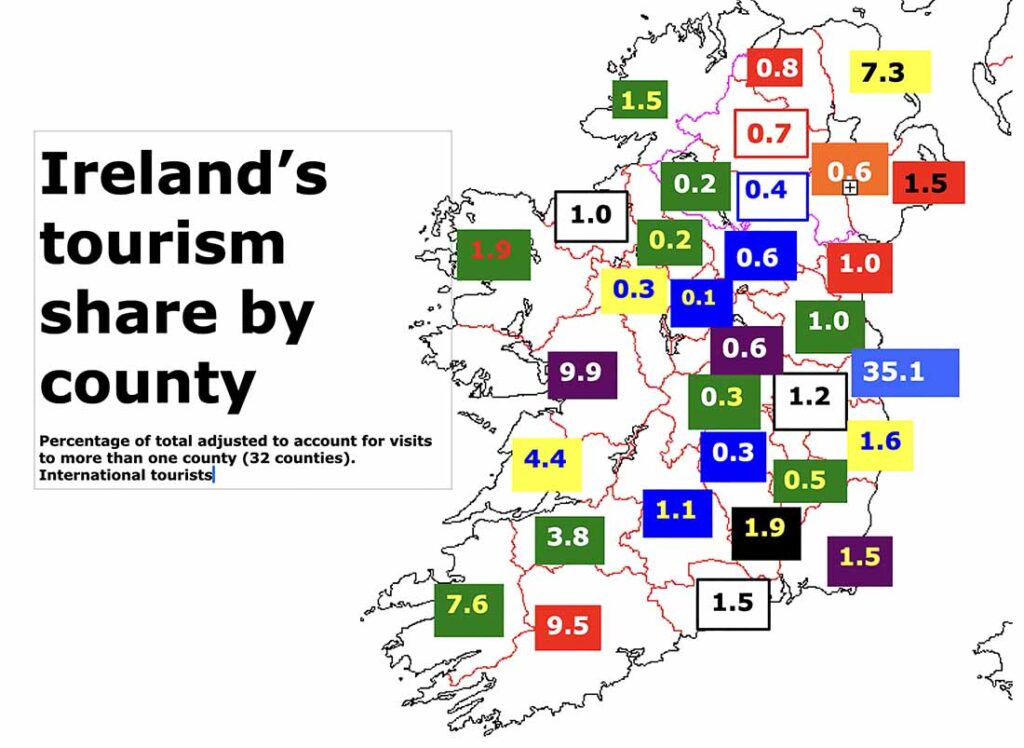
Ireland’s county Dublin combines cultural heritage with urban appeal, with Trinity College’s Book of Kells and Dublin Castle offering historical depth. The Guinness Storehouse provides a journey through Ireland’s iconic stout, while Phoenix Park’s vast green spaces are ideal for cycling. The River Liffey’s scenic walks and Kilmainham Gaol’s historical tours make Dublin a versatile destination for culture and history. Dublin is Ireland’s third smallest county by size (922 square km) and largest by population (1,458,154). Dublin is also Ireland’s most visited tourist county by a margin, with around four million international visitors per year. In terms of hospitality,
Introduction – Adventure – Anthem – Archaeology – Attractions – Awards – Birdwatching – Camping – Castles – Churches – Contact list – Cycling – Dining – Equestrian – Festivals – Fishing – Folklore – Gardens – Golf – Graveyards – Happening – Haunted – Highest – Hiking – History – Holy Wells – Hotels – Hotels top 8 – Hunting & shooting – Instagrammable – Itineraries – Largest town – Luxury – MICE – Movies – Music – New – Name – Novelists – Off the beaten track – Poets – Pubs – Quotes – Random Facts – Restaurant Awards – Sacred Places – Saints – Songs – Spas – Sports – Sunsets – Sustainable – Things to do – Towns – Video – Villages – Walking – Wanderlist – Weddings – Wild swimming – Writers – 1837 – 1846 – 1852 – 1909 – 1955 – 1980 –