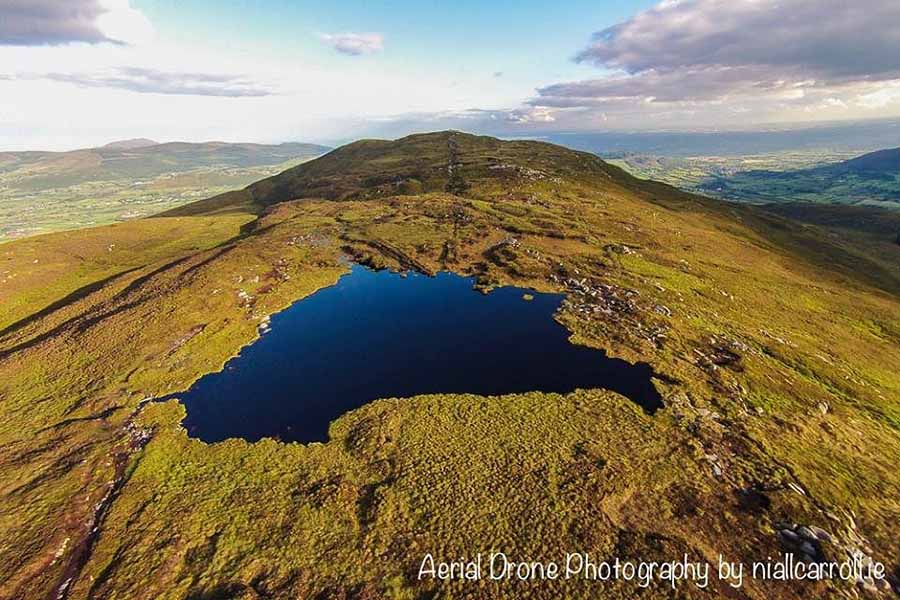
An inland county of Ulster, bounded on the north by Lough Neagh, on the east by the county of Down, on the south by the counties of Louth and Monaghan, and on the west by the counties of Monaghan and Tyrone. Its greatest length, from Jonesborough near the Newry mountains to the vicinity of Dungannon, is about 37 English miles; and its greatest breadth, from Charlemont on the Blackwater to the neighbourhood of Poyntzpass, is about 28 miles. Its area is computed at 328,579 acres, or 513 square miles; of which about 265,000 acres are arable land. Its outline is very irregular; and its surface, though in general gently undulating, and nowhere mountainous, is beautifully diversified with small hills, fertile valleys, and numerous lakes. The principal elevations are the hills of Killeavy and Carrickatavally on the southern frontier, rising respectively about 1,145 and 1,000 feet above sea-level; Slieve Gullion, an isolated and very conspicuous mountain near the southern extremity, attaining an altitude of 1,893 feet; and Camlough mountain, near Newry, rising to about 1,400 feet. The general aspect of the county is highly pleasing; and in the southern and southeastern districts, it is eminently picturesque and romantic.
The principal rivers are the Upper Bann, the Blackwater, the Callan, the Cusher, the Camlough water, the Clanrye or Newry river, and the Fane. The Upper Bann has its source among the Mourne mountains in the south of Down, enters Armagh a little to the east of Poyntzpass, flows northward through a rich and beautiful valley, and falls into Lough Neagh at Charlemont. The Blackwater rises in the county of Monaghan, forms for several miles the boundary between Armagh and Tyrone, receives the Oona water from the latter county, and discharges itself into Lough Neagh at Benburb. The Callan has its source in the parish of Kildress, flows eastward past Armagh, and falls into the Blackwater near Middletown. The Cusher rises near Tandragee, and falls into the Bann near Portadown. The Camlough water and the Clanrye both fall into the Newry river, and communicate with the Newry canal. The Fane rises near Keady, and flows into the bay of Dundalk. The Newry canal, connecting Lough Neagh with Carlingford Lough, traverses the southeastern extremity of the county for about 5 miles, and is navigable for vessels of considerable burden. The Ulster canal enters the county near Middletown, and pursues a northerly course to Lough Neagh.
The soils are exceedingly various, but in general highly fertile. The northern and western districts consist chiefly of strong clay, well adapted to tillage; the southern and southeastern districts are principally a rich loam, admirably suited both to tillage and pasturage; and the central districts exhibit a mixture of clay, loam, and light gravelly soils. Limestone is abundant in the north and northwest; freestone and whinstone occur in various parts; and coal is found in small quantities near Lough Neagh. The agriculture is in a very advanced state; the farms are in general small, but are well cultivated; and the system of green-cropping, stall-feeding, and irrigation is extensively practised. The principal crops are oats, wheat, barley, potatoes, and flax; and large quantities of excellent butter and pork are produced for exportation. The linen manufacture, which was formerly the staple of the county, has greatly declined; but the cotton manufacture, and the making of coarse linens and sheetings, are still carried on to a considerable extent.The population in 1841 was 232,317; of whom 115,322 were males, and 116,995 females; 114,366 were returned as living in rural districts, and 117,951 in towns and villages. The principal towns are Armagh, the county town, Portadown, Lurgan (partly in Armagh), Tandragee, Newry (partly in Armagh), Keady, and Middletown. The county contains 29 parishes, and parts of 4 others; and is divided into the baronies of Armagh, Lower Fews, Upper Fews, Lower Orior, Upper Orior, and Tiranny. The estates are in general small, and much subdivided; but there are several large and well-managed properties. The Grand Jury presentments for 1843 amounted to £21,456 17s. 5d. The assizes are held at Armagh; and quarter-sessions at Armagh, Lurgan, and Newry. The county returns two members to parliament for the county at large, and one for the borough of Armagh.
Ireland in 1846
Antrim – Armagh – Carlow – Cavan – Clare – Cork – Derry – Donegal – Down – Dublin – Fermanagh – Galway – Kerry – Kildare – Kilkenny – Laois – Leitrim – Limerick – Longford – Louth – Mayo – Meath – Monaghan – Offaly – Roscommon – Sligo – Tipperary – Tyrone – Waterford – Westmeath – Wexford – Wicklow
County Armagh:
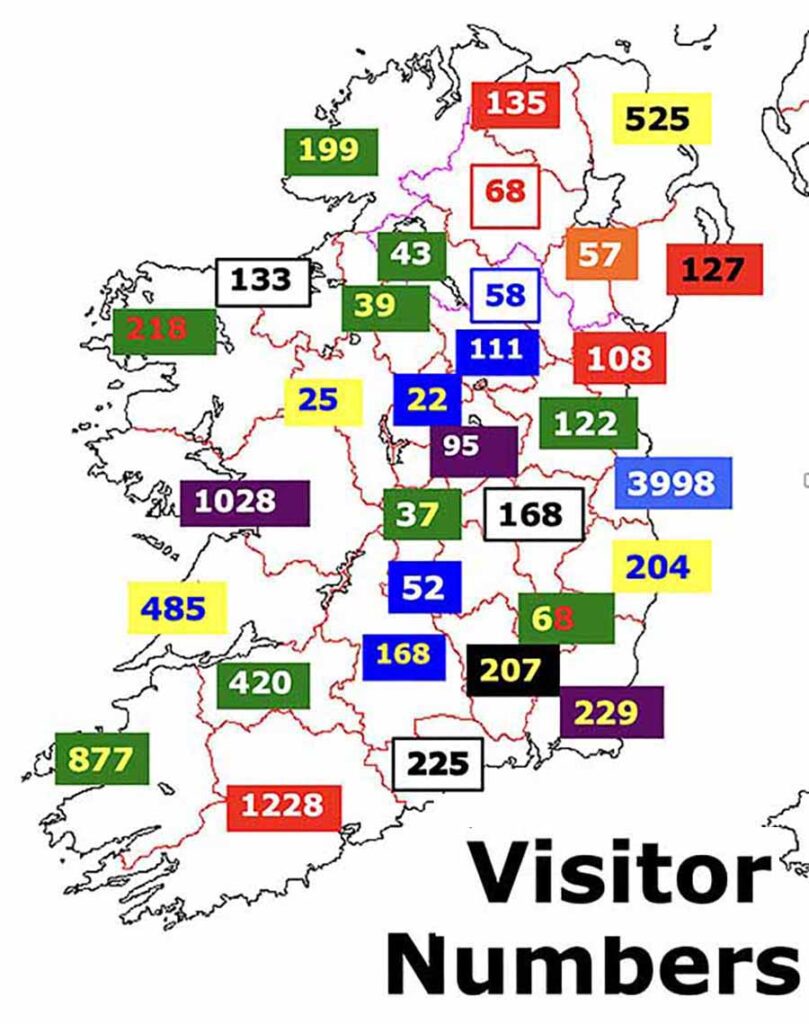
Ireland’s County Armagh is steeped in history and natural beauty, with the Navan Fort, an ancient ceremonial site, offering archaeological intrigue. The Armagh Observatory and Planetarium provide stargazing opportunities, while the city’s two cathedrals reflect its ecclesiastical heritage. Other attractions include the nearby Slieve Gullion Forest Park with its hiking trails and panoramic views. Armagh is Ireland’s fifth smallest county by size (1,253 square km) and tenth largest by population (194,394). Population peaked at 232,393 in 1841 and reached its lowest point, 108,815, in 1937. In terms of hospitality, Armagh is Ireland’s 26th most visited tourist county with around 57,000 international visitors per year.
Introduction – Adventure – Anthem – Archaeology – Attractions – Awards – Birdwatching – Camping – Castles – Churches – Contact list – Cycling – Dining – Equestrian – Festivals – Fishing – Folklore – Gardens – Golf – Graveyards – Happening – Haunted – Highest – Hiking – History – Holy Wells – Hotels – Hotels top 8 – Hunting & shooting – Instagrammable – Itineraries – Largest town – Luxury – MICE – Movies – Music – New – Name – Novelists – Off the beaten track – Poets – Pubs – Quotes – Random Facts – Restaurant Awards – Sacred Places – Saints – Songs – Spas – Sports – Sunsets – Sustainable – Things to do – Towns – Video – Villages – Walking – Wanderlist – Weddings – Wild swimming – Writers – 1837– 1846 – 1852 – 1909 – 1955 – 1980 –