- Ardress House and the Servant Girl’s Curse: Ardress House is haunted by a wronged servant girl, whose spirit causes disturbances like moving objects, seeking retribution for her mistreatment. Built in the 17th century, the house reflects landlord-tenant tensions. Dúchas.ie records tales of ghostly unrest tied to social injustices. Ardress House, near Portadown, County Armagh.
- Armagh Cathedral and St. Patrick’s Founding: St. Patrick is said to have founded his first church in Armagh, declaring it the ecclesiastical capital of Ireland. Visions guided him to the site, marked by a sacred stone. Dating to the 5th century, St. Patrick’s life blends history and myth. Armagh’s prominence as a Christian centre stems from this legend, tied to its twin cathedrals. St. Patrick’s Cathedrals (Catholic and Church of Ireland), Armagh city, County Armagh.
- Gosford Castle and the Soldier’s Ghost: Gosford Castle is haunted by a spectral soldier, seen in the grounds, believed to be a casualty of 19th-century conflicts. The castle, built in the 1800s, served as a military base. Ghost stories reflect its use during turbulent times, as per local accounts. Gosford Castle, near Markethill, County Armagh.
- Loughgall Manor and the Grey Lady: Loughgall Manor is haunted by a Grey Lady, seen in the gardens, believed to be a former resident mourning a lost child. The 18th-century manor was home to landed families. Tales of the Grey Lady tie to domestic tragedies, per oral tradition. Loughgall Manor, Loughgall, County Armagh.
- Mullavilly Church and the Phantom Bell: Mullavilly Church is haunted by a phantom bell that tolls at midnight, believed to be rung by a ghostly parishioner lost in a storm. The 18th-century church has a history of rural tragedies. Local lore connects the bell to a lost soul seeking shelter, per Dúchas.ie. Mullavilly Church, near Laurelvale, County Armagh.
- Navan Fort and the Warrior’s Shade: Navan Fort is haunted by a spectral warrior, possibly from the Red Branch Knights, seen patrolling the ancient site at dusk. Linked to the Ulster Cycle, Navan was a ceremonial centre. Dúchas.ie mentions ghostly figures tied to its mythological warrior past. Navan Fort, near Armagh city, County Armagh.
- Portadown Railway Station and the Phantom Train: Portadown Railway Station is haunted by a phantom train, heard whistling at night, believed to be linked to a fatal 19th-century crash. The station, a key rail hub, saw accidents in its early years. Dúchas.ie records tales of ghostly trains tied to railway disasters. Portadown Railway Station, Portadown, County Armagh.
- Richhill Castle and the Lady in White: Richhill Castle is haunted by a Lady in White, believed to be a Richardson family member, seen drifting through the halls in sorrow. The 17th-century castle was home to the Richardson family. Tales of the ghost stem from a tragic love story, as per oral accounts. Richhill Castle, Richhill, County Armagh.
- Slieve Gullion and the Cailleach’s Shade: Slieve Gullion is haunted by the Cailleach Bhéara’s shade, a hag-like figure seen near the summit, guarding her ancient domain. The Cailleach is a Celtic deity tied to the mountain’s cairns. Dúchas.ie mentions spectral sightings linked to Slieve Gullion’s mythological past. Slieve Gullion, near Newry, County Armagh.
- Tandragee Castle and the O’Hanlon Ghost: Tandragee Castle is haunted by a member of the O’Hanlon clan, former lords of the area, whose spirit roams the grounds, guarding ancestral lands or seeking vengeance. The O’Hanlons were a powerful Gaelic family, and their castle’s turbulent history, including confiscations, fuels ghost stories. The castle’s ruins amplify its haunted reputation. Tandragee Castle, Tandragee, County Armagh.
- The Black Pig’s Dyke: The Black Pig’s Dyke, an ancient earthwork, was created by a monstrous boar that tore through the land to form a defensive barrier against invaders or cattle raiders. This Iron Age fortification, found across Ulster, is explained through folklore as the work of a supernatural beast. Its remnants in Armagh reflect efforts to mythologise ancient boundaries. Scattered earthworks, particularly near Newtownhamilton, County Armagh.
- The Fairy Forts of Lisnadill: Ring forts in Lisnadill are fairy forts, homes to the aos sí (fairy folk). Disturbing them risks curses, such as illness or bad harvests, as they are protected by ancient magic. These Iron Age structures are imbued with Celtic beliefs in the Otherworld. Armagh’s rural landscape preserves many such forts, reinforcing tales of fairy retribution. Lisnadill, near Armagh city, County Armagh.
- The Fairy Hawthorn of Mullaghbawn: A lone hawthorn tree in Mullaghbawn is a fairy tree, sacred to the aos sí. Cutting it down invites misfortune, such as illness or death, as it serves as a portal to the fairy realm. Fairy trees are rooted in Celtic belief in the Otherworld. Armagh’s countryside, dotted with hawthorns, preserves this tradition, with locals avoiding such trees. Mullaghbawn, near Forkhill, County Armagh.
- The Lough Neagh Eel Legend: Lough Neagh’s eels are linked to a curse by St. Patrick, who transformed a serpent into eels after it threatened him. The eels are said to have mystical properties. Lough Neagh, Ireland’s largest lake, has long inspired folklore. The eel fishery, vital to Armagh’s economy, ties to this legend, blending Christian and pagan elements. Lough Neagh, near Portadown, County Armagh.
- Vicar’s Hill and the Clergyman’s Ghost: Vicar’s Hill is haunted by a ghostly clergyman, seen wandering at night, tied to a tragic death or unresolved grievance. Armagh’s ecclesiastical history fosters ghost stories. The hill’s proximity to the cathedral links the spirit to 18th-century church disputes, per local tradition. Vicar’s Hill, Armagh city, County Armagh.
Haunted
Antrim – Armagh – Carlow – Cavan – Clare – Cork – Derry – Donegal – Down – Dublin – Fermanagh – Galway – Kerry – Kildare – Kilkenny – Laois – Leitrim – Limerick – Longford – Louth – Mayo – Meath – Monaghan – Offaly – Roscommon – Sligo – Tipperary – Tyrone – Waterford – Westmeath – Wexford – Wicklow
County Armagh:
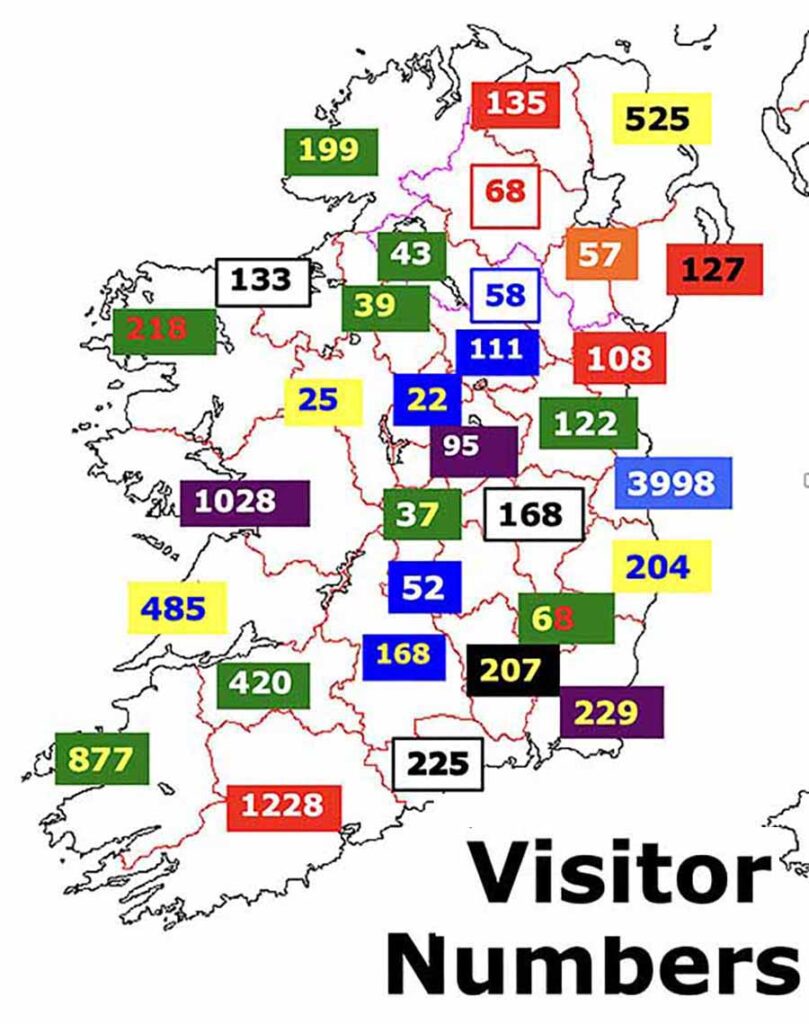
Ireland’s County Armagh is steeped in history and natural beauty, with the Navan Fort, an ancient ceremonial site, offering archaeological intrigue. The Armagh Observatory and Planetarium provide stargazing opportunities, while the city’s two cathedrals reflect its ecclesiastical heritage. Other attractions include the nearby Slieve Gullion Forest Park with its hiking trails and panoramic views. Armagh is Ireland’s fifth smallest county by size (1,253 square km) and tenth largest by population (194,394). Population peaked at 232,393 in 1841 and reached its lowest point, 108,815, in 1937. In terms of hospitality, Armagh is Ireland’s 26th most visited tourist county with around 57,000 international visitors per year.
Introduction – Adventure – Anthem – Archaeology – Attractions – Awards – Birdwatching – Camping – Castles – Churches – Contact list – Cycling – Dining – Equestrian – Festivals – Fishing – Folklore – Gardens – Golf – Graveyards – Happening – Haunted – Highest – Hiking – History – Holy Wells – Hotels – Hotels top 8 – Hunting & shooting – Instagrammable – Itineraries – Largest town – Luxury – MICE – Movies – Music – New – Name – Novelists – Off the beaten track – Poets – Pubs – Quotes – Random Facts – Restaurant Awards – Sacred Places – Saints – Songs – Spas – Sports – Sunsets – Sustainable – Things to do – Towns – Video – Villages – Walking – Wanderlist – Weddings – Wild swimming – Writers – 1837– 1846 – 1852 – 1909 – 1955 – 1980 –