- George William Russell (AE) from Lurgan (1867-1935): Born in Lurgan, Russell, known by his pseudonym AE, was a key figure in the Irish Literary Revival. His mystical poetry, such as “The Silence of Love,” reflects spiritual themes. He later lived in Dublin, fostering literary circles with Yeats and Joyce.
- Paul Muldoon from Portadown (1951-): Born in the townland of The Moy near Portadown, Muldoon grew up in Armagh. A Pulitzer Prize winner (2003), his playful, innovative poetry, including “Quoof” and “Moy Sand and Gravel,” explores identity and history. He teaches at Princeton University.
- John Montague from Garvaghy (1929–2016): Although born in Brooklyn, New York, Montague was raised in Garvaghy from age four. His poetry, such as “The Rough Field,” delves into Ulster’s history and personal memory. He lived in Cork and France, earning acclaim as a leading Irish poet.
- William Wright from Tandragee (1780-1830): Born near Tandragee, Wright was an Ulster-Scots poet and weaver. His vernacular poems, published in local papers, captured rural Armagh life. Less widely known, his work reflects the rhyming weaver tradition of the early 19th century.
- James Stuart from Markethill (1764-1820): Born in Markethill, Stuart was a poet and historian whose verse appeared in Belfast publications. His poetry, often patriotic, celebrated Armagh’s landscapes and local culture, though his historical writings overshadowed his verse.
- Thomas Stott from Loughgall (1755-1829): Born in Loughgall, Stott was an Ulster-Scots poet known for his humorous and pastoral verse. His work, published in the Belfast News-Letter, reflected Armagh’s rural society, aligning with the rhyming weaver tradition.
- Samuel Thomson from Carngranny (1766-1816): Born in Carngranny near Templepatrick (partly in Armagh), Thomson, dubbed the “Bard of Carngranny,” wrote Ulster-Scots poetry like “The Hawthorn.” His work celebrated rural life and influenced later poets like Burns. He lived in Crumlin.
- Hugh Murphy from Armagh City (fl. early 19th century): Based in Armagh City, Murphy was a lesser-known poet whose work appeared in local anthologies. His verse focused on Armagh’s history and folklore, though limited records obscure his full biography.
- John O’Neill from Keady (1777-1857): Born in Keady, O’Neill was a Gaelic poet and scribe whose Irish-language verse preserved Armagh’s oral traditions. His manuscripts, held in local archives, include elegies and songs, though he remains understudied.
- James Conor Patterson from Newry (1987-): Born in Newry (partly in Armagh), Patterson is an emerging poet whose debut collection, bandit country, explores the Troubles’ legacy in Armagh’s borderlands. His work blends hyper-literate style with raw regional themes.
- Art Mac Cumhaigh (c. 1738–1773): A major Irish-language poet of the 18th century, likely born in or near Creggan, Co. Armagh. He is known for his “aislingí” (vision poems) and for his work Ag úr-chill an Chreagáin.
- Sinéad Morrissey (b. 1972): Born in Portadown, she is a renowned contemporary poet who has won the T.S. Eliot Prize and the Forward Prize for Poetry. She was appointed the inaugural poet laureate for Belfast in 2014.
- Arthur Bennett (Art Mac Bionaid) (1793–1879): Born in Ballykeel, Forkhill, he was a 19th-century Irish scribe, scholar, and poet who helped preserve much of the Irish-language poetry and lore of South Armagh.
- Niall Mac Kenna (MacCann) (fl. 1700): A poet, harper, and songwriter born in the Fews, Co. Armagh.
Poets
Antrim – Armagh – Carlow – Cavan – Clare – Cork – Derry – Donegal – Down – Dublin – Fermanagh – Galway – Kerry – Kildare – Kilkenny – Laois – Leitrim – Limerick – Longford – Louth – Mayo – Meath – Monaghan – Offaly – Roscommon – Sligo – Tipperary – Tyrone – Waterford – Westmeath – Wexford – Wicklow
County Armagh:
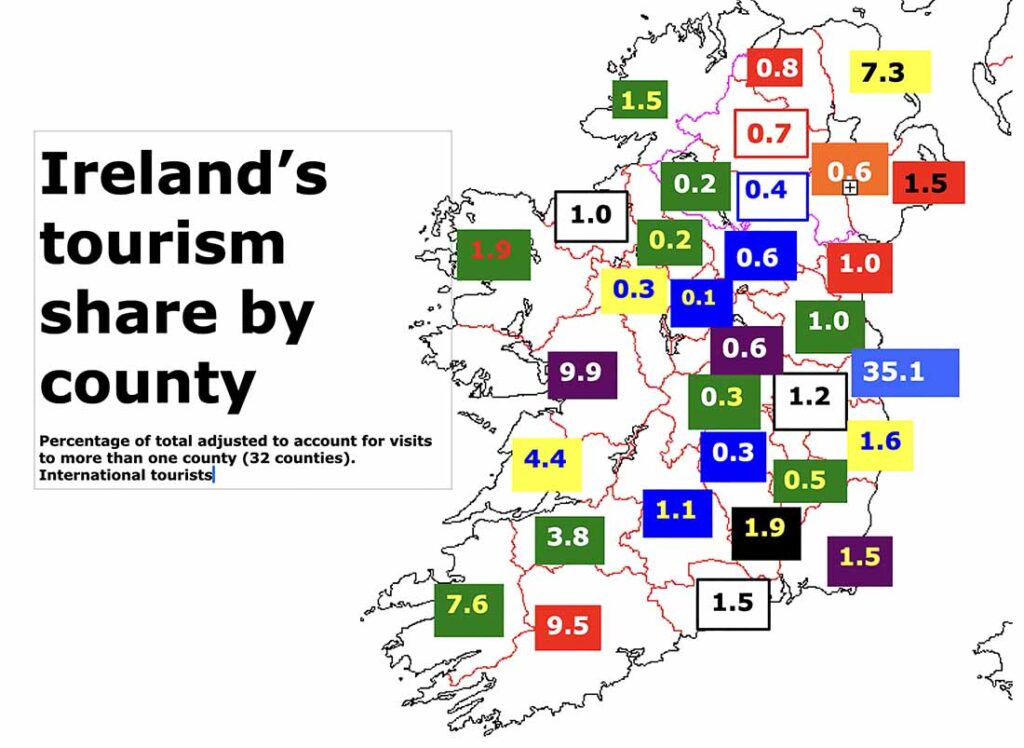
Ireland’s County Armagh is steeped in history and natural beauty, with the Navan Fort, an ancient ceremonial site, offering archaeological intrigue. The Armagh Observatory and Planetarium provide stargazing opportunities, while the city’s two cathedrals reflect its ecclesiastical heritage. Other attractions include the nearby Slieve Gullion Forest Park with its hiking trails and panoramic views. Armagh is Ireland’s fifth smallest county by size (1,253 square km) and tenth largest by population (194,394). Population peaked at 232,393 in 1841 and reached its lowest point, 108,815, in 1937. In terms of hospitality, Armagh is Ireland’s 26th most visited tourist county with around 57,000 international visitors per year.
Introduction – Adventure – Anthem – Archaeology – Attractions – Awards – Birdwatching – Camping – Castles – Churches – Contact list – Cycling – Dining – Equestrian – Festivals – Fishing – Folklore – Gardens – Golf – Graveyards – Happening – Haunted – Highest – Hiking – History – Holy Wells – Hotels – Hotels top 8 – Hunting & shooting – Instagrammable – Itineraries – Largest town – Luxury – MICE – Movies – Music – New – Name – Novelists – Off the beaten track – Poets – Pubs – Quotes – Random Facts – Restaurant Awards – Sacred Places – Saints – Songs – Spas – Sports – Sunsets – Sustainable – Things to do – Towns – Video – Villages – Walking – Wanderlist – Weddings – Wild swimming – Writers – 1837– 1846 – 1852 – 1909 – 1955 – 1980 –