A maritime county of the province of Munster, is bounded, on the north, by Clare; on the east, by the River Shannon (separating it from Tipperary); on the south, by Cork; and on the west, by Kerry and the Atlantic Ocean. Its greatest length, from north-east to south-west, is about 48 miles; its greatest breadth, from east to west, is about 38 miles; and its area is 661,153 statute acres, or about 1,033 square miles, of which about 500,000 acres are arable or under cultivation, 100,000 bog and mountain, 20,000 woodland, and the rest towns, villages, roads, and water (including portions of the Shannon estuary).
POPULATION, In 1831, 250,406; in 1841, 286,394, showing an increase of 35,988, or about 14.4 per cent. Houses in 1841, 47,392. Families chiefly employed in agriculture, 35,614; in manufactures and trade, 7,614; in other pursuits, 4,164. Families dependent chiefly on property and professions, 1,614; on the direction of labour, 10,614; on their own manual labour, 30,614; on means not specified, small number.
The county is divided into 9 baronies: Clanwilliam, Coshlea, Coshma, Kenry, Kerrykeel (or Coonagh), Owneybeg, Pubblebrien, Shanid, and Small County (with Upper and Lower Connello often noted separately in subdivisions). It contains 128 civil parishes, and parts of others; about 2,200 townlands. Poor Law Unions: Limerick, Kilmallock, Newcastle, Rathkeale, and parts of others. The Poor-Law valuation is about £400,000 to £450,000.
SURFACE AND TOPOGRAPHY, The surface is highly diversified: the east and centre form a fertile undulating plain (extension of the Golden Vale), rich in loam and pasture; the west and south-west are mountainous and hilly, with glens and valleys; the north is partly level along the Shannon, partly boggy. Mean elevation about 300-400 feet above sea-level. Principal mountains: Mullaghareirk range (up to 1,800-2,611 feet in parts), Slievefelim (1,132-1,504 feet), Galtee Mountains (outliers up to 2,000+ feet), Knockfierna (951-1,100 feet), Ballyhoura Hills. Bogs extensive in west and north (reclaimable); limestone prevails in east and centre, affording excellent manure; sandstone and slate in hills.
RIVERS AND LAKES, The chief river is the Shannon (forms eastern boundary for much of its course, navigable for large vessels to Limerick city; estuary forms the Bay of Limerick, excellent harbour). Principal tributaries: Maigue (navigable to Adare/Cappagh), Deel (navigable to Newcastle), Feale (western districts, navigable in lower parts), Brosna (Little), Camogue, Loobagh, Groody, Mulkear, etc. Lakes: Lough Gur (celebrated for antiquities, about 3 miles long), small loughs in mountains (Graney, etc.); no large inland lakes beyond Shannon expansions. Fisheries valuable (salmon, eels, herring).
SOIL AND AGRICULTURE, Soil varies: rich alluvial loam and deep clay in east/central valleys (excellent for wheat, barley, oats, potatoes); lighter gravelly loam in hills; rocky and moorish in west/south-west. Limestone districts highly fertile with marl; bogs improvable. Crops: oats and barley chief, wheat increasing, potatoes extensive, flax and hemp. Pasture supports superior dairy cattle (butter and cheese exported), sheep, pigs. Tillage improving with liming, rotation, drainage; farms medium; husbandry advanced in east, backward in mountainous west.
CLIMATE, Mild, moist, equable; heavy rainfall from Atlantic influence; salubrious, tempered by Shannon and sea; suitable for grazing and tillage.
MINERALS, Limestone abundant (building stone, manure); coal (slaty, worked limitedly near Newcastle); sandstone, slate, marble (black/variegated); iron ore, lead traces; peat extensive.
TRADE AND MANUFACTURES, Chiefly agricultural; exports via Limerick port (grain, butter, provisions, bacon, wool, cattle); imports coal, timber, salt, manufactures. Fisheries important (herring, salmon). Manufactures: linen, woollen, brewing/distilling (noted ale), milling, tanning in Limerick and towns.
TOWNS, Limerick (county town, chief seaport and manufacturing centre, pop. about 48,000-50,000; cathedral, castle, bridges, quays); Newcastle West (pop. about 3,500); Kilmallock (pop. about 3,200); Rathkeale (pop. about 3,000); Adare (picturesque, pop. about 2,000); Askeaton, Abbeyfeale, Croom, Hospital, etc.
ECCLESIASTICAL, Diocese of Limerick (province of Cashel; cathedral St. Mary’s in city); parts in Killaloe, Emly. Roman Catholic bishopric at Limerick; numerous chapels. Protestant churches limited. Tithes commuted.
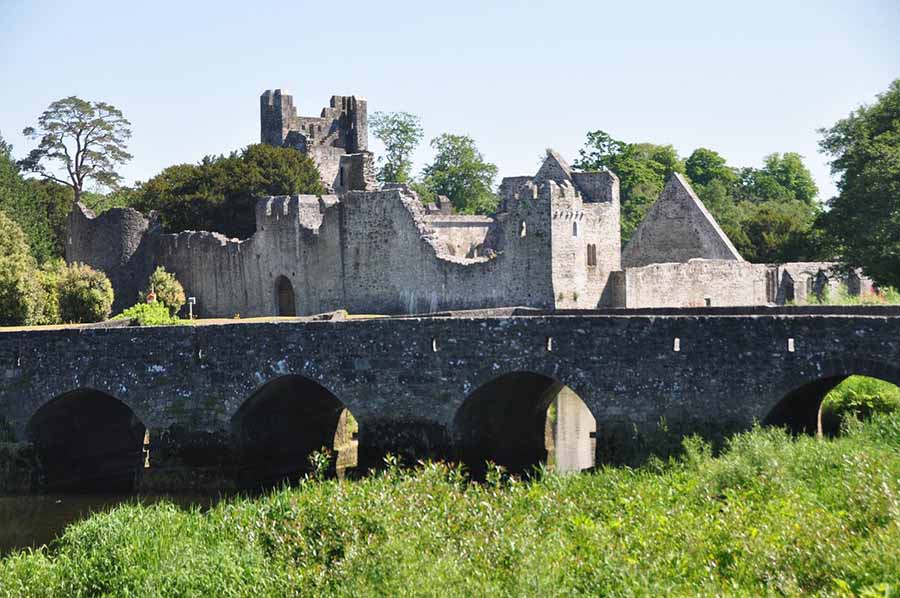
ANTIQUITIES, Extremely rich: King John’s Castle (Limerick); St. Mary’s Cathedral (Gothic); Franciscan, Dominican, Augustinian abbeys (ruins in Limerick); Kilmallock Abbey and round tower; Askeaton Friary and castle; Adare Abbey and Desmond Castle; Carrigogunnell Castle; Lough Gur cromlechs and stone circles; raths, forts, high crosses; Treaty Stone (1691).
Ireland in 1846
Antrim – Armagh – Carlow – Cavan – Clare – Cork – Derry – Donegal – Down – Dublin – Fermanagh – Galway – Kerry – Kildare – Kilkenny – Laois – Leitrim – Limerick – Longford – Louth – Mayo – Meath – Monaghan – Offaly – Roscommon – Sligo – Tipperary – Tyrone – Waterford – Westmeath – Wexford – Wicklow
County Limerick:
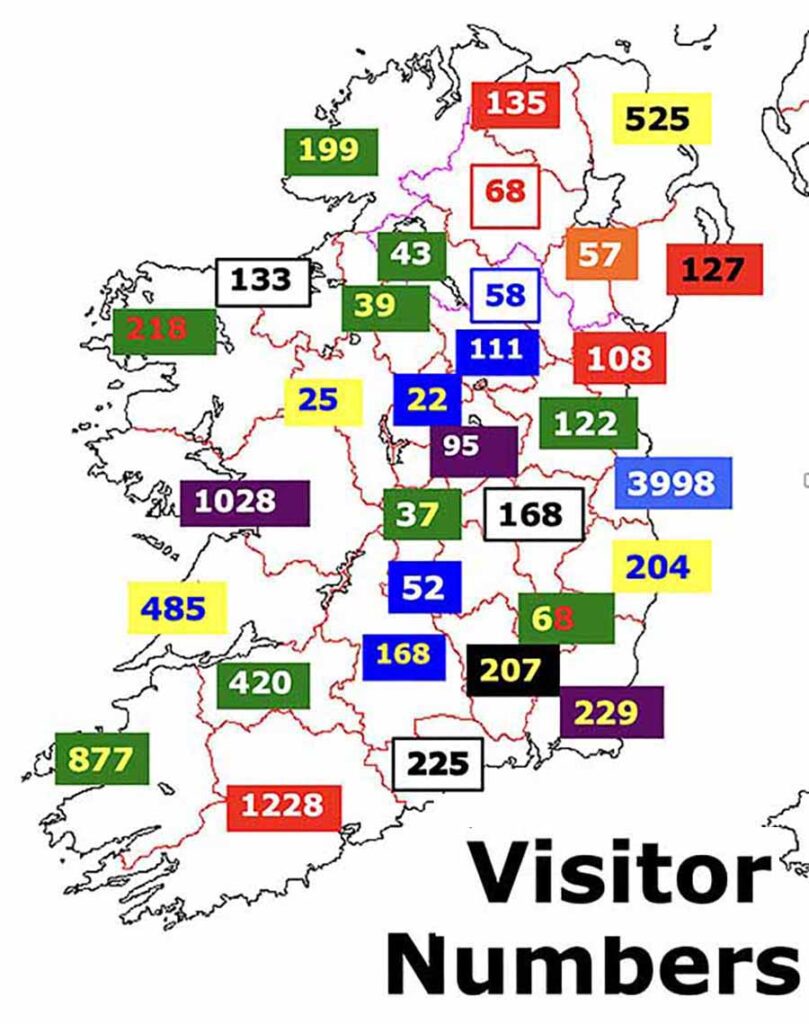
Ireland’s county Limerick combines historic landmarks with riverside charm, with Limerick City’s King John’s Castle offering insights into medieval history along the Shannon. The Hunt Museum showcases an eclectic art collection, while Adare’s thatched cottages and historic manor add picturesque appeal. Other attractions include the nearby Ballyhoura Mountains’ cycling trails. Limerick is Ireland’s tenth largest county by size (2,686 sq km), and ninth largest by population (209,536). Population peaked at 330,029 in 1841 and reached its lowest point, 133,339 in 1971. In terms of hospitality, Limerick is Ireland’s seventh most visited tourist county with around 420,000 international visitors per year.
Introduction – Adventure – Anthem – Archaeology – Attractions – Awards – Birdwatching – Camping – Castles – Churches – Contact list – Cycling – Dining – Equestrian – Festivals – Fishing – Folklore – Gardens – Golf – Graveyards – Happening – Haunted – Highest – Hiking – History – Holy Wells – Hotels – Hotels top 8 – Hunting & shooting – Instagrammable – Itineraries – Largest town – Luxury – MICE – Movies – Music – Name – New – Novelists – Off the beaten track – Poets – Pubs – Quotes – Random Facts – Restaurant Awards – Sacred Places – Saints – Songs – Spas – Sports – Sunsets – Sustainable – Things to do – Towns – Video – Villages – Walking – Wanderlist – Weddings – Wild swimming – Writers – 1837 – 1846 – 1852 – 1909 – 1955 – 1980 –